Free No Tarmac tools / Build & setup
Build Advisor
Tell us how and where you drive, and we'll score the gear — from suspension to tyres to recovery — and build a prioritised setup with warnings, prep and trails to match.
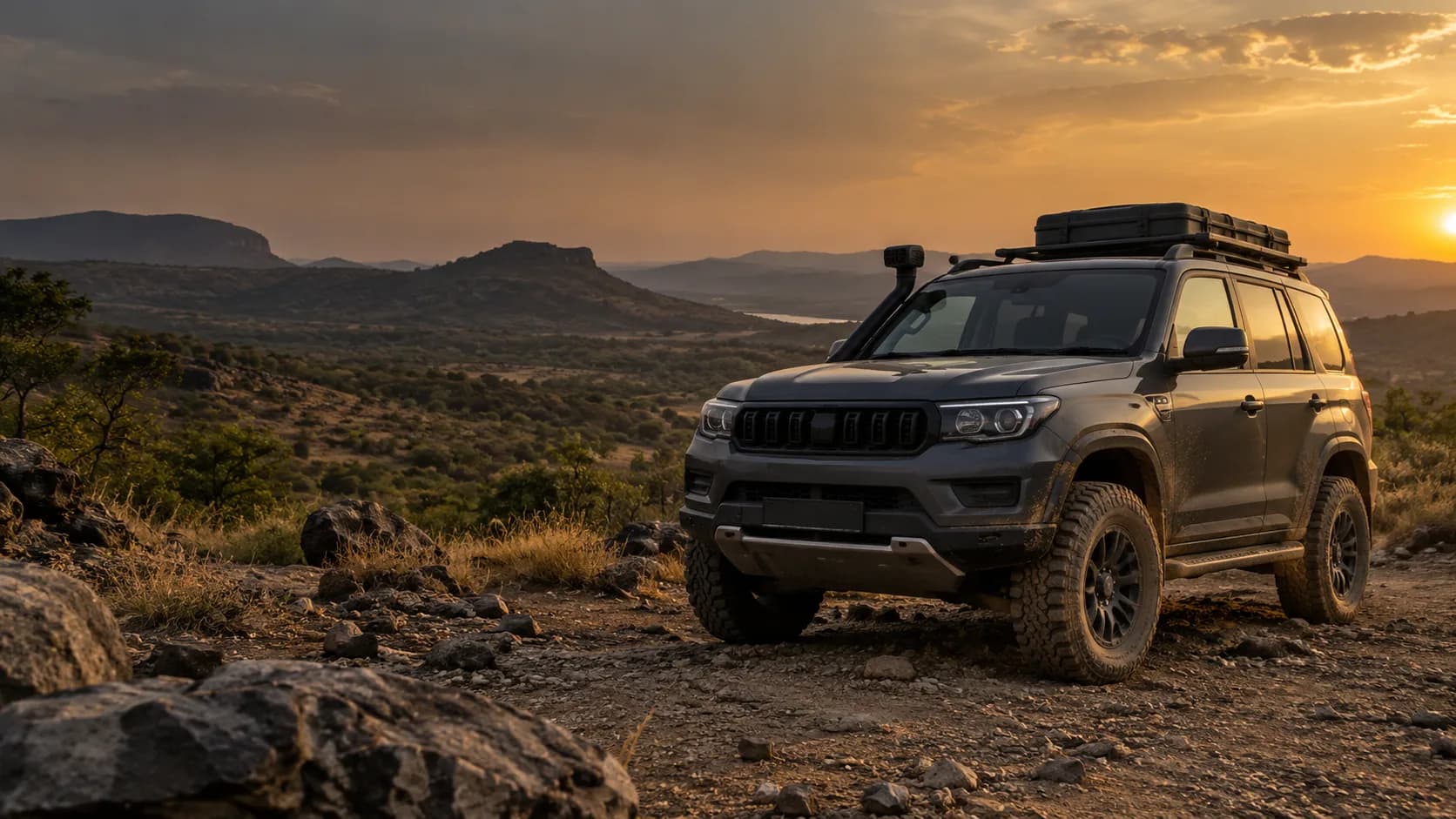
AI-generated representative scene
Quick answer
For most Indian 4x4s, the highest-impact off-road upgrade order is tyres first (the biggest traction gain), then recovery gear, then suspension and a mild 1–2 inch lift for clearance and travel. This advisor scores and prioritises gear for 41 vehicles against your terrain and driving style.
Which vehicle are you building?
Build goals at a glance
Four use-case archetypes — pick the one that matches your actual terrain and frequency of use before spending a rupee.
Weekend Trail
Best startThe highest-ROI entry build.
Best for
- Weekend trails and rocky patches near home
- AT tyres, rock sliders and a modest lift
- Highest capability gain per rupee
Avoid if
- Multi-week remote expeditions with heavy cargo
- Extreme articulation or competition events
- Budget
- ₹₹
- Complexity
- Low
- Build time
- ~6 months
- Daily use
- Yes
Daily Driver + Capability
Road-friendly with trail access.
Best for
- Daily commute with occasional weekend off-road
- AT tyres and a mild lift (within 50 mm)
- Road comfort prioritised
Avoid if
- Frequent technical terrain or deep ruts
- Heavy cargo loads — watch GVM carefully
- Budget
- ₹₹
- Complexity
- Low–Med
- Build time
- ~6 months
- Daily use
- Yes
Overland / Expedition
Self-sufficient for multi-week routes.
Best for
- Multi-week routes across India (Himalayas, deserts, coasts)
- Winch, dual battery, roof rack and a 50–75 mm lift
- Reliability over raw capability
Avoid if
- Daily city commuting — service costs rise significantly
- Tight timelines — allow 6–12 months to build
- Budget
- ₹₹₹
- Complexity
- High
- Build time
- 6–12 months
- Daily use
- Yes, with care
Rock Crawl / Competition
Maximum articulation, event-only.
Best for
- Competition events and rock gardens
- Extreme articulation and custom fabrication
- Trailered to events rather than daily-driven
Avoid if
- Road use — rarely road-legal at this level
- Remote touring — very high issue rate far from help
- Limited budget or local workshop access
- Budget
- ₹₹₹+
- Complexity
- Very High
- Build time
- 12+ months
- Daily use
- No
Plan your build
Crunch your numbers before you spend. Enter your own figures — nothing is pre-filled or fabricated.
Payload calculator
Enter your vehicle's kerb weight and GVW from the manufacturer specification sheet, then fill in your expected load. No specs are pre-filled — enter your own figures.
Enter kerb weight and GVW (from your manufacturer spec sheet) to see your payload headroom.
GVW and kerb weight figures come from the manufacturer specification sheet. After-market accessories and modifications — lift kits, roof racks, winches, bull bars — add to kerb weight and reduce your payload headroom. Fuel weight is not included above; add approximately 0.75 kg per litre of tank capacity for a conservative estimate.
Build budget calculator
Set your total budget, then fill in your own quoted costs per line item. No prices are pre-filled — enter figures from your actual quotes.
Enter a total build budget above to start tracking your spend.
Costs vary significantly by brand, retailer and region. Always get written quotes before committing. Installation, alignment, tyre fitting and consumables are separate costs — factor them into the Miscellaneous line or keep a 10–15% contingency in the remaining budget.
Re-gear calculator
Fitting bigger tyres changes your effective gearing and speedo reading. Enter your stock and new tyre sizes (and your diff ratio, from the compliance plate) to see the impact and the ratio that restores stock feel.
Stock diameter
776 mm (30.6 in)
New diameter
834 mm (32.8 in)
+7.4% vs stock
Speedo error
7.4% under-read
At 100 shown ≈ 107 km/h actual
Effective ratio (no re-gear)
enter diff ratio
Ratio to restore stock
enter diff ratio
Over ~7% taller: expect sluggish response, higher fuel use and a strained drivetrain, especially loaded or towing. Re-gearing to the restore ratio below brings back stock behaviour.
Standard SAE tyre-dimension maths. Diff ratios are vehicle-specific — confirm yours before ordering; the nearest available ratio (e.g. 4.10 / 4.27) is usually chosen as the next step above the computed restore ratio. Re-gearing is a workshop job — get it done by a specialist.
Fuel-range calculator
Off-road economy is much worse than the highway figure. Enter your tank, reserve and real economy, pick your terrain, and get a conservative safe-refuel distance for remote routes.
Enter your tank capacity and real highway economy to see your off-road range.
Terrain factors are indicative real-world figures — actual economy varies with vehicle weight, tyres, altitude and driving style. Always confirm your tank capacity and reserve from your vehicle documentation.
Winch-size calculator
Under-sizing a winch is dangerous. Enter your vehicle's GVM (gross vehicle mass, from the compliance plate / RC) and pick your use case to get the minimum line pull and a recommended winch class.
Enter your vehicle's GVM to size a winch.
The 1.5× / 2.0× GVM rule is standard winch-manufacturer guidance. GVM is vehicle-specific — confirm yours from the compliance plate or registration certificate before buying. Recovery is high-risk: use rated gear and correct technique, and get trained.
Window-tint (VLT) legality checker — India
Enter the MEASURED Visible Light Transmission (VLT %) of each glass and how the tint is achieved. Checks both the VLT limits and whether the method is legal under CMVR Rule 100.
Enter the measured VLT % of at least one glass to check compliance.
General legal information, not legal advice — VLT limits and enforcement are set by CMVR Rule 100, the 2012 Supreme Court order and the 2021 amendment, and can change. Measure VLT with a proper meter and confirm current rules with your RTO.
Where to next
Tyre Advisor
Pick the right off-road tyre — the highest-impact upgrade for any build.
Wheel Advisor
Match rim width and offset to your tyre size.
Lift Kits
Lift kit options and what height fits your use case.
Suspension
Suspension upgrades matched to your build goal.
Overlanding & Touring
Plan a self-sufficient touring build that stays under GVM — payload, power, roof and storage.
Auxiliary Lighting
Spot, flood or combo beams — and how to stay road-legal in India.
Armour & Protection
Skid plates, sliders and winch bumpers — plus the bull-bar legality position.
Winch & Recovery Hardware
Size a winch to your GVM, choose rope, and mount it safely.
Snorkel & Water Crossing
When you need a snorkel, breather extensions, and the crossing protocol.
Recovery Points
Rated vs. unrated anchors — the safety-critical step before any recovery.
Recovery Gear
Kinetic rope, traction boards, hi-lift and shackles — what each does and when.
Air Compressor
Air down for the trail, air up for the road — portable vs. on-board and sizing.
Recovery Kit
Stage 1 of every build — essential recovery gear before you push harder terrain.
Buy it · get it installed
Common questions and the complete 4x4 build reference(deep dive)
Off-road build advisor FAQ
- How does the off-road build advisor work?
- You tell it your vehicle, the terrain you drive and how you drive, and it scores and prioritises gear across suspension, tyres, wheels, lift and recovery — building a setup with warnings, prep notes and matching trails. It uses your real inputs, not a generic list.
- What should I upgrade first on my 4x4 for off-road?
- Tyres usually give the biggest traction gain for the money, followed by recovery gear for safety, then suspension and a mild lift for clearance and travel. The advisor orders upgrades by impact for your specific vehicle and terrain.
- Do I need a lift kit to go off-road in India?
- Not necessarily. A good all-terrain tyre and the right pressures handle most Indian trails. A 1–2 inch lift adds tyre clearance and travel for harder terrain, but any lift beyond manufacturer spec needs RTO/ARAI approval and insurer disclosure.
- Which advisor should I start with?
- Start with the tyre advisor if you run stock or worn tyres — it's the highest-impact change. Move to suspension and lift for clearance and load, and wheels when you're changing tyre size or want to air down on beadlocks.
How to build a 4x4 in India — the complete reference
How to build a 4x4 for India — the correct upgrade priority order (recovery → tyres → protection → suspension → accessories), use-case-driven builds, real budgets, payload/GVM, reliability and the MV Act/ARAI/insurer legal reality.
Key takeaways
- Recovery gear first, always. A kinetic strap, rated shackles, and working tow points cost under ₹30,000 and enable self-rescue. Without them, no other modification matters when you are stuck 80 km from help.
- Tyres are the highest ROI modification on any 4x4. All-terrain tyres cover 90% of Indian use cases. Mud-terrain tyres add weight, road noise, and payload penalty without proportional capability gain for mixed-use driving.
- Treat roughly 50mm (2 inches) as the practical ceiling for suspension changes before formal approval is needed. Beyond that, type-approval (ARAI/CMVR) and RTO approval under MV Act §52 plus a Form 20 RC update are required; approval is indicatively costly and slow (verify current figures). An unapproved alteration is illegal under §52, can attract §190 penalties, and can lead your insurer to reject a claim.
- Disclose every modification to your insurer in writing and obtain a policy endorsement before work begins. This is non-negotiable under IRDA rules. A rejected accident claim on an undisclosed modification can leave you personally liable for third-party damages.
- Driver skill consistently outperforms hardware. ₹2 lakh invested in advanced 4x4 driver training (line selection, tyre pressure management, recovery technique) covers 80% of India's recreational off-road terrain. Build the driver before building the vehicle.
- Build complexity drives failure rates. Stock vehicles fail at 5–8% per year. Trail builds at +15–20%. Overland builds at +25–35%. Rock builds at +50–70%. Every modification is a new failure point. Match complexity to your actual needs, not your worst-case fantasy.
- India's terrain requires region-specific builds. A desert-optimized build with MT tyres underperforms in the Western Ghats. A high-articulation rock build consumes excess fuel on sand. Carbureted engines lose 15–20% power above 3,000m in the Himalayas. Choose your primary terrain first, then build for it.
Build Philosophy: Terrain First, Reliability Second, Looks Never
The single most expensive mistake in the Indian 4x4 community is building for the Instagram photo instead of the terrain you actually drive. A heavily modified, unreliable vehicle stranded 80 km from the nearest town in Spiti is a liability, not an asset. A stock Mahindra Bolero with the right tyres, a confident driver, and solid recovery gear will complete 80% of India's off-road routes.
Build philosophy for Indian conditions must account for three non-negotiables: terrain diversity (sand in Rajasthan, altitude above 3,000m in the Himalayas, rocky basalt in the Western Ghats, mud in the Northeast), legal constraints (Motor Vehicles Act 1988 §52 on alterations, ARAI/CMVR homologation, RTO approvals), and the reality that heavily modified vehicles tend to fail considerably more often than stock — the deeper the build, the higher the failure rate (the percentage figures used in this guide are indicative, not measured for your specific vehicle).
The correct order is always: recovery capability → traction → protection → geometry → comfort → power. Every rupee spent in this sequence returns more real-world capability than the same rupee spent out of order. A winch on a vehicle with stock tyres is half-useful; all-terrain tyres on a vehicle with no recovery gear leaves you stuck with good grip but no way out.
Modifications must be matched as a system. Adding power, weight, or speed without simultaneously upgrading the components that have to cope with it is dangerous: bigger/heavier tyres and a loaded vehicle need brakes (pads, discs, lines), cooling (radiator, oil cooler), and drivetrain (axles, joints, gearing) rated for the new load — never upgrade one in isolation. Any structural work (recovery points, bumpers, sliders, lift mounts, chassis welds) must be designed, fabricated, and certified by qualified professionals to a load rating, not improvised. A failed weld, a mismatched brake, or an under-rated tow point fails at the worst possible moment and can be fatal.
This guide is general educational information for India, not professional engineering, legal, or safety advice. Figures, prices, part numbers, capability percentages, and reliability rates are indicative only and vary by vehicle, region, supplier, and date — verify everything against the manufacturer and a qualified workshop before you act. You assume all risk for any modification you choose to make. When in doubt, do not proceed without certified professional sign-off.
A well-kept stock Mahindra Bolero can cover very high mileage on roughly 10,000 km service intervals at modest cost, with a low annual rate of major issues. A deep rock-crawl build typically shortens service intervals (around 5,000 km), raises per-service cost, and sharply increases the rate of major issues — custom parts, scarce labour, and repairs such as a cracked welded frame can run into the tens of thousands of rupees. These figures are indicative ranges, not guarantees — they vary widely by build and usage. The takeaway holds regardless: choose complexity consciously.
Investing in advanced 4x4 driver training (line selection, recovery technique, tyre pressure management, water-crossing assessment) covers a large share of India's off-road scenarios for a fraction of a full hardware build. The same money spent on hardware modifications that push beyond your driving skill creates risk, not capability. Build the driver first, then the vehicle. (Cost and capability figures here are indicative.)
In India, altering a vehicle's structure, engine, or dimensions (lift, suspension geometry, engine power, chassis, bumpers/sliders that change dimensions, or tyres beyond OEM tolerance) requires prior RTO approval under Section 52 of the Motor Vehicles Act 1988, with ARAI/CMVR type-approval where applicable. Modifications that change the vehicle from its registered specification are not permitted without this approval — the Supreme Court has held that alterations inconsistent with the registration are illegal.
Using a vehicle in an unsafe or non-compliant condition can attract penalties under Section 190 of the Act, and an unapproved alteration can be treated as an illegal alteration. After any approved change you must update the Registration Certificate (Form 20 process). Separately, you must declare every modification to your motor insurer and obtain a written endorsement — an undisclosed modification can void your policy, including third-party cover, at claim time. Enforcement varies by state, but the legal and financial exposure is real. Confirm requirements with your local RTO, ARAI, and insurer before building.
The Correct Upgrade Priority Order: Stage by Stage
This sequence is not arbitrary. Each stage is foundational to the next. Skipping a stage — or reordering for aesthetic reasons — wastes money, creates safety gaps, and produces a vehicle that looks capable but underperforms in the field.
This order reflects long-standing Indian off-road community consensus (enthusiast forums, established 4x4 workshops, and overlanding experience) — verify specifics for your own vehicle and use case with a reputable workshop and current sources.
5-Stage Build Sequence
Month 1–2
1Stage 1 — Recovery Capability
Recovery gear enables self-extraction when you get stuck. Without it, every other upgrade is irrelevant — you cannot use your tyres, suspension, or lights if the vehicle is immovable.
Minimum kit: kinetic recovery strap, rated D-shackles (at least 4), tree-saver strap, snatch block, a line damper (weight bag draped over the rope mid-span to absorb energy if the line snaps), and tow points front and rear. Add a 12V electric winch (rated 1.5× vehicle GVW) as the single highest-impact purchase. Cost: ₹20,000–30,000 for non-winch kit; ₹80,000–1,50,000 for winch and mounting. During any winch or kinetic-strap recovery, all bystanders must stand clear of the rope line and at least 1.5× the line length to each side — a parted rope or shackle is a lethal projectile.
Only use manufacturer-backed, load-rated, warranted recovery gear bought through an authorised Indian distributor — verify the distributor and the product's rating before you buy. Counterfeit shackles and straps fail catastrophically under load; only purchase from reputable, established brands with a verifiable Indian service presence. Match every component's working-load rating to your vehicle's weight.
Never use locally fabricated recovery hooks welded to the chassis without professional engineering design and certification to a load rating. A shackle or tow point rated for the wrong load can snap under tension and become a lethal projectile. Recovery points are structural — have them fabricated and certified by a qualified professional.
Month 2–3
2Stage 2 — Tyres
Tyres are the highest ROI modification on any 4x4. They are the only contact point between the vehicle and terrain. Upgrading from stock to all-terrain (AT) tyres adds 2–3 degrees of approach angle improvement, dramatically improves traction on loose surfaces, and transforms vehicle behavior on wet roads.
For mixed highway/off-road use — which covers the large majority of Indian 4x4 owners — all-terrain tyres are the correct choice. Mud-terrain (MT) tyres are overkill for most: they increase road noise, reduce highway fuel economy, add roughly 12–32 kg of unsprung weight, and consume payload capacity. As an indicative example, a premium all-terrain tyre from a reputable maker in a popular size (265–285 width range) typically runs on the order of ₹25,000–35,000 per tyre, i.e. roughly ₹1–1.4 lakh for a set of four — verify the exact size, fitment, and current price with a reputable tyre dealer.
Stay within ±10% of OEM diameter/width specification. Exceeding this threshold requires ARAI type-approval and alters speedometer accuracy by 12–15%. If you upsize beyond tolerance, recalibrate the speedometer via OBD tool.
Month 3–4
3Stage 3 — Protection (Skid Plates + Rock Sliders)
Before lifting the suspension, protect the components underneath. Skid plates (transmission, transfer case, fuel tank) and rock sliders prevent catastrophic damage on rocky terrain. Once you have traction, you will use it — and the first rocky trail will find your sump if it is unprotected.
Rock sliders for a vehicle like the Mahindra Thar (heavy-duty steel, one-piece welded) are indicatively around ₹13,000–₹20,000 per set; a full skid-plate set is indicatively ₹30,000–₹60,000 depending on material and coverage — verify current pricing and fitment with a reputable workshop. Properly fitted, sliders protect the undercarriage, serve as entry/exit steps, and should not reduce ground clearance.
Note: rock sliders and skid plates are not always explicitly addressed in ARAI/RTO guidance, and items that change the vehicle's registered dimensions can fall under MV Act §52. Best practice is to get written pre-approval from your local RTO before installation and to disclose them to your insurer.
Month 4–6
4Stage 4 — Suspension Lift
Suspension upgrades come after recovery gear, tyres, and protection — not before. Without upgraded tyres, a suspension lift gives you height without traction. Without recovery gear, a lift gives you the confidence to get more deeply stuck.
The functional ceiling for most Indian 4x4s is a 2-inch (50mm) lift. Beyond 2 inches, suspension geometry — driveshaft angles, steering geometry, brake balance — deviates beyond what can be corrected without ARAI certification. Stock Indian vehicle suspension typically fails within 40,000 km due to potholes, speed breakers, and monsoon conditions.
Indicative pricing (verify with a reputable workshop): entry-level shock replacement roughly ₹25,000–₹45,000; mid-range lift kit with shocks and springs roughly ₹80,000–₹1,30,000; full expedition setup roughly ₹1,50,000–₹2,50,000. A quality branded gas suspension kit from a reputable, established aftermarket suspension maker for a popular platform (such as the Mahindra Thar) is indicatively in the ₹1,30,000–₹1,45,000 range and may carry a multi-year/limited-kilometre warranty — confirm the exact kit, price, and warranty terms with the manufacturer's authorised dealer. A lift changes geometry: re-check brake-line length, brake balance, and driveline angles, and have a full wheel alignment done afterwards.
Approach angle is more critical than raw lift height for rocky terrain. A 2-inch lift gives less than 2 degrees of approach angle improvement on its own. Combine it with a proper aftermarket bumper to achieve the 30–32 degrees that rocky terrain requires (stock is 25–28 degrees).
Lifts beyond about 50mm generally require formal type-approval (ARAI/CMVR) and RTO approval under MV Act §52; approval can be costly and slow (indicatively on the order of ₹1–8 lakh and several weeks — verify current figures). Without approval, the alteration is illegal and your insurer can reject a claim where the modification is a contributing factor, leaving you personally exposed.
Month 6–12
5Stage 5 — Functional Accessories (Snorkel, Lighting, Dual Battery)
Snorkel: useful for water crossings deeper than bumper height and for cleaner air in dust. An aftermarket diesel snorkel for a popular platform (e.g. Mahindra Thar) is indicatively around ₹12,000–₹18,000 — verify current pricing and fitment with a reputable workshop. A snorkel raises only the air intake; it does NOT waterproof the differentials, transfer case, electrics, or brakes, so it does not make any depth safe. Install only after recovery, tyres, and protection are in place. Treat roughly 2–3 feet (depending on snorkel intake height) as an upper guide, not a guarantee — never exceed the intake height, and assess depth and current before every crossing.
LED lighting: Improves visibility on unlit trails and enables safe night driving. Cost: ₹500–₹60,000+ depending on fixture quality. ARAI-certified LED headlight pairs (AIS 009 standard) cost ₹8,000–₹25,000. Non-certified aftermarket LEDs are technically illegal.
Dual battery: Required only for multi-week overlanding with refrigeration or power-intensive comms. India-specific INR pricing is not verified from authoritative sources — contact local electrical shops. This is an advanced upgrade, not a foundational one.
Build Stage Budget Reference
All prices below are indicative ranges only — they vary by region, supplier, and date, and must be verified with local dealers before budgeting. Labour (indicatively ₹15,000–₹30,000) is excluded from component prices. Figures reflect broadly recent rates; treat them as a planning starting point, not a quote.
| Stage | What | Budget INR | Mid INR | Premium INR | Capability Impact |
|---|---|---|---|---|---|
| 1 — Recovery | Strap, shackles, snatch block, tow points | ₹20,000–30,000 | ₹50,000–80,000 | ₹80,000–1,50,000 (+ winch) | Critical — enables self-rescue |
| 2 — Tyres | All-terrain set (4 tyres) | ₹40,000–80,000 | ₹80,000–1,28,000 | ₹1,00,000–1,50,000 | Highest ROI — transforms traction |
| 3 — Protection | Skid plates + rock sliders | ₹13,500–30,000 | ₹30,000–60,000 | ₹50,000–80,000 | High — prevents catastrophic damage |
| 4 — Suspension | Shock replacement or lift kit | ₹25,000–45,000 | ₹80,000–1,30,000 | ₹1,50,000–2,50,000 | High — articulation + clearance |
| 5 — Snorkel | FRP functional snorkel | ₹12,000–18,000 | ₹20,000–35,000 | ₹40,000–80,000 | Medium — water + dust protection |
| 5 — Lighting | LED bar or headlights | ₹500–5,000 | ₹8,000–25,000 | ₹25,000–60,000 | Low-Medium — visibility only |
| 5 — Dual Battery | VSR + auxiliary battery | Not verified (INR) | Not verified (INR) | Not verified (INR) | Low — expedition power only |
| Total (Stages 1–5) | Complete functional build | ₹1,50,000–2,50,000 | ₹2,50,000–4,00,000 | ₹4,00,000–6,00,000+ | Full off-road capability |
Budget = basic parts only. Mid = quality components. Premium = expedition-grade with warranty. Excludes labour and vehicle.
Choosing Your Build by Use Case
The worst build decision is building for use cases you will never encounter. Every build type has clear strengths, predictable failure modes, and a realistic cost envelope. Match your build to your actual primary terrain and frequency of use before spending a rupee.
Build Type Comparison
- Total Cost (lakhs)
- 4
- Off-Road Capability
- 7
- Reliability
- 7
- Road Manners
- 6
- Legal Complexity
- 5
- Maintenance Burden
- 5
₹2–5L build. AT tyres, skids, modest lift 40–65mm. Best entry point. 15–20% higher issue rate vs stock.
- Total Cost (lakhs)
- 6
- Off-Road Capability
- 7
- Reliability
- 6
- Road Manners
- 6
- Legal Complexity
- 4
- Maintenance Burden
- 4
₹8–15L build. Reliability focus, dual battery, roof rack, winch, 50–75mm lift. 25–35% higher issue rate. 6–12 month build time.
- Total Cost (lakhs)
- 5
- Off-Road Capability
- 4
- Reliability
- 7
- Road Manners
- 8
- Legal Complexity
- 6
- Maintenance Burden
- 7
₹3–8L predominantly comfort/cosmetic. 25–50mm lift max. GVM risk if cargo-heavy. Lowest capability gain per rupee.
- Total Cost (lakhs)
- 2
- Off-Road Capability
- 10
- Reliability
- 2
- Road Manners
- 2
- Legal Complexity
- 1
- Maintenance Burden
- 1
₹15–40L+. 100–150mm lift, custom fab, locking diffs. 50–70% major issue rate. Rarely road-legal. Frame cracks in 4–5 years.
Which Build Path Is Right for You?
What is your primary use case?
Weight, Payload, and GVM Management
Every modification adds weight. Every kilogram of modification reduces the payload available for fuel, water, occupants, and gear. This is a hard mathematical constraint backed by India's Motor Vehicles Act 1988 and the Central Motor Vehicles Rules — exceeding the manufacturer's Gross Vehicle Weight (GVW/GVM) is illegal, can void insurance, and creates a genuine safety hazard (overloaded brakes, suspension, and tyres).
Typical Indian SUV GVW is indicatively in the 2,000–2,300 kg range, with curb weight around 1,400 kg, leaving very roughly 600–900 kg of usable payload — check your own vehicle's plate/RC for the exact figures. A trail build can consume on the order of 150–250 kg (suspension hardware, bumpers, sliders, winch) and an overland build 200–300 kg. Add four occupants (~300 kg) and expedition cargo (fuel, water, food, camping — several hundred kg) and you can be at or beyond GVW before you leave the car park.
The manufacturer's Gross Vehicle Weight (GVW/GVM) is legally binding under the Motor Vehicles Act 1988 / CMVR. Exceeding it is an offence, can lead your insurer to deny a claim, and creates real enforcement risk at weighbridges and police checkpoints. Formally increasing rated weight (where even permitted) requires type-approval and is costly and slow — indicatively on the order of ₹1–2 lakh and several months; verify current cost and feasibility with ARAI/RTO. Most builders operate within the factory GVW; do not simply load past it.
Formula: Available Payload = GVM − Curb Weight − Modification Weight − Occupant Weight. Example: GVM 2,200 kg − Curb 1,400 kg = 800 kg available. Subtract suspension + bumpers + sliders + winch (200 kg) = 600 kg remaining. Four occupants (300 kg) = 300 kg for cargo. Add AT tyres (+20 kg vs stock) not MT tyres (+32 kg vs stock). MT tyres on an already heavy overland build can push you over GVM before you pack a single jerry can.
Track your build weight incrementally. Weigh the vehicle at a public weighbridge at each major stage. Do not estimate — weigh.
Stock tyres (225/65R17) weigh approximately 40 kg total. AT tyres (245/75R16) weigh approximately 60 kg total — adding 20 kg. MT tyres (285/75R16) weigh approximately 72 kg total — adding 32 kg. This 32 kg tyre penalty, combined with heavier suspension, can eliminate 50+ kg of expedition payload capacity. AT tyres are the correct choice for any build where GVM compliance matters.
India Legality of Modifications: MV Act, RTO, ARAI, and Insurer
Modification legality in India is governed primarily by the Motor Vehicles Act 1988 — Section 52 prohibits altering a vehicle so it no longer conforms to its registered specification without approval, and Section 190 penalises using a vehicle in an unsafe/non-compliant condition — together with ARAI/CMVR type-approval protocols, state RTO rules, Supreme Court rulings (notably the 2019 judgment restricting structural alterations / bull bars), and IRDA insurance-disclosure requirements. Enforcement is inconsistent, but the consequences when it matters — an accident claim — are severe.
The single most common and expensive mistake is not disclosing modifications to your insurer. When a claim is filed, insurers now cross-check the RC book against the actual vehicle. A mismatch voids coverage. This is not a technicality — it is a standard clause in every motor insurance policy.
IRDA (Insurance Regulatory and Development Authority) requires all modifications to be disclosed to your insurer before modification, via a policy endorsement. Non-disclosure means: if you have an accident and the modification is in any way involved, the insurer can — and regularly does — reject the entire claim. This includes third-party liability. You could be personally liable for damage and injury costs. Disclose every modification. Get written endorsement. Keep a copy.
| Modification | Legal Status | What Is Required | Risk if Skipped |
|---|---|---|---|
| AT Tyres within ±10% OEM | Generally allowed | No formal approval needed; update RC for safety | Low — but speedometer deviation if near limit |
| Tyre upsizing >±10% OEM | Requires ARAI approval | ARAI type-approval certificate + Form 20 RC update | High — illegal, voids insurance, braking affected |
| Suspension lift up to 50mm (2 inches) | Generally acceptable if geometry preserved | RTO written approval recommended; notify insurer | Medium — technically unapproved without RTO letter |
| Suspension lift over 50mm | Requires ARAI testing | ARAI type-approval (₹1–8L, 4–12 weeks) + Form 20 | High — illegal, voids insurance, geometry unsafe |
| Rock sliders / skid plates | Not explicitly addressed in ARAI/RTO guidance | Written pre-approval from local RTO recommended | Medium — ambiguous; get RTO letter for safety |
| Snorkel (aftermarket) | Technically illegal without ARAI cert; widely fitted | ARAI certification or OEM-supplied unit preferred | Low-Medium — inconsistent enforcement |
| LED headlights (ARAI-certified pair) | Legal | AIS 009 compliant units + insurer disclosure | None if certified units used |
| LED headlights (uncertified aftermarket) | Technically illegal | Replace with AIS 009 certified units | Medium — liability in accident, insurer dispute |
| Bull bars (full-width) | Restricted post-2019 Supreme Court ruling | Minimal crash bars only, within OEM width; ARAI cert | High — active enforcement in many states |
| Winch (body-mounted) | Generally permitted as accessory | Insurer disclosure; do not modify chassis without RTO | Low-Medium — depends on mounting method |
| Engine power increase >10% | Requires ARAI approval | ARAI type-approval + Form 20 RC update | High — voids warranty and insurance |
| Chassis/frame modification | Strictly prohibited without ARAI/RTO approval | ARAI testing mandatory; virtually no DIY approval | Very High — criminal liability possible |
| Form 20 RC amendment (after approval) | Mandatory after any approved modification | ₹2,000–5,000 at local RTO | High — vehicle non-compliant without RC update |
| Insurance endorsement for all above | Mandatory per IRDA | Written disclosure to insurer; obtain endorsement | Critical — claim rejection on accident |
Indicative summary only; not legal advice. Statuses and costs are approximate and change over time, and RTO enforcement varies significantly by state. Always consult your local RTO, ARAI, and insurer for definitive guidance on your specific modification before acting.
Reliability-First Principle: Build for the Breakdown, Not the Build
Every experienced India off-road expedition leader will tell you the same thing: the most dangerous vehicle is the one that breaks down far from help. Reliability is not an afterthought — it is the primary engineering principle for any vehicle operating in remote Indian terrain (Spiti at 4,000m, Rann of Kutch, deep Western Ghats forest tracks).
Complexity is the enemy of reliability. Each added component is a new failure point. Each weld is a future crack. Each electrical connection is a potential short. Each custom suspension arm is a part that cannot be sourced at a roadside mechanic in Nubra Valley.
The reliability-first principle dictates: prefer reversible modifications over permanent ones; prefer OEM or OEM-equivalent parts over custom fabrication; prefer proven products from established brands with Indian service networks over cheaper imports with no local support; and never add a modification you cannot diagnose and field-repair with basic tools.
Stock vehicle: 10,000 km service interval, ₹2,000–5,000 per service, 5–8% annual major issue rate. Trail-built vehicle: 5,000 km service interval, ₹8,000–15,000 per service, +15–20% annual issue rate. Overland build: 5,000 km interval, ₹8,000–15,000, +25–35% issue rate. Rock build: 5,000 km interval, ₹8,000–15,000+, +50–70% issue rate. The more complex the build, the faster it needs attention and the more expensive that attention becomes — often in places where no good workshop exists.
Suspension bushings: wear at 2–3 years in a modified build, ₹10,000–20,000 to repair. Welded frame mounts: crack at 4–5 years (quality-dependent), ₹20,000–50,000. Engine overheating in sustained low-range operation (rock builds): ₹30,000–80,000+. Locking differential failure: ₹40,000–1,00,000. Fuel pump failure on extended tanks (wrong gauge wire): ₹5,000–20,000. Alternator inadequacy under dual-battery draw: ₹5,000–15,000. Schedule proactive replacement — do not wait for failure on a remote trail.
Region-Specific Build Considerations Across India
India's terrain diversity means there is no universal optimal build. A Thar Desert-optimized build with mud-terrain tyres fails in the Western Ghats. A Himalayan reliability build with conservative ground clearance fails on sand dunes. Choose your primary terrain first, then build for it.
| Region / Terrain | Primary Challenge | Priority Mods | Avoid | Special Requirement |
|---|---|---|---|---|
| Himalayas (Ladakh, Spiti, Rohtang) | Altitude, rocky, cold, remote | Reliability, AT tyres, snorkel, extra fuel, EFI engine | Over-complex custom fab | EFI vehicle; carbs lose 15–20% power above 3,000m |
| Western Ghats (Karnataka, Goa, Kerala) | Rocky basalt, stream crossings, mud, dense forest | High approach angle, skid plates, snorkel, underbody sealing | MT tyres (highway to trailhead) | Full underbody sealing ₹20,000–30,000 |
| Rajasthan / Thar Desert | Deep sand, heat, long distances | AT or MT tyres, snorkel, extra fuel, ground clearance | Heavy armour (payload penalty) | Low-range competence; tyre deflation critical |
| Northeast (Arunachal, Meghalaya, Manipur) | Mud, wet forest, waterlogging, remote fuel | Waterproofing, mud articulation, snorkel, undercoating | Anything that limits articulation | Full sealing + undercoating ₹30,000–40,000 |
| Coastal (Konkan, Kerala, Odisha coast) | Saltwater corrosion, sand, monsoon flooding | Corrosion-resistant hardware, sealing, waxing | Steel armour without coating | Stainless hardware; re-wax every monsoon |
Primary terrain determines which modifications deliver real value versus which waste money.
30+ Beginner Build Mistakes to Avoid
These reflect widely reported Indian off-road community experience (enthusiast forums, workshop feedback, and expedition practice). Every item on this list has cost someone real money or real safety — treat figures as indicative and verify for your vehicle.
| Mistake | Why It Happens | Consequence | Correct Approach |
|---|---|---|---|
| Buying MT tyres for a mixed highway/trail vehicle | Looks aggressive, social media influence | High road noise, poor highway fuel economy, excess weight, payload loss | AT tyres for 90% of India use cases |
| Lifting first before buying AT tyres | Lift looks dramatic; tyres seem boring | Clearance gain without traction; more deeply stuck on same trails | Tyres before suspension, always |
| Skipping recovery gear to buy accessories | Lights and racks are visible; recovery is 'for when things go wrong' | Stranded with no extraction capability; ₹5,000 tow vs ₹30,000 winch | Stage 1 is always recovery gear |
| Using fabricated recovery hooks without load rating | Cheaper, faster, looks similar | Hook/weld failure under load at speed; projectile risk; fatal | Only rated, manufacturer-backed tow points |
| Not disclosing modifications to insurer | Assume minor mods don't matter | Entire claim rejected on accident; personal liability for damage and injury | Disclose everything; get written endorsement |
| Fitting suspension lift without wheel alignment | Alignment seems optional | Uneven tyre wear, steering wander, accelerated suspension wear | Full 4-wheel alignment after every suspension change |
| Upsizing tyres without speedometer recalibration | Assume small upsizing doesn't matter | Speedometer reads 60 km/h while doing 68–70 km/h; speed limits violated unknowingly | OBD recalibration or instrument calibration after upsizing |
| Over-building for terrain never driven | Planning for 'worst case' Himalayan expedition | ₹10–20 lakh build for weekend forest trails; poor ROI, heavy vehicle | Build for terrain you actually use, not fantasy use |
| Installing bull bars post-2019 without RTO approval | Shops still sell them; enforcement inconsistent | Non-compliant modification; rejected by RTO; insurance disputes | Minimal crash bars within OEM width only; RTO pre-approval |
| Buying from unverified online sellers without warranty | Price difference appears significant | Counterfeit shackles, straps, or suspension parts fail in field | Only authorized Indian distributors of established, reputable aftermarket brands |
| Fitting suspension lift over 50mm without ARAI approval | Bigger lift = more capable (misconception) | Illegal, uninsured, geometry unsafe, premature wear | Stay within 50mm; beyond that, budget ₹1–8L for ARAI testing |
| Ignoring GVM when adding modifications | Adding 'just a few kg' items one at a time | Cumulative weight exceeds GVM; illegal, unsafe, insurance void | Weigh vehicle at each build stage; track payload budget |
| Running stock engine in sustained low-range rock mode | 'Stock engine is fine' | Overheating; ₹30,000–80,000+ repair | Upgrade cooling system before extended low-range use |
| Using roadside mechanics for suspension installation | Saves ₹5,000–10,000 on labour | Poor installation as dangerous as substandard parts; premature failure | Use a reputable, qualified workshop only — verify credentials |
| Not planning for modified vehicle service intervals | Stock service habit | Miss 5,000 km service; suspension bushing failure at 12,000 km | Set alerts; service at half the stock interval |
| Exceeding water crossing depth with snorkel fitted | Snorkel = waterproof (misconception) | Hydro-lock if water enters snorkel above intake height; engine destruction | Never exceed 2–3 feet depth; check snorkel height marking |
| Running wrong tyre pressure across terrain types | Set once and forget | Underinflated tyres overheat and fail on highway; overinflated lose traction off-road | Carry quality gauge + 12V pump; adjust pressure for terrain |
| Confusing approach angle with suspension lift height | More lift = better approach (misconception) | ₹1.3L suspension gives <2° approach gain; bumper change gives +5° | Address bumper height and design, not just lift, for approach angle |
| Fitting LED headlights without ARAI certification | Non-certified LEDs are widely available and cheap | Technically illegal; insurer disputes in accident; blinding oncoming traffic | Buy AIS 009 certified units only (₹8,000–25,000 per pair) |
| Skipping Form 20 RC amendment after approved modification | Assume RTO verbal OK is sufficient | Vehicle non-compliant; mismatch between RC and actual vehicle; fine/impound | Complete Form 20 process at RTO (₹2,000–5,000) |
| Building a rock-crawl vehicle for touring/overland use | Want maximum capability | +50–70% annual major issue rate; parts unavailable remotely | Separate vehicles for separate purposes; rock builds are not tourers |
| Not budgeting for testing breakdowns | Assume nothing goes wrong during testing | ₹1–3 lakh typical testing-phase repair budget shortfall | Allocate 20% of total build cost for testing-phase repairs |
| Ignoring altitude effects on carbureted engines | Works fine at sea level | 15–20% power loss above 3,000m; EFI vehicles mandatory for Himalayan expeditions | EFI vehicle or budget ₹50,000–80,000 for EFI conversion |
| Buying cheap suspension without warranty | ₹30,000 cheaper upfront | No recourse on premature failure; a quality branded kit from an established maker (e.g. 3yr/60,000km warranty) vs an unbranded import with no warranty | Always demand manufacturer warranty; verify authorized distributors |
| Copying another vehicle's build without matching your vehicle's GVM/geometry | Looks the same on paper | Different GVM, different geometry, different failure modes per platform | Every build is vehicle-specific; consult platform-specific forums |
| Adding dual battery before the alternator can support it | Dual battery looks professional | Alternator burnout; charging failure far from help | Verify alternator output before adding second battery; upgrade if needed |
| Installing winch without rated recovery points | Winch is the visible item | Winch pulls but tow point tears off chassis; catastrophic | Rated tow points are Stage 1; winch is Stage 2 |
| Building cosmetically first (paint, accessories) before functional mods | Aesthetics are immediately visible and satisfying | ₹1–2L spent on appearance before tyres and recovery; poor real-world capability | All functional mods complete before any cosmetic spend |
| Not verifying prices with local dealers before budgeting | Use online estimates as final budget | Regional price variation significant; Gurgaon ≠ Bangalore ≠ Kochi | Always get 3 local quotes before committing to a build stage |
| Assuming insurance covers all modifications automatically | Policy says 'vehicle is insured' | Standard motor policy voids coverage for unapproved mods | Read your policy; call your insurer; get written endorsement before starting |
Frequency: how often this mistake is seen in Indian builds. Cost Impact: financial consequence of the mistake.
Expert Tips from India's Off-Road Community
These tips represent widely shared experience from the Indian off-road community (enthusiast forums, expedition practice, and established modification workshops). They are India-specific rather than generic 4x4 advice — verify specifics for your own vehicle.
Never attempt to complete all build stages in one go. Phasing gives you time to field-test each stage, identify gaps in your actual use case, and avoid spending on stages that turn out to be unnecessary. Weekend trail builds: 6 months, 4 phases. Overland builds: 12 months. Each phase should be tested on real terrain before the next phase begins.
A 2-inch (50mm) suspension lift gives less than 2 degrees of approach angle improvement on its own. The same money spent on a well-designed aftermarket bumper (higher-mounted, shorter snout) gives 5+ degrees of approach angle gain. For rocky terrain (Western Ghats, Himalayan trails), approach angle determines whether you clear a ledge or damage your front end. Address the bumper design before spending on maximum lift height.
Public weighbridges are available at most major truck stops and weigh stations for a nominal fee. Weigh your vehicle before Stage 1, after Stage 3 (protection added), and before every expedition. This is the only way to know your actual payload margin. Do not estimate build weights — they consistently run 20–30% higher than theoretical because of brackets, hardware, and wiring not counted in component specs.
For a first-time 4x4 owner, the best possible investment is: all-terrain tyres on the correct-sized rim, basic recovery gear (strap, shackles, tow points), and one structured 4x4 driving course. This combination unlocks 70–80% of India's recreational off-road terrain at a fraction of the cost of a full build. Add stages only after you have exhausted what this foundation can do.
Choose a reputable, established workshop with a track record in 4x4 modification — and verify its credentials yourself; do not rely on names alone. Before committing: ask for references from previous builds, inspect completed vehicles and weld quality in person, confirm parts carry genuine manufacturer warranty documentation, and demand written warranty terms and proper GST invoices (for your RTO/insurer records) before any work begins. The quality of installation is as critical as the quality of parts — structural work should be done only by qualified, certified fabricators.
Before every off-road departure: (1) Verify tyre pressure and adjust for terrain. (2) Check all recovery gear is present, accessible, and undamaged. (3) Confirm snorkel inlet is unobstructed. (4) Check fluid levels (engine oil, coolant, brake fluid, transfer case oil). (5) Inspect suspension visually for cracked bushings or loose mounts. (6) Verify communications (charged satellite communicator or local SIM with coverage map). (7) File a route plan with someone at home — departure time, route, expected return, emergency contact.
Myths vs Facts: What the Indian 4x4 Community Gets Wrong
These myths are consistently repeated on forums, at modification shops, and in social media builds. Each one has cost real money or created real safety risk.
12 Critical Myths Debunked
Myth: A bigger lift means more capability.
Fact: Lift beyond 2 inches (50mm) alters suspension geometry, brake balance, and steering — increasing wear and legal risk. Approach angle comes from bumper design, not lift height. Capability comes from tyres and driver skill, not lift.
Myth: MT (mud-terrain) tyres are always better for off-road.
Fact: AT tyres are the correct choice for 90% of Indian 4x4 owners who mix highway and off-road driving. MT tyres add weight, noise, and payload penalty while performing marginally better only in deep mud — which is rare on most Indian routes.
Myth: A snorkel makes deep water crossings safe at any depth.
Fact: A snorkel raises the air intake — it does not waterproof the rest of the vehicle (differentials, transfer case, electrics, brakes). Maximum safe depth is 2–3 feet depending on snorkel height. Always check depth before entering.
Myth: Modifications that are sold in India must be RTO-approved.
Fact: Shops sell accessories without regard to RTO legality. A product being for sale does not make it legal to fit. ARAI type-approval and RTO written permission are separate requirements that you, the owner, are responsible for.
Myth: The insurer will cover my vehicle regardless of modifications.
Fact: Standard motor insurance voids coverage for unapproved modifications per IRDA rules. Insurers cross-check RC books against actual vehicle during claims. Non-disclosed modifications can result in complete claim rejection, including third-party liability.
Myth: A heavily built vehicle will outperform a stock one in off-road conditions.
Fact: A stock Mahindra Bolero with a skilled driver regularly outperforms over-built vehicles with inexperienced operators. Driver skill — line selection, tyre pressure management, momentum control, recovery technique — is the dominant variable, not hardware.
Myth: More lift equals more approach angle.
Fact: A 2-inch suspension lift gives less than 2 degrees of approach angle improvement. An aftermarket bumper with a higher, shorter design can give 5+ degrees. Approach angle is primarily a function of bumper geometry and tyre size, not lift height.
Myth: All recovery straps are the same — buy the cheapest.
Fact: Recovery straps (particularly kinetic recovery straps) must be rated for vehicle GVM. A strap that fails at load generates a projectile with lethal force. Only use manufacturer-backed, load-rated straps purchased through authorised distributors of established, reputable brands.
Myth: Rock sliders are illegal in India.
Fact: Rock sliders are not explicitly prohibited by ARAI or MV Act. However, they are also not explicitly approved. Best practice is to get written pre-approval from your local RTO before installation — ambiguity is not the same as prohibition.
Myth: After getting ARAI approval, I'm done with compliance.
Fact: ARAI type-approval is only one step. You must also: complete Form 20 RC amendment at the RTO (₹2,000–5,000), notify and get endorsement from your insurer, and update your vehicle documentation. Skipping Form 20 leaves the vehicle non-compliant even with ARAI approval.
Myth: Carbureted vehicles work fine in the Himalayas above 3,000m.
Fact: Carburetors lose 15–20% power above 3,000m due to lean/rich tuning problems at altitude. EFI vehicles (modern diesel Thar, Gurkha, Hilux, Fortuner) self-compensate. For high-altitude Himalayan expeditions in carbureted vehicles, factor in significant performance loss or budget ₹50,000–80,000 for EFI conversion.
Myth: If previous owners fitted mods without issues, I'm safe to drive them.
Fact: You are legally responsible for the vehicle's compliance in your name at the time of use. Modifications made by previous owners that are not on the RC book are illegal in your hands if undisclosed. Verify modification history and RC compliance when buying a modified 4x4.
Frequently Asked Questions
These are the most common questions from first-time Indian 4x4 builders, answered with general, best-effort information — prices, specs, and legal points are indicative and must be verified for your vehicle. Anything involving specific legality for your vehicle and RTO jurisdiction requires direct consultation with your local RTO — no online guide substitutes for official confirmation.
20 Questions Every New Builder Asks
What is the very first modification I should do?
Buy a kinetic recovery strap, two rated D-shackles, and know where your vehicle's factory tow points are. This costs under ₹5,000–10,000 and gives you self-rescue capability immediately. Everything else comes after.
Should I buy a winch or recovery straps first?
Recovery straps first. They require a second vehicle or anchor but cover the most common stuck scenarios. A winch is the single highest-capability upgrade but costs ₹80,000–1,50,000 with mounting. Add the winch in Stage 1 once your basic strap kit is complete.
Is a 2-inch (50mm) suspension lift safe and legal?
A 2-inch lift is generally acceptable to RTOs if axle geometry is preserved, and is recognized as the functional ceiling before formal ARAI testing becomes mandatory. It is not automatically approved without RTO written confirmation. Get written pre-approval from your local RTO and notify your insurer with an endorsement before installation.
What suspension kit do you recommend for the Mahindra Thar?
A quality branded gas-shock lift kit from an established aftermarket suspension maker with an Indian service network is a commonly recommended option for the Thar, indicatively in the ₹1,30,000–₹1,45,000 range and often with a multi-year/limited-kilometre warranty. Confirm the exact kit, current price, warranty terms, and authorised dealer with the manufacturer — and have it fitted and aligned by a reputable workshop.
Which tyres should I buy for mixed highway and off-road use?
All-terrain (AT) tyres from a reputable, established tyre maker in a popular size are indicatively on the order of ₹25,000–₹35,000 per tyre — verify the exact size, fitment, and current price with a reputable tyre dealer. Stay within roughly ±10% of OEM tyre dimensions to avoid approval issues, and avoid mud-terrain for any build where GVW compliance matters.
Do I need to tell my insurance company about modifications?
Yes — this is mandatory per IRDA guidelines. Call your insurer before modifying, describe the planned modification, and request a written policy endorsement. Without this endorsement, your entire policy can be voided on any accident claim. This is the highest-consequence compliance step for any modifier.
What does ARAI approval actually cost and how long does it take?
ARAI type-approval for simple modifications costs ₹1–3 lakhs. For complex structural changes it can reach ₹5–8 lakhs. The timeline is 4–12 weeks. ARAI rarely approves DIY or small-batch aftermarket parts — they primarily work with OEM suppliers. Most Indian builders operate without formal ARAI approval, which is a legal gray area. After any ARAI approval, the Form 20 RC amendment (₹2,000–5,000 at the RTO) is also mandatory.
Can I legally fit rock sliders to my Thar?
Rock sliders are not explicitly addressed in official ARAI or MV Act guidance. They are not explicitly prohibited. Best practice: contact your local RTO in writing, describe the modification, and request written pre-approval before installation. Many owners fit them without approval; the risk is inconsistent enforcement and potential insurance disputes.
Is a snorkel a worthwhile modification?
For vehicles that regularly ford streams or drive in dusty conditions, yes. An aftermarket diesel snorkel for a popular platform (e.g. Mahindra Thar) is indicatively around ₹12,000–₹18,000 — verify pricing and fitment with a reputable workshop. It is only useful once recovery gear, tyres, and underbody protection are addressed. Important: a snorkel raises only the air intake and does not waterproof the rest of the vehicle — treat roughly 2–3 feet as an upper guide (subject to intake height), not a safe guarantee, and assess every crossing first.
How much should I budget for a complete but sensible off-road build?
Budget tier (recovery + AT tyres + rock sliders + basic shocks): ₹1,50,000–2,50,000. Mid tier (adds quality lift kit): ₹2,50,000–4,00,000. Premium/expedition tier (full expedition-grade suspension, winch, snorkel, skid plates, lighting): ₹4,00,000–6,00,000+. Add ₹15,000–30,000 for installation labour at each stage. These figures exclude the vehicle.
Should I buy a Mahindra Thar, Force Gurkha, or Maruti Jimny as a base?
All three are verified modern platforms. The Thar has the deepest aftermarket ecosystem in India (most parts availability). The Gurkha is purpose-built for off-road with a larger body and is popular with overlanders. The Jimny has a smaller platform ideal for tight forest trails with less modification needed. The correct answer depends on your primary use case and whether you need a 4-seat or 5-seat vehicle.
Can I go to Ladakh or Spiti on a stock vehicle?
Yes — thousands of stock vehicles complete Ladakh and Spiti circuits every year. A stock modern diesel SUV (EFI engine) with good tyres, careful driving, and proper recovery gear will complete these routes. AT tyres and recovery gear improve safety. Heavily modified vehicles often create more problems than they solve at altitude due to complexity and parts unavailability.
What is the maximum safe water crossing depth?
Without a snorkel: generally not exceeding bumper height (roughly 18–20 inches). With a snorkel: 2–3 feet maximum, depending on snorkel intake height — marked on the snorkel body. Never enter a water crossing without knowing the depth. Never enter moving water above 18 inches at speed. Check the bottom for soft mud before committing.
Are bull bars legal in India?
Full-width bull bars are heavily restricted following the 2019 Supreme Court judgment on pedestrian safety. Only minimal crash bars that do not exceed the vehicle's original width and integrate with the OEM bumper are generally permissible. Do not assume a product sold in the aftermarket is RTO-approvable — verify with your local RTO and seek ARAI certification for any external structure.
How do I know if a modification shop is trustworthy?
Use a reputable, established workshop and verify its credentials yourself rather than relying on a name. When evaluating any shop: ask for references from previous builds, inspect weld quality and completed vehicles in person, check that parts come with genuine manufacturer warranty documentation, and confirm they will provide proper installation invoices for your RTO/insurer records. For any structural work, ensure the fabricator is qualified and can certify it.
What happens at a police checkpoint if my vehicle is modified?
An officer can demand your RC book. If the RC does not show the modification (because you did not complete Form 20 amendment), the officer can fine you and, in serious cases, impound the vehicle. The strength of enforcement varies significantly by state and officer. Documented compliance (RTO letters, Form 20 RC update, insurer endorsement) is the only reliable protection.
Does tyre upsizing void my vehicle warranty?
Yes — OEM vehicle warranties (typically 3 years/100,000 km) can be voided if unapproved modifications are discovered during a warranty service claim. If you upsize tyres, notify your dealer in writing and retain all documentation. Tyres within ±10% OEM specification are the safest position; significantly larger tyres will likely be noted during any dealer inspection.
What is the single most important skill for Indian off-road driving?
Line selection — choosing the correct path across terrain before you move. A driver with good line selection on stock tyres will outperform an over-built vehicle with poor technique. The second most important skill is knowing when not to proceed. Both are taught in structured 4x4 driver training courses available through adventure sports organizations across India.
Is a used modified vehicle a good buy?
Potentially, but only with full due diligence: obtain the complete modification history and invoices, verify every modification is listed on the RC book or has documented RTO approval, check if the vehicle was re-registered via Form 20 for each change, and have the build inspected by a trusted shop before purchase. A modified vehicle with no paper trail is a liability, not an asset.
What communications should I carry on remote expeditions?
For routes where mobile network coverage is absent (standard in Spiti, parts of Ladakh, deep forest tracks), a satellite communicator (e.g., Garmin inReach or SPOT) is the only reliable option. Always file a route plan and expected return time with someone who can initiate rescue if you are overdue. Local SIM cards with pre-downloaded offline maps (OsmAnd, Maps.me) provide navigation where signal exists.
Emergency Scenarios: When Your Build Fails Far From Help
The following emergency scenarios are specific to over-built or complex modified vehicles failing in remote Indian terrain. They reflect failure patterns widely discussed in the Indian off-road community (enthusiast forums and workshop experience) and are presented as illustrative guidance, not as documented incident reports with verified citations.
Critical Failure Scenarios for Modified 4x4s
Engine Overheating in Sustained Low-Range Operation (Rock Crawl / Hill Climb)
Symptoms
- Temperature gauge in red zone or warning light on
- Steam from engine bay or coolant reservoir
- Loss of power with engine running rough
- Burning smell from under the bonnet
Do immediately
- Stop moving immediately — do not push through overheating
- Shift to neutral and let engine idle at low RPM (do not switch off immediately if severely hot)
- Turn off all electrical loads (AC, lights, winch)
- Open bonnet carefully — stand back; do not open radiator cap while hot
- After 5–10 minutes idling, switch engine off and allow 30+ minutes to cool
Do NOT
- Do not open the coolant cap while steam is visible — pressurised fluid causes severe burns
- Do not pour cold water on a hot engine — thermal shock can crack the block
- Do not restart until temperature gauge returns to normal
- Do not continue driving with a temperature warning — one further overheat can destroy the engine (₹30,000–80,000+ repair)
Recovery
- Check coolant level after cooling — top up with distilled water if available
- Inspect for coolant leaks (hose splits, radiator damage)
- If level was correct and still overheated: suspect thermostat failure or water pump failure
- If coolant loss is significant and no repair is possible: call for tow — do not attempt to drive further
- Repair cost: ₹30,000–80,000+ for engine damage; thermostat/hose: ₹2,000–5,000 if caught early
Call a pro when: If engine has been run while steaming or temperature gauge was pegged for more than 2–3 minutes: do not attempt self-repair. Call authorized service (Mahindra, Maruti, etc.) or a tow. Head-gasket failure from overheating costs ₹30,000–80,000+ and leaves you immobile.
Suspension Bushing or Mount Failure (Cracking / Snapping) on Remote Trail
Symptoms
- Loud metallic clunk over bumps that was not there before
- Vehicle pulling strongly to one side on flat road
- Suspension visually drooping or tilted on one corner
- Steering wheel off-centre when driving straight
- Grinding or rubbing noise from wheel area
Do immediately
- Stop and safely park off the trail
- Do not continue driving on a failed suspension mount — further movement causes additional damage and loss of vehicle control
- Visually inspect all four corners for obvious damage, cracks in welds, separated bushings
- Check if tyre is contacting body or suspension arm — if yes, vehicle is not driveable
Do NOT
- Do not drive on a cracked or separated suspension mount at speed — vehicle can lose wheel control
- Do not attempt to weld in the field without proper equipment — an improper field weld is worse than no weld
- Do not assume a clunk is minor — symptoms escalate rapidly on rocky terrain
Recovery
- If bushing is separated but mount is intact: low-speed drive to nearest town may be possible (under 30 km/h, no further off-road)
- If mount is cracked: do not drive — call for tow or recovery assistance
- Repair: suspension bushing replacement ₹10,000–20,000 at authorized shop; cracked welded mount ₹20,000–50,000
- Schedule inspection of all other mounts after repair — failures cluster in time
Call a pro when: A cracked welded frame mount or separated upper control arm is not a trailside repair. Contact a reputable, qualified suspension/fabrication workshop (verify credentials) or a recovery service. Provide GPS coordinates to the recovery team. Do not attempt to drive — secondary failure causes total loss of steering or wheel separation.
Winch Recovery Point Failure / Snatch Block Failure During Self-Recovery
Symptoms
- Audible crack or bang during winch operation
- Rope suddenly goes slack without vehicle moving
- Visible deformation of shackle, D-ring, or tow point
- Winch anchor (tree saver/stake) pulling free
Do immediately
- Stop winch operation immediately
- Clear all personnel from the winch rope line and 45-degree angle either side — a snapping rope is a lethal projectile
- Engage vehicle handbrake and wheel chocks if on slope
- Assess which component failed before attempting second recovery
Do NOT
- Never stand in line with a winch rope under tension — ever
- Do not re-use a bent, cracked, or deformed shackle — discard it
- Do not winch at full load on a single-line pull if snatch block is available — double-line halves the load on recovery points
- Do not anchor to a tree without a tree-saver strap protecting the bark — anchor slippage causes sudden load release
Recovery
- Identify the failed component: shackle, tow point weld, rope, anchor
- If tow point has torn from vehicle: the vehicle has a structural defect requiring professional repair before further recovery attempts
- If shackle failed: replace from spare kit (always carry 2 extra rated shackles)
- Redirect winch to alternative anchor point if available; use snatch block for mechanical advantage
- If no recovery is possible alone: call for second vehicle assistance or tow
Call a pro when: If the recovery point has torn from the chassis, stop all recovery attempts. The vehicle structure is compromised. Call a professional towing service. Attempting further recovery with a compromised tow point can worsen structural damage and create a projectile hazard. Only use rated, manufacturer-warranted recovery hardware from reputable, established brands with authorised Indian distribution.
Indian 4x4 Vehicle Platforms: Quick Reference
Modification advice is always vehicle-specific. The platforms below are the most commonly modified in India. Aftermarket ecosystem depth varies significantly between them.
| Vehicle | 4WD Type | Best Build Use Case | Aftermarket Depth (India) | Key Build Consideration |
|---|---|---|---|---|
| Mahindra Thar (2020+) | Part-time 4WD, low range | Weekend trail, overland, daily capable | Excellent — deepest ecosystem in India | Most parts and most community/forum knowledge; widest pricing reference |
| Force Gurkha (2021+) | Part-time 4WD, low range | Overland, serious trail, overlanding | Good — growing rapidly | Larger body than Thar; portal axles give factory high clearance |
| Maruti Suzuki Jimny (2023+) | Part-time AllGrip Pro 4WD | Weekend trail, light overland, tight forest | Moderate — international ecosystem helps | Small, nimble; limited payload for heavy overland builds |
| Maruti Suzuki Gypsy (legacy) | Part-time 4WD | Weekend trail (budget) | Limited — parts scarce | Carbureted engine: Himalayan performance loss above 3,000m |
| Toyota Fortuner (2016+) | Part-time 4WD, low range | Comfortable overland, mixed highway/off-road | Moderate — OEM accessories available | Heavy; GVM management critical for overland builds |
| Toyota Hilux (2022+) | Part-time 4WD, low range | Overland, utility, serious expedition | Moderate — international platform advantages | Flatbed utility; payload capacity advantage for expedition cargo |
| Mahindra Scorpio-N (2022+) | 4WD (select trims) | Weekend overland, mixed use | Good — Mahindra ecosystem | SUV body limits articulation vs purpose-built platforms |
Aftermarket rating reflects India-specific parts availability and community build knowledge as of 2024–2025.
Sources & further reading
This guide is general educational information for India, not professional engineering, legal, financial, or safety advice. All prices, part numbers, specifications, capability percentages, and reliability rates are indicative and were not individually verified for every vehicle, supplier, or date — confirm everything against the manufacturer, a qualified workshop, your RTO, and your insurer before acting. Modification legality changes over time and varies by state; you assume all risk for any modification you make.
Last reviewed: 2026-06-21 — verify current prices, specifications, and the legal/insurance position before relying on any figure in this guide.
- Vehicle & component manufacturer specs and modification policies
- Ministry of Road Transport & Highways (MoRTH) — Motor Vehicles Act / CMVR on alterations (https://morth.nic.in)
- Automotive Research Association of India (ARAI) — compliance & certification (https://www.araiindia.com)
- Your insurer's policy terms on declared modifications
- A certified automotive fabricator/workshop for structural work