Free No Tarmac tools / Tyres · build & fitment
Tyre Advisor
Tell us your rig, terrain and how you drive, and we'll recommend the right tyre size, type and pressures.
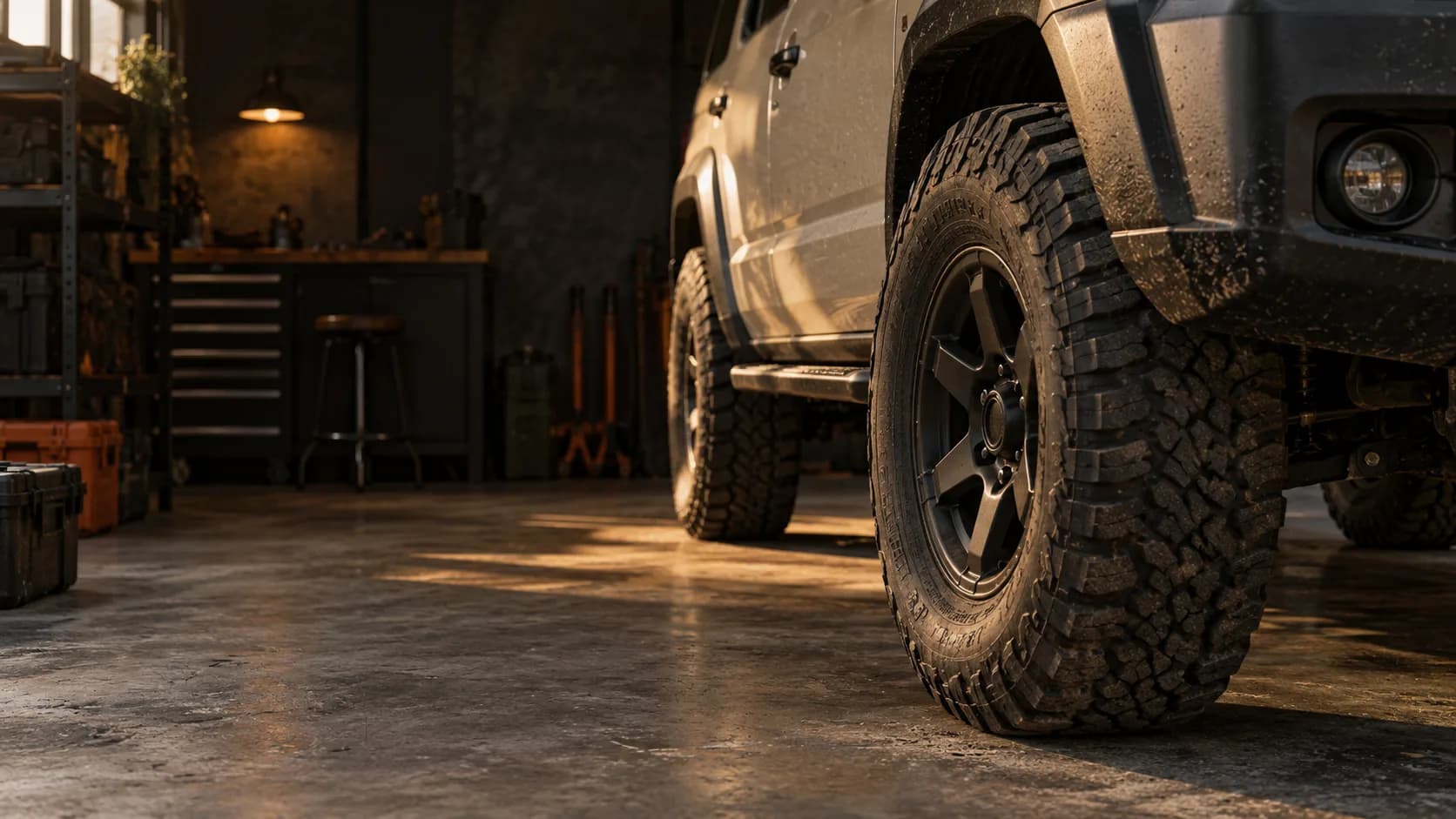
AI-generated representative scene
Quick answer
For most Indian 4x4s, an all-terrain tyre in your factory size (or one size up) is the sweet spot — comfortable on the road, grippy on the trail. Go mud-terrain only for serious mud and rock. Tell the advisor your vehicle below and it matches a size, type and pressure across 30 models and 20 brands.
Get a tyre recommendation in 10 seconds
No forms — tap how you driveWhy we recommend this
- The right tread for where you actually drive gives you grip and confidence — mud tyres for real off-road, all-terrains for a mix, highway tyres if you're mostly on tarmac.
- Matching the correct size and load rating keeps your handling, braking and speedo accurate.
- Letting air out for terrain and topping it back up for the road is the biggest free upgrade to grip there is.
Things to consider
Cost
- Off-road tyres cost more and wear faster on tarmac — buy for how you really drive, not the trip you take twice a year.
- Going bigger often means new wheels, and sometimes a small lift, to fit.
Trade-offs
- Aggressive mud tyres are louder, thirstier and give less wet-road grip than all-terrains.
- Larger, heavier tyres slow acceleration and braking and can dull the steering.
Common beginner mistakes
- Running one tyre type for everything.
- Forgetting to re-inflate to road pressure after airing down.
- Fitting a size that rubs at full steering lock or over bumps.
Legal & fitment
- Big size changes may need approval and can affect insurance and warranty — check before buying.
Get a detailed recommendation
Answer five quick questions for a full match — size, pressure, example models and the trade-offs vs your stock tyres — or compare brands and models directly.
Choose your path
Start with guidance, compare options, or run the numbers. Your place stays visible.
Guided advisor
What terrain will you tackle?
Select all that apply.
Fitment and legality vary. Lifts, oversized tyres or wheel changes beyond manufacturer spec may require RTO/ARAI approval and an updated RC, must be disclosed to your insurer, and can affect warranty and roadworthiness. Verify with your RTO, insurer and a qualified fitter before modifying.
Tyre types at a glance
Four everyday categories, and who each one is really for.
Highway (H-T)
The efficient stock-style tyre.
Best for
- Daily city & highway
- Best comfort & fuel economy
- Light gravel roads
Avoid if
- You hit mud, ruts or sharp rock
- You want real trail grip
- Budget
- ₹
- Road noise
- Low
- On-road
- Excellent
- Off-road
- Minimal
All-terrain (A-T)
Most popularThe all-round sweet spot for most Indian 4x4s.
Best for
- Daily driving + weekend trails
- Overlanding & touring
- Mixed terrain
Avoid if
- You mostly tackle deep mud or competition rock
- Budget
- ₹₹
- Road noise
- Low–Med
- On-road
- Very good
- Off-road
- Good
Rugged A-T
Near-mud-terrain bite that's still daily-able.
Best for
- Mixed hard use
- Frequent rock & trails
- Aggressive look, still road-friendly
Avoid if
- Long highway commutes where quiet & economy matter most
- Budget
- ₹₹–₹₹₹
- Road noise
- Medium
- On-road
- Good
- Off-road
- Very good
Mud-terrain (M-T)
Maximum self-cleaning bite for the toughest going.
Best for
- Deep mud & ruts
- Technical rock
- Frequent hardcore off-road
Avoid if
- You mostly drive highways
- You want a quiet, efficient, long-wearing tyre
- Budget
- ₹₹₹
- Road noise
- High
- On-road
- Fair
- Off-road
- Excellent
Tyre size calculator
Compare a new tyre size against your current one to see the change in overall diameter, your speedometer error and ground-clearance gain — and whether it stays within the ±3% diameter comparison threshold.
New diameter
802.8 mm
31.61 in
Diameter change
+26.5 mm
+3.4%
Ground clearance
+13.3 mm
at the axle
Speedo at true 100
96.7 km/h
reads low
Beyond ±3%, your speedo/odo read noticeably off and clearance gets tight. Recalibrate the speedometer and verify clearance at full lock and articulation before committing.
Overall diameter is the theoretical (unloaded) size; real fitted diameter varies a little by brand, load and pressure. Always confirm clearance and load/speed ratings before buying.
Safety, ownership & compliance(maintenance, fitment, legal & warranty)
Regular maintenance & inspection
- Rotate tyres at regular service intervals or as your vehicle manufacturer recommends to promote even wear; use the rotation pattern suited to your drivetrain — directional tyres and staggered fitments may need a different method.
- After changing tyres or wheels, verify TPMS operation and reprogram or relearn sensors where required.
- Check pressures when tyres are cold and before extended trips; set to suit load, terrain and manufacturer recommendations.
- Balance new tyres on installation, and rebalance if vibration develops or after significant impacts or repairs.
- Check wheel alignment after fitting new tyres, changing suspension, or heavy off-road impacts.
- After demanding off-road use, inspect for sidewall cuts, embedded rocks, tread chunking, bead damage and air leaks.
Age, damage & repair
- Check the manufacturing date before purchase and inspect regularly for ageing, cracking or structural deterioration.
- Not all damage is safely repairable — replace tyres with significant sidewall damage, exposed cords or structural failure.
- After airing down for off-road driving, always re-inflate to road pressure before sustained highway travel.
- Off-road pressures are a starting range, not a fixed rule — the right figure depends on tyre construction, wheel size, vehicle weight, terrain and bead retention.
- Avoid very low pressures on standard rims — excessive deflation raises the risk of the tyre unseating (debeading) from the rim.
Size, load & speed ratings
- Choose a load index equal to or greater than the original-equipment specification.
- Match or exceed the OE speed rating unless an approved alternative suits your application and local rules.
- Ensure the spare matches rolling diameter, load rating and conditions — mismatched sizes can affect 4WD systems and stability. Inspect the spare regularly for pressure, age and condition; an unused spare still deteriorates with age.
- Larger tyres combined with an incorrect wheel offset can cause rubbing, increased steering load and suspension wear.
Terrain performance & storage
- Mud-terrain tyres generally give reduced wet-road braking and handling versus all-terrains — adjust speed and following distance.
- These recommendations are intended for Indian conditions; dedicated winter tyres may be required in snow or ice (relevant for Ladakh, Spiti and colder regions).
- Store spare or seasonal tyres cool, dry and out of direct sunlight, away from oils, fuels, chemicals and heat.
- Larger/heavier tyres raise unsprung weight, affecting acceleration, braking, steering, economy and suspension — pick the lightest suitable option.
Warranty & legal
- Non-standard sizes or incorrect fitment may affect warranty claims for tyres, suspension, steering and driveline.
- Keep tyre size, load index, speed rating and overall dimensions within current legal requirements before using public roads.
- Disclose significant modifications to your insurer where required.
Informational guidance only — not professional advice or a safety guarantee. Follow your vehicle and component manufacturers' instructions, verify against current local regulations, and consult a qualified specialist for safety-critical work.
Where to next
Wheel Advisor
Match rim width & offset to your new tyre size.
Lift Kits
Going bigger? See what lift you need to clear the tyres.
Build Advisor
Plan your whole build, not just the tyres.
Recovery Kit
Airing down for grip? Pack the right recovery gear.
Tyre Hub
Browse tyre brands & models with vehicle fitment.
Buy it · get it installed
Advanced technical notes — the complete India off-road tyre reference(deep dive)
The complete India off-road tyre reference
Choose, size, inflate and care for off-road tyres in India — H/T vs A/T vs rugged-A/T vs M/T, reading the sidewall, legal upsizing, pressure by terrain, plus a buying checklist.
Key takeaways
- Match tyre type to your actual driving split, not aspirational use: A/T covers 70-80% of Indian 4x4 owners; M/T is only justified for regular extreme terrain (deep mud, rock crawling, river crossings) — the fuel, noise, and tread-life penalties are real and daily.
- The 3% diameter rule is non-negotiable: stay within plus or minus 3% of OEM tyre diameter or risk ABS malfunction, speedometer error, and insurance claim rejection — and disclose all modifications to your insurer in writing before making them.
- Tyre pressure management is the highest-impact zero-cost skill in off-road driving: airing down to 15-20 PSI dramatically increases traction on sand and mud; but always re-inflate to OEM spec before any tarmac driving — highway speeds on under-inflated tyres cause blowouts.
- Sidewall ply rating matters more than brand: upgrade to 6-ply (Load Range C) minimum for any serious off-road use; factory 4-ply tyres are adequate for tarmac but lack the sidewall strength for rocky terrain like Spiti, Coorg, or Aravalli trails.
- India's climate accelerates tyre ageing: replace at 5-6 years regardless of remaining tread depth — Indian UV intensity and summer road surface temperatures above 50°C degrade sidewall compounds faster than temperate climates; check the DOT manufacture date on every tyre you buy or currently run.
- Category and construction choice matters more than maker name: a correctly chosen mid-range A/T with a multi-ply sidewall on the right vehicle outperforms a premium H/T in any off-road scenario; and a quality domestic A/T in the right size outperforms a specialist M/T for any driver who is 70%-on-road — the tread pattern and load range, not the badge, determine performance.
- Never drive off-road without a full-size spare matching your fitted tyres, a working portable compressor, and a tread puncture repair kit — space-saver spares are not rated for off-road use and a second flat in remote terrain without a proper spare is a stranding emergency.
The India Off-Road Tyre Guide: Who This Is For and Why It Matters
India's off-road terrain is among the most varied on earth. Within a single expedition, you may cross river fords in the Western Ghats, navigate loose Himalayan scree, sink into Thar desert sand, and return home on National Highway tarmac doing 100 km/h. No single tyre excels at all of these. Making the wrong choice means reduced traction where it counts, premature wear, higher fuel bills, or a sidewall blowout three hours from the nearest town.
This guide is written for owners of Indian 4x4s — Mahindra Thar, Force Gurkha, Maruti Jimny, Toyota Fortuner, Toyota Hilux, and the legacy Gypsy — as well as competent two-wheel-drive SUV owners who occasionally venture off tarmac. It covers every decision you face: understanding tyre construction, choosing the right type for your use pattern, reading the sidewall code, sizing legally, managing pressures on different terrain, caring for tyres in Indian heat and monsoon, and buying without getting ripped off.
All specifications, prices, and vehicle sizes in this guide come from verified sources only. Where data could not be confirmed, it is omitted or flagged explicitly. We do not invent numbers.
This guide is general educational reference, not vehicle-specific engineering advice. Tyres are a primary safety-critical component: the wrong size, load index, speed rating, pressure, or fitment can cause loss of control, a blowout, or a crash. Every number here — sizes, load/speed ratings, pressures, prices, diameters, fuel and wear figures — is indicative and must be verified against your own vehicle before you act.
The single sources of truth for YOUR vehicle are: (1) the tyre manufacturer's official specification (size, load index, speed rating, inflation table) and (2) your vehicle owner's manual and the door-jamb / fuel-filler placard (OE tyre size and cold pressures). Where this guide and those sources disagree, the manufacturer and placard win — always.
Get fitment, upsizing, load/speed-rating selection, beadlock use, pressure choices, ABS/speedometer recalibration, and any structural or sidewall repair decision confirmed by a qualified tyre professional. If a tyre, wheel, or bead is damaged, do not drive on it. Off-roading carries inherent risk of injury, death, and vehicle damage; you are responsible for your own safety, your passengers, and legal compliance.
Every recommendation in this guide is filtered through Indian conditions: summer road surface temperatures above 50°C in Rajasthan, sustained monsoon mud in the Konkan and Northeast, high-altitude rock in Ladakh and Spiti, and RTO/ARAI legal requirements that differ from Western markets.
Tyre type and size recommendations in this guide apply to products verifiably distributed in India. Indicative prices are in INR from 2025-2026 market data and move constantly — confirm the current price and the specific size's availability with an authorised dealer or tyre retailer before buying.
Tyre Anatomy and Construction: How a Tyre Makes Traction
Before comparing tyre types, you need to understand what is actually happening when rubber meets terrain. A tyre is not a simple rubber hoop — it is a precision-engineered pressure vessel that manages load, heat, impact, and friction simultaneously.
The tread is the outermost layer, the only part that contacts the ground. Tread compound (rubber hardness), pattern (block shapes, groove geometry), and void ratio (ratio of open space to rubber) all determine traction on different surfaces. A high void ratio expels mud; a low void ratio maximises contact on tarmac.
Below the tread sit steel belts, which stabilise the tread and resist puncture. The sidewall runs from the tread shoulder down to the bead — this is the most vulnerable part off-road, exposed to sharp rocks and snagging debris. Sidewall thickness and ply count determine resistance to cuts and bruising.
The bead is the steel wire bundle at the inner rim edge that holds the tyre onto the wheel. Air pressure keeps the bead seated against the rim. Drop pressure too far and the bead breaks free — this is called de-beading, and it is a genuine emergency.
Radial construction — standard on every Indian vehicle sold today — runs cord plies perpendicular (radially) from bead to tread. This gives superior road manners, heat dissipation, and load management versus the old bias-ply design. When choosing off-road tyres, you will always be choosing within radial construction.
| Component | What It Does | Off-Road Importance | What to Look For |
|---|---|---|---|
| Tread compound | Provides grip via friction and deformation | Critical — hard compound lasts on tarmac; softer bites rock/mud | Balance: harder = longer life, softer = more grip |
| Tread pattern / void ratio | Channels water, expels mud, bites terrain | High void ratio = self-cleaning in mud/sand | Higher void = off-road; lower void = on-road comfort |
| Steel belts | Stabilise tread, resist puncture from below | Moderate — stops tread penetration | Multi-layer steel belts for rocky terrain |
| Sidewall ply rating | Carries load, resists cuts and bruising | Critical — rocks attack the sidewall directly | 6-ply minimum for rock; 8-ply for serious terrain |
| Bead bundle | Seats tyre on rim, holds air seal | Critical — de-beading = immediate emergency | Beadlocks if airing below 12 PSI regularly |
| Inner liner | Seals air inside tubeless tyre | Important — thicker liner resists slow leaks | Thicker liners on quality off-road tyres |
| Shoulder blocks | Grip trail edges and provide side-bite | High importance on loose terrain | Aggressive shoulder blocks for mud/rock |
Most Indian passenger SUVs arrive from the factory with 4-ply (Load Range B) tyres — adequate for tarmac use. If you off-road even occasionally, upgrade to 6-ply (Load Range C) at minimum. For hardcore rock crawling, 8-ply (Load Range D) is the standard. The extra ply layers add weight (slightly) but dramatically reduce sidewall puncture risk on rocky trails like those in Coorg, Spiti, or the Aravalli.
The Four Tyre Types Explained: H/T, A/T, Rugged-A/T, and M/T
Every tyre sold for an Indian SUV or 4x4 falls into one of four categories. Understanding what each is optimised for — and where it fails — is the foundation of a smart tyre choice.
Highway Terrain (H/T): Built for tarmac. Optimised for fuel economy, low noise, and long tread life. The tread pattern is shallow and fine, maximising contact area on smooth roads. On mud, these are genuinely dangerous — the grooves fill and grip disappears. Most factory-fitted SUV tyres are H/T. If you drive 95%+ on roads and only occasionally see light gravel, these are correct. Replace them the moment your off-road use increases.
All-Terrain (A/T): The most popular choice for Indian 4x4 owners and correctly so. The construction ratio is roughly 70% road-biased, 30% off-road capable. Larger tread blocks and wider grooves than H/T give meaningful mud and rock grip, while remaining comfortable and quiet enough for daily driving. A/T tyres are the intelligent compromise for vehicles that split time between city commutes and weekend expeditions.
Rugged All-Terrain (Rugged-A/T): A category between A/T and M/T, sometimes also called a hybrid terrain or trail tyre. The construction goes deeper and more widely spaced than a standard A/T — larger shoulder blocks, reinforced two- or three-ply sidewalls, and a higher void ratio — while remaining manageable on tarmac. If you do 50-60% off-road or face genuinely difficult terrain (deep Coorg mud, Leh rockfields) but still need highway usability, this is your category. Availability in India is limited but growing through specialist 4x4 shops.
Mud-Terrain (M/T): Purpose-built for extreme conditions. Massive, widely spaced tread blocks with a high void ratio self-clean aggressively in deep mud. Reinforced sidewalls and thick lugs handle sharp rock. The cost: significantly more road noise than an A/T, a meaningful fuel penalty (commonly cited around 5-10%, varies by tyre and vehicle), and noticeably shorter on-road tread life than an A/T (often quoted near 30,000-40,000 km vs 50,000-65,000 km, but real figures depend on driving and conditions — treat as indicative). Critically, an aggressive M/T trades away on-road wet performance: the large tread blocks and reduced contact area generally give WORSE wet braking and wet grip on tarmac than a quality A/T, which matters because most of any Indian drive is on wet-capable roads — in monsoon this raises real-world accident risk on the road sections. M/T tyres are only justified if you do genuinely extreme terrain — deep river crossings, boulder crawling, competition driving. Daily-driving M/T tyres in Bangalore traffic is expensive, loud, fuel-hungry, and worse in the rain.
Tyre Type Scorecard (10 = Best in Class)
- On-road comfort
- 10
- Wet grip
- 9
- Mud traction
- 2
- Rock traction
- 4
- Sand traction
- 3
- Tread life
- 10
- Noise (low = quiet)
- 10
- Value for money
- 9
Excellent road tyre; genuinely dangerous in real mud. For 95%+ tarmac use only.
- On-road comfort
- 7
- Wet grip
- 8
- Mud traction
- 5
- Rock traction
- 7
- Sand traction
- 7
- Tread life
- 8
- Noise (low = quiet)
- 7
- Value for money
- 8
Best all-round choice for most Indian 4x4 owners. 70:30 road-to-off-road construction.
- On-road comfort
- 6
- Wet grip
- 7
- Mud traction
- 7
- Rock traction
- 8
- Sand traction
- 8
- Tread life
- 6
- Noise (low = quiet)
- 5
- Value for money
- 7
For 40-60% off-road use. Reinforced sidewalls. Growing India availability.
- On-road comfort
- 4
- Wet grip
- 6
- Mud traction
- 9
- Rock traction
- 9
- Sand traction
- 9
- Tread life
- 4
- Noise (low = quiet)
- 2
- Value for money
- 4
Unbeatable off-road. Loud, fuel-hungry, short-lived on road. Serious terrain only.
The 5/10 mud score for A/T tyres represents moderate sticky mud — the kind you find on a farm track. In deep, clay-heavy monsoon mud (Western Ghats, Assam, Meghalaya), A/T tread fills and packs solid. Multiple sources describe A/T as 'useless' in real deep mud. If your route includes river crossings or clay-soil trails after heavy rain, a Rugged-A/T or M/T is not optional — it is a safety requirement.
How to Choose: A Decision Framework for Indian 4x4 Owners
Choosing a tyre type comes down to three variables: how much of your driving is on tarmac, what terrain you actually encounter off-road, and your budget. Work through this decision tree honestly — the biggest mistake most Indian 4x4 owners make is buying M/T tyres because they look aggressive, then paying the noise and fuel penalty daily for terrain they rarely see.
Which Tyre Type Is Right for You?
What percentage of your driving is on paved roads (tarmac, NH, city)?
Reading Tyre Size and Plus-Sizing: Decoding the Sidewall
Every tyre sidewall carries a standardised code that tells you everything about its dimensions, load capacity, and speed capability. Reading this code correctly is non-negotiable before buying replacement or upgrade tyres for an Indian 4x4.
Example code: 245/75 R16 110S — a size commonly cited for a base Mahindra Thar (verify the exact OE size on your vehicle's door-jamb placard, as it changes by variant and model year). Breaking it down: 245 is width in millimetres, 75 is the aspect ratio (sidewall height as a percentage of width, so 75% of 245 mm = ~184 mm sidewall), R means radial construction, 16 is the wheel diameter in inches, 110 is the load index, and S is the speed rating. On the standard load-index table, index 110 corresponds to 1,060 kg per tyre and speed symbol S to 180 km/h — but always confirm the figure for your specific tyre against the manufacturer's load-index and speed-symbol tables.
The load index of each fitted tyre must meet or exceed your vehicle's OE requirement — the placard tells you the minimum. For a 4x4 carrying roof tents, jerry cans, and recovery gear, the safety rule is that each tyre's rated load must comfortably exceed the heaviest load that axle imposes; check the per-axle and gross figures on your placard / manual, and that all four tyres together exceed your vehicle's GVWR with a margin. Never fit a tyre with a load index below the OE requirement — that is a structural safety failure waiting to happen, not just an insurance issue.
The speed rating must also meet or exceed OE. The standard symbols are S = 180, T = 190, H = 210, V = 240 km/h (verify against the manufacturer's table). Fitting a tyre rated below your vehicle's specified speed symbol means the tyre can generate heat faster than it can dissipate at sustained highway speed — risking heat failure and blowout. Never downgrade the speed rating below OE.
| Code Element | Example Value | What It Means | Off-Road Note |
|---|---|---|---|
| Section width | 245 | Tyre width in mm (tread + shoulders) | Wider = more contact patch in sand; wider also means more rubbing risk |
| Aspect ratio | 75 | Sidewall height as % of width (75% of 245 mm = ~184 mm) | Higher ratio = taller sidewall = more flex and cushion on rocks; better for off-road |
| Construction | R | R = Radial (standard); B = Bias-belted (rare) | Always R for modern Indian vehicles |
| Wheel diameter | 16 | Rim diameter in inches | Smaller diameter + higher aspect = more sidewall for off-road; 16" is sweet spot for Thar |
| Load index | 110 | Max load per tyre: index 110 = 1,060 kg per tyre | Must meet or exceed OEM; check against GVWR with full load |
| Speed rating | S | S = 180 km/h max sustained speed | Must meet or exceed OEM rating; never downgrade speed rating |
| Load range | C (6-ply) | Load range letter on sidewall (B=4-ply, C=6-ply, D=8-ply) | C minimum for serious off-road; D for rock crawling |
| Load Index | Max Load (kg per tyre) | Max Load (4-tyre set, kg) | Typical Application (indicative) |
|---|---|---|---|
| 100 | 800 | 3,200 | Light SUV, 2WD only |
| 104 | 900 | 3,600 | Mid-size SUV, light 4x4 |
| 107 | 975 | 3,900 | Standard 4x4 (Gypsy class) |
| 110 | 1,060 | 4,240 | Thar, Jimny, Gurkha |
| 116 | 1,250 | 5,000 | Fortuner, Hilux |
| 120 | 1,400 | 5,600 | Heavy duty / commercial 4x4 |
Load-per-index values are from the standard ISO/ETRTO load-index table; the 'typical application' column is indicative only. Always confirm the load index your specific vehicle requires from the door-jamb placard, and the load each tyre carries from the tyre maker's spec — do not select a tyre from this column alone.
A 75-series tyre (245/75 R16) has a taller sidewall than a 65-series (245/65 R16) of the same width. That extra rubber height acts as suspension on rocks and rough terrain, absorbing impacts before they reach your rim and suspension. This is why experienced off-road drivers prefer 75-series or 80-series tyres for rocky terrain — the sidewall itself becomes part of your suspension travel.
On a Thar or Gurkha doing Spiti or Leh, do not drop to low-profile 65-series tyres for aesthetics. The taller sidewall is functional, not just cosmetic.
Maximum Tyre Size per Indian 4x4 and RTO/ARAI Legality
Plus-sizing — fitting a larger tyre than OEM — is popular in India's 4x4 community. Done correctly, it increases ground clearance, improves off-road capability, and looks better. Done incorrectly, it causes ABS malfunction, tyre rubbing, insurance claim rejection, and RTO fines.
The critical rule is the 3% diameter tolerance. Tyre diameter must stay within plus or minus 3% of OEM diameter. Beyond 3% overage: your speedometer reads low (at 3% over, the speedo shows 60 km/h when you are doing 63.3 km/h), ABS wheel speed sensors lose calibration, and traction control may malfunction. Beyond 5% diameter increase, ABS and electronic stability control malfunction is highly likely.
For insurance and warranty safety, stay within 2% diameter change. Any modification must be disclosed to your insurer in writing before the change — non-disclosure can result in claim rejection on any subsequent claim, regardless of whether the tyre caused the incident.
Physically, wider tyres risk rubbing on suspension arms at full steering lock. Always test full lock-to-lock turns on both sides after fitting any larger tyre, both on flat ground and with suspension compressed.
| Vehicle | OEM Size (Base) | OEM Size (Top Variant) | Safe Upsize (Stock Suspension) | Max With 2-inch Lift | Key Notes |
|---|---|---|---|---|---|
| Mahindra Thar (2020+) | 245/75 R16 | 255/65 R18 | 265/60 R18 (30.5" OD) | 285/60 R18 | Beyond 285 mm width: rubbing risk on suspension arms at full lock. Factory fitment is an all-terrain tyre — verify specific type with your vehicle's door-jamb placard. |
| Force Gurkha (2021+) | 255/65 R18 | 255/65 R18 | 265/65 R18 | 275/65 R18 | Ladder-frame chassis with good clearance; verify clearance at full steering lock |
| Maruti Jimny (2023+) | 195/80 R15 | 195/80 R15 | 205/80 R15 | 215/80 R15 | Compact platform; even minor width increase can rub on body; go taller not wider |
| Toyota Fortuner 2WD | 265/65 R17 | 265/65 R17 | 275/65 R17 | 285/65 R17 | Independent front suspension limits upsize; check clearance carefully |
| Toyota Fortuner 4WD | 265/60 R18 | 265/60 R18 | 275/60 R18 | 285/60 R18 | Solid rear axle; more clearance rear; verify front independent arm clearance |
| Toyota Hilux | 265/60 R18 | 265/60 R18 | 275/60 R18 | 285/65 R18 | Pickup format offers good clearance; body lift increases envelope further |
| Maruti Gypsy (discontinued) | 205/80 R16 | 205/80 R16 | 215/80 R16 | 235/80 R16 | Narrow track; wider tyres increase tip-over risk; go taller not wider |
Indicative OE sizes and commonly-reported upsizing limits only — they vary by variant, model year, wheel offset, and individual vehicle, and are NOT a guarantee of clearance. Confirm your exact OE size from the door-jamb placard and verify any upsize physically (full lock-to-lock, suspension compressed) and against the 3% diameter rule before fitting. Rubbing risk is assessed for stock suspension; a suspension lift extends the clearance envelope but does not remove the legal, ABS/speedo, and load/speed-rating requirements.
Tyre upsizing is legally permitted under Indian Motor Vehicles Act 1988 provided: (1) the replacement tyre meets or exceeds OEM load index and speed rating; (2) the tyre does not protrude beyond the vehicle body/mudguard line — protruding tyres attract fines for endangering road safety; (3) the tyre does not exceed vehicle track width; (4) ARAI approval is obtained if significant chassis or suspension modification accompanies the tyre change.
Individual states may impose stricter rules than the national standard. Check with your local RTO before modifying. Most police enforcement focuses on visible protrusion — if the tyre is clearly outside the body line, expect to be stopped.
Disclose ALL tyre modifications to your insurer in writing and obtain written acknowledgment BEFORE making the change. Non-disclosure is a common reason for claim rejection after accidents.
Fitting tyres larger than the manufacturer's approved sizes is a vehicle alteration. Under the Motor Vehicles Act 1988 and the Central Motor Vehicles Rules, the vehicle must continue to conform to the maker's approved specification; alterations that change the as-approved specification can require approval from the registering authority / ARAI and, if unapproved, can render the vehicle non-compliant and attract penalties. Stay within the maker's approved tyre sizes unless you have obtained the required approvals.
An oversize change that affects rolling diameter throws off your speedometer and odometer. A speedometer reading low is itself a regulatory and safety problem (you may exceed limits believing you are within them). Have the speedometer/ABS recalibrated by a dealer or specialist after any diameter change, and confirm accuracy against GPS.
Declare every tyre/wheel modification to your motor insurer in writing and obtain written acknowledgment BEFORE fitting. An undeclared modification can void cover or get a claim rejected after an accident — regardless of whether the tyre caused it. Rules also vary by state RTO; confirm locally. This is general information, not legal advice — verify current CMVR/MoRTH requirements and your policy terms.
At 3% diameter overage: speedometer reads 60 km/h when actual speed is 63.3 km/h — a meaningful error in speed-camera zones.
At 5%+ diameter overage: ABS wheel speed sensors lose calibration. The system expects a specific wheel rotation count per km based on OEM tyre circumference. Oversized tyres rotate fewer times per km, causing ABS to misread wheel lockup. This is not a theoretical risk — it is a documented failure mode that can cause ABS to either fail to activate or activate incorrectly.
If you upsize beyond 3%, have your speedometer and ABS recalibrated by a dealer or specialist. Some vehicles require ECU reprogramming.
Tyre Pressure and Airing Down: The Physics of Contact Patch
Tyre pressure management is the single highest-impact technique available to an off-road driver. It costs nothing to learn, requires minimal equipment, and can be the difference between driving out of a situation and getting stuck — or worse, breaking a bead.
The physics is simple: lower pressure means the tyre's sidewalls flex outward, increasing the contact patch — the area of rubber actually touching the ground. A larger contact patch distributes your vehicle's weight over more terrain, reducing ground pressure. On soft surfaces like sand or mud, reduced ground pressure means less sinkage and better flotation. On rock, a softer tyre conforms to the surface irregularities instead of bouncing off them.
In summer India — specifically Rajasthan, where road surface temperatures exceed 50°C — the pressure dynamic reverses on tarmac. Heat causes air inside the tyre to expand at approximately 1 PSI for every 10°F (5.6°C) rise in temperature. Tyres inflated to factory spec in the morning will read higher by afternoon. Never reduce pressure because a hot tyre reads high — that is normal thermal expansion, and the tyre needs that pressure for the load.
The mandatory rule: re-inflate every tyre back to your vehicle's OE on-road cold pressure (read it off the door-jamb / fuel-filler placard — do not guess a number) BEFORE returning to tarmac, and before driving at any real speed on a hard surface. Driving at highway speeds on aired-down, under-inflated tyres generates heat faster than the tyre can dissipate it, which leads to cord failure and blowout. Re-inflating first is not optional — it is the most common way aired-down off-roaders destroy a tyre.
| Terrain Type | Light 4x4 (Jimny, Gypsy class) | Mid 4x4 (Thar, Gurkha) | Heavy 4x4 (Fortuner, Hilux) | Critical Notes |
|---|---|---|---|---|
| Hard tarmac (highway) | OEM spec (check door jamb) | OEM spec (check door jamb) | OEM spec (check door jamb) | Never guess — use door jamb sticker |
| Graded gravel / hard dirt road | 28-30 PSI | 30-32 PSI | 32-35 PSI | Minor reduction; prioritise tread protection |
| Rocky trail / riverbeds | 20-24 PSI | 22-26 PSI | 26-30 PSI | Lower for more sidewall flex; go slowly |
| Monsoon mud (clay, sticky) | 18-22 PSI | 20-24 PSI | 22-26 PSI | Maximise contact patch; watch for de-bead |
| Thar desert sand / coastal dunes | 15-18 PSI | 16-20 PSI | 18-22 PSI | Lowest safe pressure for flotation |
| Extreme rock crawl (beadlocks required) | 8-12 PSI | 10-14 PSI | 12-16 PSI | DO NOT attempt below 12 PSI without beadlocks |
These are starting reference pressures. Adjust based on vehicle weight, load, tyre brand, and actual terrain. Always check vehicle door jamb for OEM on-road pressure. Re-inflate to OEM pressure before returning to tarmac.
De-beading occurs when pressure drops low enough that the tyre bead separates from the rim. On factory (non-beadlock) wheels, the minimum safe pressure is not a single number — it depends on tyre ply rating, wheel diameter, and vehicle load. As a practical guide: on 4-ply (Load Range B) OEM tyres with a fully loaded vehicle, treat 18–20 PSI as your floor; on 6-ply (Load Range C) tyres with a lighter load, 12–15 PSI may be achievable — but always err higher when the vehicle is loaded, the terrain involves side-loading (cambers, ruts), or the tyres are standard passenger fitment. The wide range commonly cited (12–20 PSI) reflects the spread across these conditions; never assume the low end of that range is safe for your specific vehicle and load.
If you want to air down below 12 PSI for maximum traction on technical terrain, you MUST use beadlock wheels. Beadlock rings mechanically clamp the tyre bead with 16-32 bolts, creating a connection that does not depend on air pressure. With beadlocks, pressures as low as 4-7 PSI are achievable for competition crawling.
Beadlock wheels are expensive and add unsprung weight. For 95% of Indian off-road use, staying at 15-20 PSI on factory wheels is sufficient and safe.
Never air down without a reliable way to re-inflate. Cordless portable tyre inflators with digital pressure displays and rechargeable batteries are widely available from auto accessories retailers and online marketplaces across multiple price points. Budget models take 5-8 minutes per tyre; faster models (higher CFM/LPM rating) significantly reduce recovery time when inflating four tyres after an off-road run.
Carry the inflator in the vehicle, not in a bag at home. Check it is charged before every expedition. A tyre gauge is equally essential — do not trust the compressor's built-in gauge for critical pressure decisions; cross-check with a quality analog or digital gauge.
In heavy monsoon rain on tarmac, reducing tyre pressure by 1-2 PSI from highway spec slightly increases the contact patch for better wet grip. This is a minor adjustment — not the dramatic airing-down done for off-road. In India's monsoon season (June-September), wet tarmac is the norm rather than the exception across Western Ghats routes, NH44 in Assam, and coastal roads. Check pressures before each long monsoon drive.
Tyre Market in India: What to Look For and Where to Buy
India's tyre market is served by both domestic manufacturers and international makers. The key distinction for 4x4 owners is not maker prestige but the tyre's category, construction rating, and verified availability of the specific type and size you need in your region — along with confirmed ARAI compliance.
Domestic manufacturers offer the widest dealer networks across India, competitive pricing, and genuine service accessibility in smaller towns. For an expedition vehicle that may need a replacement tyre in Spiti or the Nilgiris, a tyre from a maker with an authorised dealer in that town is worth more than an import-focused brand with service only in metros. The A/T range from established Indian makers covers most mixed-use requirements adequately, and these are widely available in popular SUV sizes (195/80 R15, 245/75 R16, 255/65 R18, 265/65 R17).
International makers — especially those with India manufacturing or distribution presence — offer measurable performance advantages, particularly in wet-weather grip, heat dissipation in Indian summer conditions, and documented tread life. These advantages tend to come at a 15-40% price premium and with a narrower dealer footprint outside major cities.
For speciality off-road tyres (Rugged A/T and M/T), domestic makers have limited offerings. Most Rugged A/T and purpose-built M/T products in India are sourced through specialist 4x4 import shops. Confirm local availability for the specific size you need before committing to any specialist off-road tyre — a hard-to-find tyre size is a logistical liability on a remote expedition.
When evaluating any tyre, compare: tyre category (H/T / A/T / Rugged A/T / M/T), load range/ply rating, sidewall construction (2-ply vs 3-ply), load index, speed rating, and the maker's documented tread warranty. These objective criteria, not maker reputation alone, determine suitability for your vehicle and terrain.
| Tyre Category | Primary Use | Approx Price/Tyre (INR) | Dealer Availability | Key Strengths | Key Limits |
|---|---|---|---|---|---|
| H/T (Highway Terrain) — domestic makers | Daily road use, 95%+ tarmac | 3,000-7,000 | National — including small towns | Low noise, good fuel economy, long tread life, wide network for replacements | Dangerous in mud; zero off-road capability beyond hard gravel |
| H/T (Highway Terrain) — international makers | Highway and mild city use | 8,000-18,000 | Major cities and large towns | Superior wet grip and heat management; longer documented tread warranties | Higher cost; narrower dealer reach; no off-road capability |
| A/T (All-Terrain) — domestic makers | Mixed road and moderate off-road | 3,500-8,000 | National — widely available | Best value for money; widest availability of popular 4x4 sizes; adequate for most weekend off-road use | Thinner sidewalls than premium A/T; limited deep-mud or rock capability |
| A/T (All-Terrain) — international makers | Mixed road and moderate off-road | 7,000-16,000 | Major cities; select dealers in larger towns | Better wet grip, tread life, and sidewall strength than domestic equivalents; multi-ply construction more common | Higher cost; verify availability for your specific size before committing |
| Rugged A/T / Hybrid Terrain — specialist imports | 50-60% off-road; reinforced sidewall priority | 12,000-25,000 | Specialist 4x4 shops in major metros only | 3-ply or reinforced sidewall; higher void ratio than standard A/T; usable on tarmac; best for Himalayan/rocky terrain | Very limited dealer network; confirm size availability within expedition range; moderate noise and fuel penalty |
| M/T (Mud-Terrain) — specialist imports | Extreme off-road: competition, deep mud, rock crawling | 15,000-30,000 | Specialist 4x4 shops; very limited outside metros | Maximum mud and rock grip; aggressive self-cleaning; reinforced sidewalls | Significant road noise, fuel penalty, and short tread life on tarmac; poor wet tarmac braking; import-dependent supply |
Category positioning and indicative price ranges per tyre (INR) as of 2025-2026 Indian market. Prices vary by size — larger 18" sizes command a 20-30% premium within each tier. Confirm current prices and availability for your specific size with a tyre retailer or authorised dealer.
India's 4x4 tyre market has a significant gap between what is theoretically available and what is actually in stock locally. A specialist Rugged A/T or M/T in 245/75 R16 might be available in a Bangalore specialist shop but completely out of stock in Dehradun — a critical problem if you are running those tyres on a Himalayan expedition and need a field replacement.
For any off-road tyre purchase: (1) confirm the specific size is in stock at an authorised dealer or specialist shop within your expedition range, (2) identify the nearest alternative supplier, (3) carry a comprehensive puncture repair kit and a full-size spare, not a space-saver. Space-saver ('stepney') spares are not rated for off-road use at any speed.
Tyre Care and Longevity: Maximising Life in Indian Conditions
India's climate is among the harshest for tyre longevity on earth. Summer surface temperatures above 50°C in Rajasthan and the Deccan accelerate rubber degradation. UV intensity at Himalayan altitude attacks sidewall compounds. Monsoon water, mud, and chemicals accelerate bead corrosion. A well-maintained tyre can reach 60,000+ km in India; a neglected one may fail at 25,000 km.
The four pillars of tyre care are: correct pressure at all times, regular rotation, proper alignment and balancing, and monitoring tread depth and age.
Tyre Maintenance Protocol for Indian 4x4 Owners
Monthly
1Check Pressure Monthly (Cold, Before Dawn in Summer)
Check pressures when the tyre is cold — within 3 km of driving or before the vehicle has moved. In Indian summer, morning readings before the sun heats the tarmac are the only accurate baseline.
Use a quality gauge (digital or quality analog). Do not trust petrol station air pump gauges — they are notoriously inaccurate. Misalignment between tyres (even 2-3 PSI difference front-to-rear or side-to-side) causes uneven wear.
Reference: door jamb sticker or owner's manual for OEM pressure. Never inflate beyond sidewall maximum.
Every 8,000-10,000 km
2Rotate Tyres Every 8,000-10,000 km
Cross-rotation (front-left to rear-right, front-right to rear-left) is the recommended pattern for 4x4 vehicles with non-directional tyres. This equalises wear from different axle loads and steering forces.
For directional tyres (V-pattern tread): side-to-side only (front-left to rear-left, front-right to rear-right) — directional tyres cannot be crossed without dismounting and remounting.
Include the spare tyre in the rotation every fifth cycle. A spare that sits unused for 5 years may be mechanically degraded even if it looks new.
Rotation extends tread life — the industry commonly attributes meaningful life gains to regular rotation, though the exact percentage varies by vehicle, tyre, and driving pattern. It remains the cheapest tread-preservation operation available.
Directional tyres (V-tread pattern) can only be rotated side-to-side, not crossed. Check your tyre sidewall for a rotation direction arrow before deciding.
Every 10,000 km
3Alignment Check Every 10,000 km or After Any Impact
Off-road driving — rocks, potholes, rough trails — misaligns wheels regularly. Misalignment causes uneven tread wear that can reduce tyre life by 20-40% and creates handling instability.
Signs of misalignment: vehicle pulling to one side, uneven tread wear across tyre width, steering wheel off-centre on a straight road.
In India, alignment and balancing is available at most tyre shops in cities; in smaller towns, quality varies. In 2025-2026, expect approximately Rs 500-1,500 for alignment and Rs 300-800 per tyre for balancing at a standard service centre.
Every 5,000 km or at each service
4Check Tread Depth at Every Service
Legal minimum in India is 1.6 mm (international standard; confirm with local RTO). For safe off-road use, replace at 3 mm — below this, wet rock grip and mud self-cleaning deteriorate significantly.
Use a tread depth gauge (available at any auto parts shop). The 10-rupee coin test: insert a 10-rupee coin into the tread groove — if you can see the coin's rim fully, you are at or near replacement depth.
Worn centre tread but good shoulder tread = overinflation. Worn shoulder tread but good centre = underinflation. Worn on one side = misalignment. Each pattern is a diagnostic indicator.
Monthly or before any long expedition
5Inspect Sidewalls for Cracking and Bulging
Sidewall cracking is accelerated by Indian UV intensity and heat. Minor surface crazing is cosmetic; deep cracks exposing the cord are dangerous and require immediate replacement.
Bulges or lumps on the sidewall indicate internal cord failure — the inner structure has separated. A bulging tyre should not be driven — it can blow out without warning, especially at highway speed.
In India's climate, sidewall degradation can occur from age even if tread is good. Replace tyres older than 5-6 years regardless of remaining tread depth. Beyond 10 years, no tyre is safe regardless of appearance.
The DOT code (last 4 digits on the sidewall) gives manufacture week and year. Example: '4823' = 48th week of 2023.
A sidewall bulge is a blowout waiting to happen. Do not drive the vehicle — not even to a workshop. Call a mobile tyre service or change to the spare on the spot.
After every off-road run
6Post-Expedition Wash and Inspection
After every off-road run, wash tyres and wheel wells with water to remove mud, clay, and sand. Clay-heavy Western Ghats mud and saline coastal sand both accelerate bead seal and alloy wheel corrosion.
Inspect tread blocks for embedded stones, thorns, or metal. A embedded stone left in the tread works its way deeper with each rotation and can eventually puncture the inner liner.
Check bead seal area for any mud intrusion that could create a slow leak. Inspect sidewalls for fresh cuts or abrasions from rock contact.
Buying Guide: Budget Tiers, What You Get, and Who Should Buy
India's tyre market spans a wide price range. The cheapest functional tyre and the most expensive premium option can differ by 5x in price but only 30-40% in real-world performance for typical use. Understanding where the genuine value lies — and where you are paying for a premium that does not match your use case — is the core of smart tyre buying.
Full set replacement cost for a standard Indian 4x4 runs approximately Rs 16,000 to Rs 1,10,000 for four tyres depending on size, type, and product tier. This is not a small purchase. Take time to match the tyre to your actual use, not your aspirational use. Confirm a current quote with an authorised dealer or tyre retailer — prices move with raw material costs and import duties.
| Budget Tier | Price Per Tyre (INR) | Full Set (INR) | Tyre Category / Type Options | Tread Life Expect. | Best For | Avoid If |
|---|---|---|---|---|---|---|
| Entry / Budget | 3,500-6,500 | 16,000-26,000 | H/T, A/T (limited M/T). Domestic Indian manufacturers; wide national dealer network including smaller towns. | 45,000-55,000 km | Daily driver; majority on-road; service access priority in small towns or remote states; first-time 4x4 owner | You do serious off-road — entry-tier tyres typically have thinner sidewalls and less puncture resistance than higher-rated options |
| Mid-Range | 6,500-14,000 | 26,000-56,000 | H/T, A/T, limited Rugged A/T. Mix of domestic and international makers with India distribution; reasonably available in major cities. | 50,000-65,000 km | Weekend off-road; mixed use; better wet grip or noise performance needed versus entry tier | You need deep mud or rock capability — mid-range A/T still limits out in extreme terrain |
| Premium | 10,000-18,000 | 40,000-72,000 | H/T, A/T. International makers with premium construction and heat management. Metro-focused dealer network. | 55,000-70,000 km | Highway-heavy use; fuel economy priority; best wet-weather tarmac performance; maximum documented tread life | You off-road hard — premium-tier offerings in India are concentrated in H/T and A/T with very limited Rugged A/T or M/T options |
| Specialist Off-Road | 15,000-30,000 | 60,000-1,20,000 | Rugged A/T, M/T. Specialist import products available through dedicated 4x4 shops in major metros; very limited outside major cities. | 30,000-45,000 km (on-road) | Regular serious off-road; expedition vehicles; competition; Himalayan overlanding with difficult rock or deep mud | Your driving is 70%+ on tarmac — the fuel and noise penalty will be punishing as a daily tyre |
Indicative prices per tyre INR; confirm a current quote with an authorised dealer or tyre retailer. Full set = 4 tyres. Sizes 245/75 R16 to 265/65 R17 range. Larger 18" sizes command a 20-30% premium within each tier.
For a Mahindra Thar or Force Gurkha owner who splits time between city driving and monthly weekend off-road runs: a mid-range A/T tyre in 245/75 R16 or 255/65 R18 (depending on variant) delivers the best cost-capability balance. All-terrain tyres from major Indian and international makers are widely available in these popular SUV and 4x4 sizes.
You get: genuine off-road traction for moderate terrain, manageable road noise, 50,000+ km tread life expectation, and reasonable fuel efficiency. The mid-range and premium markup over entry-tier options buys real tread life and wet grip improvement — but the specialist off-road tier buys capability you will only justify if you genuinely run extreme terrain regularly. Confirm current pricing and size availability with an authorised dealer before buying.
25+ Beginner Mistakes That Destroy Tyres and Safety
Experience in Indian off-road communities consistently shows the same errors appearing repeatedly — especially among first-time 4x4 owners. These mistakes range from expensive (premature tyre replacement) to dangerous (blowout at highway speed). Study this list and actively check your own habits against it.
| Mistake | Why It Happens | Consequence | Correct Practice |
|---|---|---|---|
| Buying M/T tyres for primarily road use | Aspirational purchase; looks aggressive | Daily noise fatigue; 5-10% fuel penalty; 30-40k km life vs 65k | Match tyre to actual use percentage, not dream use |
| Never checking tyre pressure | Inconvenient; 'looks fine' | 3-5 PSI under = 15% faster wear; blowout risk in heat | Monthly cold check with calibrated gauge |
| Airing down without a way to re-inflate | Forgot to bring compressor | Stuck on tarmac at 15 PSI; blowout risk at speed | Never air down without a working portable compressor in the vehicle |
| Driving back on tarmac after airing down | Forgot to re-inflate; rushing | Tyre overheats; cords fail; blowout; rim damage | Re-inflate to OEM spec before any tarmac driving |
| Fitting mismatched load index | Cheaper tyre had lower rating | Tyre overloads, overheats, fails under vehicle weight | Always match or exceed OEM load index; verify against GVWR |
| Fitting lower speed rating than OEM | Appeared 'good enough' | Tyre overheats at highway speed; blowout | Speed rating must meet or exceed OEM; no exceptions |
| Upsizing without ABS recalibration | Assumed 'slight size change is fine' | Speedo reads low; ABS may fail to activate or misfire | Stay within 3% diameter; recalibrate if you exceed this |
| Not disclosing modification to insurer | Did not know it was required | Claim rejected after accident; total financial loss | Notify insurer in writing before any tyre modification |
| Ignoring sidewall age (DOT date) | Tread looks fine; assumed safe | Old sidewalls crack under stress; blowout at worst time | Check DOT code; replace at 5-6 years regardless of tread |
| Ignoring sidewall bulge or crack | 'Might be OK'; inconvenient to fix | Blowout — often at highway speed on a straight road | Bulge = immediate replacement; do not drive on it |
| Using a space-saver spare off-road | 'Only for a short distance' | Space-saver not rated for off-road; damage to diff in 4x4 | Carry full-size spare matching your fitted tyres |
| Never rotating tyres | Extra cost; inconvenient | 20-40% shorter tyre life from uneven wear | Rotate every 8,000-10,000 km; include spare every 5th cycle |
| Mismatched tyre brands/types on same axle | Replaced only 2 tyres; cost saving | Handling instability; differential stress in 4x4 mode | Match brand and type on each axle minimum; ideally all 4 same |
| Over-inflating tyres 'for better fuel economy' | Old habit from bikes | Centre tread wears faster; less contact patch; worse wet grip | Use OEM pressure only; over-inflation does not save meaningful fuel |
| Driving on aired-down tyres on rocky trail at speed | Excitement overrides caution | Tyre rolls off bead; sidewall cuts; rim damage | Air down AND slow down; these are linked safety behaviours |
| Buying tyres based on looks/pattern only | Aggressive pattern = aggressive performance assumption | Pattern void ratio not optimised for your terrain; poor value | Match tread pattern to primary terrain type; research before buying |
| Not checking wheel alignment after off-road run | 'Felt straight' | Hidden misalignment; uneven wear becomes extreme over 5,000 km | Check alignment every 10,000 km or after any significant impact |
| Repairing sidewall punctures | 'It's just a small hole' | Sidewall repair fails under flex; blowout risk | Sidewall punctures = tyre replacement; no exceptions |
| Plugging large tread punctures (>6 mm) | Plug was available; saved cost | Plug fails under load and speed; sudden deflation | Replace tyre; plugs safe only for under 3 mm diameter in tread centre |
| Running directional tyres in wrong direction | Swapped without checking arrow | Hydroplaning risk; aquaplaning in monsoon | Check rotation arrow on sidewall before fitting every time |
| Inflating in extreme midday heat then checking pressure | Convenient timing | Pressure reads artificially high due to heat; under-inflated when cool | Always check cold pressure; morning before sun |
| Storing spare in vehicle roof rack in direct sun for years | Convenient storage location | UV and heat degrade sidewall; spare fails when needed most | Cover spare; check DOT date; replace if >6 years old |
| Not testing full lock-to-lock after upsizing | Assumed it would fit | Tyre rubs suspension arm; progressive damage; unexpected failure | Test both full-lock directions before driving anywhere after fitting |
| Using wrong ply rating for off-road | 4-ply was cheaper; 'same size' | Sidewall puncture on first rocky trail; tyre destroyed | 6-ply minimum for any serious off-road; 8-ply for rock |
| Relying on petrol station tyre gauge accuracy | Convenient; assumed accurate | These gauges are typically +/- 3-5 PSI off; false confidence | Own a calibrated gauge; verify compressor gauge against it |
Expert Tips from India's Off-Road Community
These are the hard-won lessons from expedition leaders, competition drivers, and experienced overlanders who have collectively covered millions of kilometres on Indian terrain. They are not found in owner's manuals.
Sand driving at the Thar requires the lowest pressures you can safely run on factory wheels — 15-18 PSI for a Thar or Gurkha. At this pressure, the tyre footprint roughly doubles compared to highway pressure. The flotation effect is dramatic: the difference between getting bogged and floating over the surface.
Rock crawling in Spiti requires a different approach: you want enough flex for the tyre to conform to rock surfaces (18-24 PSI) but not so low that the sidewall folds and cuts on sharp schist edges. Find your floor experimentally on each trail — drop 2 PSI at a time until you feel the tyre flexing well, then stop.
At altitude above 3,500 m, ambient temperature drops significantly. Cold air reduces tyre pressure at a rate that mirrors heat expansion in reverse — approximately 1 PSI per 10°F drop. A tyre inflated to 32 PSI at sea level may read 26-28 PSI in Leh in December.
Check and adjust pressures at altitude before driving on high-altitude rocky trails. Under-inflated tyres on high-altitude gravel are a rim-damage risk, not just a wear issue. Carry a quality gauge and pump at all times on Himalayan expeditions.
In Western Ghats or Northeast monsoon mud: tyre choice is necessary but not sufficient. Technique matters equally. Enter mud sections at a slight angle (V-shape) to use the tyre shoulder for lateral bite. Maintain steady momentum rather than spinning — tyre spin in clay mud polishes the tread surface and makes it worse. If spinning, stop, reduce pressure further by 2 PSI, and re-engage slowly.
M/T tyres self-clean by the mechanical action of their large blocks ejecting mud. If your A/T tyres pack solid with mud, you are likely in terrain requiring an M/T — recognise this before you are committed.
Professional tyre pluggers (mushroom plug kit with internal seal) are superior to simple rope plugs for any puncture that will be driven on for distance. Carry: a full mushroom plug kit for tread punctures under 6 mm; a can of tyre inflator sealant (temporary, buys you 30-50 km to reach a town); and a portable compressor. For sidewall damage: nothing fixes it permanently in the field — the only safe response is fitting the full-size spare.
Never rely on sealant alone for off-road recovery. Sealant works for small punctures on smooth roads but distributes poorly inside an off-road tyre and can damage TPMS sensors. Use it only as a bridge to reach proper repair.
For any expedition lasting more than 3 days in remote terrain (Ladakh, Northeast India, Chhattisgarh forest routes): carry five matching tyres, not four plus a space-saver. A second flat in remote terrain with a space-saver spare is a stranding situation. One full-size spare is a minimum; a second spare is insurance on multi-day remote routes.
Rotate all five tyres (including spare) systematically. This extends tyre life across all five and means your spare is never 5 years old and unused when you need it.
Myth vs Fact: 12 Common Tyre Beliefs Tested Against Reality
Indian 4x4 social media and garage conversations carry a significant amount of tyre mythology. Some myths are harmless. Others cause expensive mistakes or genuine safety risks. Here are the most common claims tested against verified fact.
India Off-Road Tyre Myths Debunked
Myth: M/T tyres are always the right choice for a serious Indian 4x4.
Fact: M/T tyres are the best for extreme off-road. For a vehicle that does 70%+ on tarmac, M/T tyres are the most expensive, noisiest, and most fuel-hungry choice available. A/T or Rugged A/T deliver better total value for the majority of Indian 4x4 owners.
Myth: A higher tyre pressure gives better fuel economy.
Fact: Slightly higher pressure reduces rolling resistance marginally, but over-inflation reduces the contact patch, causing faster centre tread wear, worse wet grip, and a harsher ride. The fuel saving is negligible; the wear and safety cost is real. Use OEM pressure.
Myth: Airing down damages your tyres.
Fact: Controlled airing down within safe limits (12-20 PSI on factory wheels) does not damage tyres — it is precisely what the tyres are designed to do. What damages tyres is airing down and then forgetting to re-inflate before returning to tarmac.
Myth: Bigger tyres always mean better off-road performance.
Fact: Larger tyres increase ground clearance and contact patch but also increase weight, stress drivetrain components, and raise the centre of gravity. A correctly chosen A/T or M/T in the right OEM-compatible size outperforms an oversized H/T on any terrain.
Myth: You can judge tyre age by how it looks.
Fact: A tyre can look perfect — good tread depth, no visible cracks — and be structurally degraded internally. The DOT manufacture date (last 4 digits on the sidewall) is the only reliable age indicator. At 5-6 years in India's heat, replace regardless of visual condition.
Myth: Sidewall punctures can be repaired with a plug.
Fact: Sidewall punctures cannot be safely repaired with any plug or patch. The sidewall flexes with every rotation — a plug or patch in the sidewall will work loose under load and flex. Sidewall puncture equals tyre replacement, full stop.
Myth: If the speedometer looks right, the tyre size change was fine.
Fact: The speedometer is calibrated to OEM tyre circumference. Larger tyres make the speedo read low — at 3% diameter overage, the speedo shows 60 km/h when actual speed is 63.3 km/h. The speedo appearing 'approximately right' is not a safety check for ABS calibration or drivetrain stress.
Myth: Rotating tyres is just a workshop revenue tactic.
Fact: Regular cross-rotation on a 4x4 equalises wear patterns between different axle loads and steering forces, extending usable tyre life — the gain varies by vehicle and conditions, but the benefit is universally recommended by tyre manufacturers across all major makers, who publish rotation guidance in their fitment documentation. This is established tyre industry practice, not upselling. The cost of rotation is a fraction of the tyre life you preserve.
Myth: Premium-tier imported tyres are not worth the price in India.
Fact: Premium-tier products from established international makers deliver measurable advantages in wet-weather grip, heat dissipation in Indian summer conditions, and tread life — their documented tread-life warranties consistently exceed what entry-tier options offer, though real-world km figures vary by size, driving style, and Indian road conditions; treat any specific number as indicative and verify against the tyre's warranty spec. The value equation depends on your driving profile — for highway-heavy users, the premium tread-life advantage often offsets the price premium.
Myth: If tyre tread looks OK, you do not need to replace it.
Fact: Tread depth is one factor. Tyre age, sidewall condition, and compound degradation are equally important. A 3 mm tread depth tyre that is 8 years old is significantly less safe than a 3 mm tread depth tyre that is 2 years old. Check DOT date at every inspection.
Myth: You can fit any tyre that physically fits on the wheel.
Fact: A tyre that physically mounts on a rim must also match the load index, speed rating, and be within 3% of OEM diameter to be safe and legal. Physical fitment is only the starting point; structural compatibility is what matters.
Myth: Running M/T tyres makes you a better off-road driver.
Fact: Tyre choice affects maximum grip limits but not driving technique or judgment. An inexperienced driver on M/T tyres is still an inexperienced driver — and M/T tyres on tarmac in rain can actually reduce wet grip compared to a quality A/T, increasing accident risk on the road sections that make up most of any Indian drive.
Emergency Field Guide: When Things Go Wrong on Trail
Every Indian off-road driver should know what to do when a tyre fails in the field. Response time matters — a driver who knows the symptoms and immediate steps prevents a manageable situation from becoming a dangerous one.
Tyre Emergency Scenarios
Tyre Blowout at Highway Speed
Symptoms
- Loud bang or sudden explosion sound
- Vehicle pulls sharply to one side
- Rapid vibration through steering wheel
- Vehicle feels unstable/yawing
Do immediately
- Do NOT brake hard or steer sharply — this causes loss of control
- Grip steering wheel firmly with both hands
- Maintain throttle briefly then release gradually
- Steer gently in direction of pull to maintain straight line
- Decelerate slowly; coast to the road shoulder
- Come to a complete stop off the road
Do NOT
- Slamming brakes
- Overcorrecting steering
- Changing lanes suddenly
- Stopping in live traffic lane
Recovery
- Fit full-size spare before moving vehicle
- If no spare: call roadside assistance
- Inspect rim for damage before refitting any tyre
Call a pro when: If rim is bent, suspension damage suspected, or if you cannot safely change the tyre on the road shoulder
De-Beading (Tyre Separates from Rim) Off-Road
Symptoms
- Sudden dramatic deflation while off-road
- Tyre visibly slumped on rim with no pressure
- Bead gap visible between tyre and rim edge
Do immediately
- Stop immediately — do not drive on a de-beaded tyre
- Apply parking brake
- Assess whether vehicle is in a safe position
Do NOT
- Attempting to drive even slowly on a de-beaded tyre — the rim will be destroyed
- Attempting to re-bead without a high-flow air source
Recovery
- Remove wheel; re-seat bead using portable compressor at high flow rate OR bead seater (CO2 burst method)
- If no compressor: fit spare tyre
- Inspect rim bead seat for damage before re-use
Call a pro when: If rim bead seat is damaged, tyre is damaged, or you cannot re-seat the bead in the field
Sidewall Puncture on Rocky Trail
Symptoms
- Slow or rapid deflation after rocky section
- Visible cut, gash, or hole in sidewall (not tread)
- Hissing sound from sidewall area
Do immediately
- Stop vehicle immediately — do not continue on a damaged sidewall
- Fit the full-size spare
Do NOT
- Attempting to plug or patch a sidewall puncture
- Driving even short distances on a sidewall-damaged tyre
- Using sealant foam — it will not work on a sidewall cut
Recovery
- Fit full-size spare and continue; reduce speed
- Have punctured tyre inspected by professional — in almost all cases it will need replacement
Call a pro when: If you have no spare and the puncture is in a remote area; this is a recovery situation, not a repair situation
Slow Puncture (Gradual Deflation)
Symptoms
- Vehicle handling changes gradually
- One tyre noticeably lower than others on inspection
- TPMS warning light (if equipped)
Do immediately
- Find safe place to stop off the road
- Check all four tyres; identify which is low
- If above 15 PSI: drive slowly (under 40 km/h) to nearest town for repair
- If below 15 PSI: do not drive further — fit spare
Do NOT
- Ignoring TPMS warning lights
- Continuing at normal speed on a low tyre
Recovery
- Small tread punctures (<3 mm): plug and re-inflate; get professional repair within 200 km
- Large tread or shoulder punctures: fit spare; replace tyre
Call a pro when: If puncture location is shoulder or sidewall; if tyre is below 10 PSI when you discover it
Frequently Asked Questions: Beginner to Advanced
These are the most common questions from Indian 4x4 owners at every experience level, answered directly from verified data.
India Off-Road Tyre FAQ
What tyres does the Mahindra Thar come with from the factory?
The base Thar comes with 245/75 R16 tyres; the top variant with 255/65 R18. The factory fitment is an all-terrain (A/T) tyre, which is a competent choice for the vehicle's mixed-use profile. Check your door-jamb placard for the exact OEM size and confirm the fitted product with your dealer or tyre retailer.
What is the biggest tyre I can fit on a stock Mahindra Thar without modification?
Commonly reported no-/minimal-rub upsizes on a stock Thar are around 265/60 R18 (~30.5 in overall diameter) on the 18-inch variant and a similar-diameter ~16-inch size on the base variant — but these are community figures, not a guarantee, and depend on wheel offset, variant, and the individual vehicle. Fitment beyond roughly 285 mm width tends to rub on suspension arms at full lock. Confirm your OE size on the placard, keep the new diameter within 3% of OE, and always test full lock-to-lock (both sides, suspension compressed) before committing.
Do I need to tell my insurance company if I change tyre size?
Yes, and before you change them. Non-disclosure of tyre modifications can result in claim rejection on any subsequent claim. Notify your insurer in writing and obtain written acknowledgment before making any change. Most insurers accept modifications that stay within load and speed rating requirements.
Is it legal to upsize tyres in India?
Yes, with conditions. Replacement tyres must meet or exceed OEM load index and speed rating. The tyre must not protrude beyond the vehicle body/mudguard line. The tyre must not exceed vehicle track width. For significant modifications, ARAI approval may be required. Individual state RTO rules may be stricter than national guidelines.
How far can I air down without beadlock wheels?
On factory steel or alloy wheels, the safe lower limit is approximately 12-20 PSI depending on the wheel and tyre combination. Below 12 PSI on factory wheels, the risk of the tyre bead breaking free from the rim (de-beading) becomes significant. For pressures below 12 PSI — which are only needed for competition crawling — beadlock wheels are required.
What is the Maruti Jimny's OEM tyre size?
195/80 R15, tubeless radial. The Jimny's narrow platform means even minor width increases can cause rubbing. If upsizing, go taller (higher aspect ratio) rather than wider — 205/80 R15 is a safe step.
Are specialist Rugged A/T and M/T tyres available in India?
Yes, but with limited distribution. Specialist Rugged A/T and M/T products from international makers are available through dedicated 4x4 shops in major cities, but are generally not stocked at general tyre chains. Indicative prices for these categories run approximately Rs 12,000-30,000 per tyre depending on size and type. Confirm availability for your specific size at a shop within your expedition range before committing to a purchase.
How do I know how old my tyres are?
Look for the DOT code on the sidewall — a 4-digit number at the end of the DOT sequence gives manufacture week and year. Example: '4823' means the 48th week of 2023. Replace tyres older than 5-6 years in India's climate regardless of remaining tread depth.
Can I mix A/T and M/T tyres on the same vehicle?
Not recommended. Mismatched tyre types on the same vehicle create handling instability, especially in 4WD mode where all four tyres engage together. Differential wheel speeds created by different tread diameters can stress the transfer case. At minimum, match types on each axle. Ideally, all four tyres should be identical.
What is the minimum tread depth I should replace tyres at for off-road use?
India's legal minimum is 1.6 mm (international standard — confirm with local RTO). For safety on wet tarmac, replace at 4 mm. For maintained off-road traction (wet rock grip, mud self-cleaning), replace at 3 mm. Off-road performance degrades significantly as tread approaches the legal minimum.
Why is my vehicle pulling to one side after an off-road run?
Most likely wheel alignment has shifted from impacts on rocks or rough terrain. Off-road driving regularly misaligns wheels. Get a four-wheel alignment check at any reputable tyre shop. Cost is approximately Rs 500-1,500 in India. Do not ignore pulling — it causes rapid uneven tread wear.
Do I need to rotate my tyres if I have 4WD?
Yes, even more so. 4WD vehicles place different load demands on front and rear tyres than 2WD vehicles, creating uneven wear patterns. Cross-rotation every 8,000-10,000 km is the standard recommendation. Include the spare in the rotation every fifth cycle.
Are A/T tyres enough for a Himalayan expedition to Leh?
For most Leh highway routes (Manali-Leh, Srinagar-Leh) on a standard Thar or Fortuner: quality A/T tyres are adequate. These are highways with occasional rough sections. For technical off-road Ladakh routes (Hanle, Tso Moriri cross-country, Zanskar) with serious rock and river crossings: Rugged A/T or M/T becomes necessary. Match tyre choice to the specific route, not just the destination.
What is the fuel economy difference between A/T and M/T tyres?
M/T tyres typically consume on the order of 5-10% more fuel than A/T tyres of the same size, due to higher rolling resistance, greater weight, and more aggressive tread geometry — but the exact figure varies widely by tyre, vehicle, load, and driving style, so treat any single number as indicative. As an illustration only, a roughly 5-10% penalty on a vehicle averaging 12 km/l would drop economy by about 0.6-1.2 km/l. Over tens of thousands of km this is a meaningful cost difference; measure your own before and after rather than relying on a quoted figure.
Can I repair a tyre that has been run flat?
If a tyre was run at zero or near-zero pressure for any significant distance, the sidewall and internal structure are likely damaged even if the damage is not visible externally. The tyre has experienced severe heat and flex stress without air cushioning the cord layers. The safest answer is replacement. If in doubt, have a professional inspect the tyre internally before re-use.
What tyre is best for a Fortuner used as a family vehicle that occasionally does off-road?
A quality A/T in 265/65 R17 (2WD) or 265/60 R18 (4WD). Look for a mid-range or premium A/T with a multi-ply sidewall, a documented load index matching your OEM requirement, and confirmed availability in your city. Mid-range and premium-tier A/T options from both domestic and international makers are available in these sizes and deliver daily comfort and fuel economy with genuine off-road capability for forest tracks, riverbeds, and light mud. Ask an authorised dealer for what is currently in stock in your specific size.
Why does my car's speedometer read incorrectly after fitting bigger tyres?
Your speedometer is calibrated to the OEM tyre circumference. A larger tyre travels further per wheel rotation than the OEM tyre — so the wheel rotates fewer times per km. The speed sensor counts rotations and calculates speed based on OEM circumference; with larger tyres, it undercounts and the speedo reads low. At 3% diameter overage, the speedo reads 60 km/h when actual speed is 63.3 km/h. Beyond 3%, the ABS system is also affected. Recalibration requires dealer or specialist reprogramming on most modern vehicles.
What should I carry on every off-road trip for tyre emergencies?
Mandatory: full-size spare tyre (matching your fitted tyres); portable air compressor with digital gauge; mushroom plug kit for tread punctures; tyre pressure gauge (separate from compressor gauge). Strongly recommended: can of tyre sealant (temporary bridge to the next town); bead seater or CO2 tyre inflator for rapid bead re-seating; leather work gloves for tyre changes on hot or sharp surfaces; wheel brace that fits your specific wheel nuts (never rely solely on the factory-supplied spanner).
Sources & further reading
This guide is general educational reference for off-road tyres in India, compiled from manufacturer specifications, vehicle documentation, Indian regulatory material, and off-road community practice. Tyre sizes, load indices, speed ratings, pressures, prices, diameters, and fuel/wear figures are indicative and change by variant, model year, market, and over time — always verify against the manufacturer's spec and your vehicle's door-jamb placard before acting.
It is not legal, engineering, or vehicle-specific advice. Tyres are a safety-critical component; for fitment, upsizing, load/speed-rating selection, recalibration, and any repair decision, consult a qualified tyre professional and your insurer. You are responsible for your own safety and legal compliance.
Last reviewed: 2026-06-21. Use the sources below to verify any figure against the current primary reference before relying on it.
- Tyre manufacturer specs — size, load index, speed rating, pressure tables
- Vehicle owner's manual & door-jamb placard — OE size and pressures
- Tyre & Rim Association / Bureau of Indian Standards (BIS) tyre standards (https://www.bis.gov.in)
- Ministry of Road Transport & Highways (MoRTH) — CMVR on alterations (https://morth.nic.in)
- Your insurer's policy terms on declared modifications