Free No Tarmac tools / Recovery kit builder
Recovery Kit Builder
Answer a few questions about your rig, terrain and travel style and get a tiered recovery kit — with a readiness score, safety check and indicative cost — built from real off-road recovery practice.
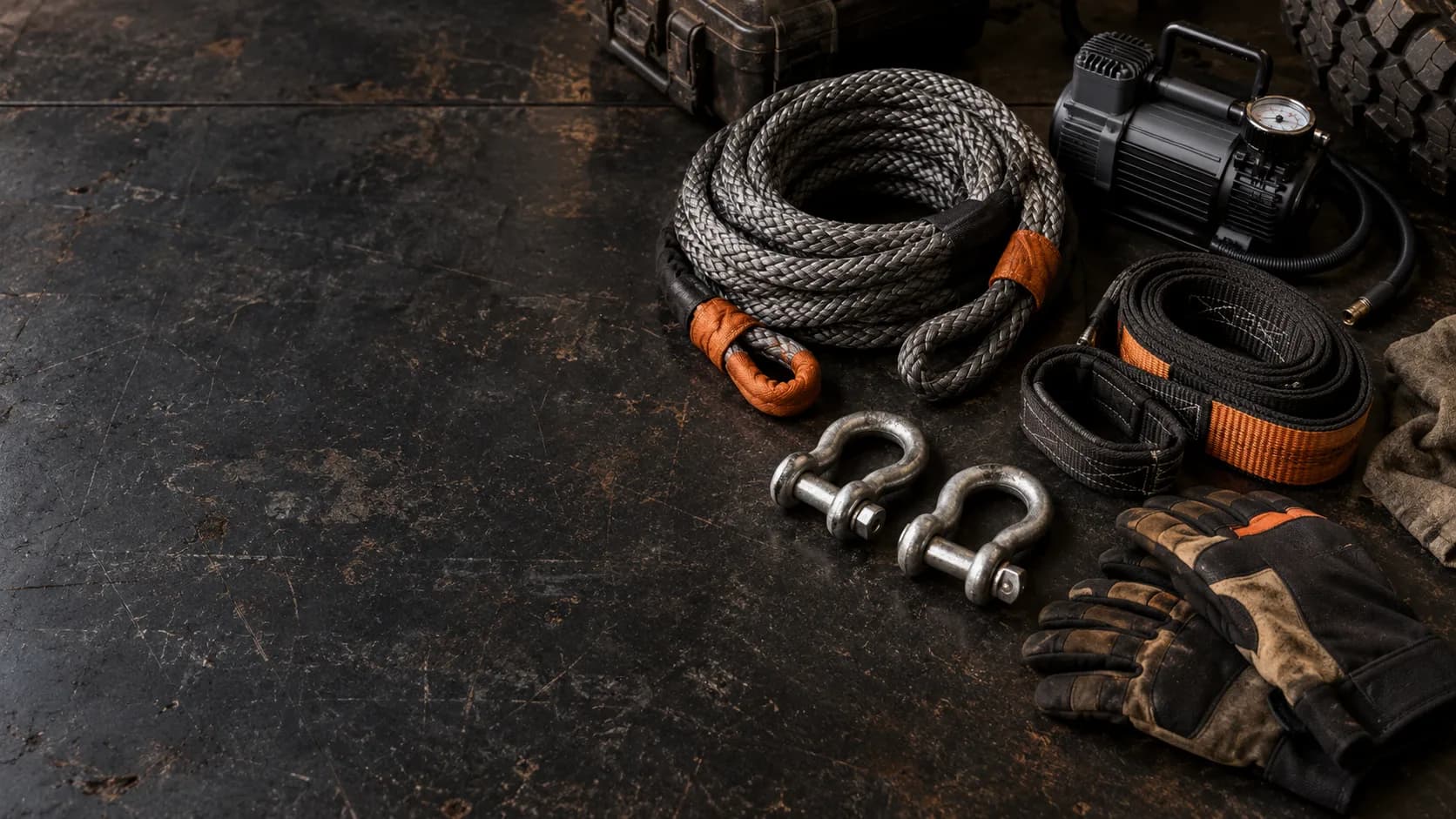
AI-generated representative scene
Quick answer
A good recovery kit is matched to your vehicle, terrain and who you travel with — not a one-size box. The essentials (deflator, compressor, shovel, gloves, plug kit, rated recovery points, soft shackles, first-aid, extinguisher) belong in every kit; traction boards, a kinetic rope and a winch get added as your terrain and solo-risk demand. This builder assembles a tiered kit from 34 gear items, scores how trail-ready it is, and flags any safety gaps.
Choose your path
Start with guidance, compare options, or run the numbers. Your place stays visible.
Kit Builder
What do you drive?
Four rules that keep recovery safe
Air down first
Dropping tyre pressure is the cheapest, biggest traction gain there is — it prevents most bogs before they happen. Re-inflate before tarmac.
Only as strong as the weakest link
Recovery point, shackle, rope and anchor all carry the load. Rate every part to your vehicle's GVM and never exceed the weakest one.
A damper, every time
A heavy blanket over a tensioned line turns a snapped-line projectile into a harmless drop. Use it on every kinetic and winch pull.
Lowest-energy method wins
Boards before snatch before winch. The simplest recovery that works is the safest — and the kindest to your gear.
Gear is only half of it — get hands-on training before you rely on a winch or kinetic recovery. The kit gets you home; the technique keeps everyone safe.
Kit tiers at a glance
Five driver profiles — from a first trail run to expedition-grade remote self-rescue. Gear counts, readiness and indicative costs all come from the same engine as the builder above.
Beginner Kit
First trails, with a group.
Best for
- First trails with a convoy
- Light mud and graded tracks
- Brand new to recovery
Avoid if
- Solo travel or technical terrain
- Sand, snow or expeditions
- Budget
- ₹
- Items
- 10
- Readiness
- Expedition Ready
- Indicative cost
- ₹12,000–₹52,000
Weekend Kit
Regular weekend wheeling.
Best for
- Weekend convoy and camping trips
- Mixed trails, mud and rocks
- Some recovery experience
Avoid if
- Remote solo expeditions
- Serious sand dunes or deep snow
- Budget
- ₹₹
- Items
- 10
- Readiness
- Expedition Ready
- Indicative cost
- ₹12,000–₹52,000
Overlanding Kit
Most versatileSelf-reliant touring.
Best for
- Overlanding and self-reliant camping
- Sand, mud, mountains and expedition routes
- Intermediate to advanced experience
Avoid if
- Technical solo rock crawling without a winch
- Budget
- ₹₹₹
- Items
- 18
- Readiness
- Ultimate Kit
- Indicative cost
- ₹17,850–₹81,000
Expedition Kit
Remote, multi-day, solo-capable.
Best for
- Remote multi-day solo trips
- Technical terrain and river crossings
- Winch-equipped rigs in serious country
- Budget
- ₹₹₹₹
- Items
- 28
- Readiness
- Ultimate Kit
- Indicative cost
- ₹40,550–₹1,58,500
Professional Kit
Guide / trainer / recovery pro.
Best for
- Guides, trainers and recovery professionals
- All terrains with full winch rigging
- Maximum trail capability
- Budget
- ₹₹₹₹
- Items
- 28
- Readiness
- Ultimate Kit
- Indicative cost
- ₹40,550–₹1,58,500
Kit weight & cost calculator
Tick the gear you carry (or plan to) to total your recovery pack weight and indicative budget. Your selection is saved on this device, so it doubles as a “gear I own” checklist.
Items
0
Pack weight
0.0 kg
Indicative cost
—
Safety
Recovery straps
Shackles
Recovery boards
Tyre equipment
Digging
Winching
Utility
Camping & jacking
Weights and price bands are indicative planning figures and vary by brand, rating and retailer. Confirm the working load limit (WLL) of every load-bearing item before use.
Where to next
Recovery kit FAQ(5 questions)
- What should be in a basic 4x4 recovery kit?
- At a minimum: a tyre deflator and a compressor, a folding shovel, recovery gloves, a tyre plug kit, rated recovery points, soft shackles, a first-aid kit and a fire extinguisher. Add traction boards if you touch sand or snow, and a kinetic rope once you wheel with a buddy vehicle. The builder tailors this to your vehicle and terrain.
- Do I really need rated recovery points?
- Yes. Factory tie-down and tow hooks are not rated for the shock loads of a kinetic recovery — they can tear off and become a deadly projectile. Bolt-on rated recovery points sized to your vehicle's GVM are the single most important upgrade before any snatch recovery.
- Kinetic rope or snatch strap — which is better?
- A kinetic recovery rope stretches more and recovers more smoothly, with less shock to both vehicles, and it's lighter and easier to store. A snatch strap is cheaper and does the same job with a little less finesse. Either way, match the rated strength to roughly two to three times your vehicle's gross weight, and always use a damper.
- How big a winch do I need?
- The common rule is a winch rated to about 1.5 times your vehicle's gross vehicle mass (GVM), loaded. Synthetic line is lighter and far safer than steel if it fails. A winch only earns its place once you wheel solo on technical ground or in genuinely remote terrain — for group trail runs, boards and a snatch usually do the job.
- What's the safest order to attempt a recovery?
- Lowest energy first: air down and try to drive out, then traction boards, then a kinetic snatch with a buddy, then the winch. Walk the obstacle first, clear a path with the shovel, keep everyone clear of any tensioned line, and never skip the damper.
Not sure where to start your build?
The Build Advisor turns your vehicle, terrain and goals into a tailored gear, trail and prep plan in a few questions.
Open the Build Advisor