Free No Tarmac tools / Wheels · build & fitment
Wheel Advisor
Tell us your rig, terrain and how you drive, and we'll recommend the right wheel diameter, width, offset and fitment.
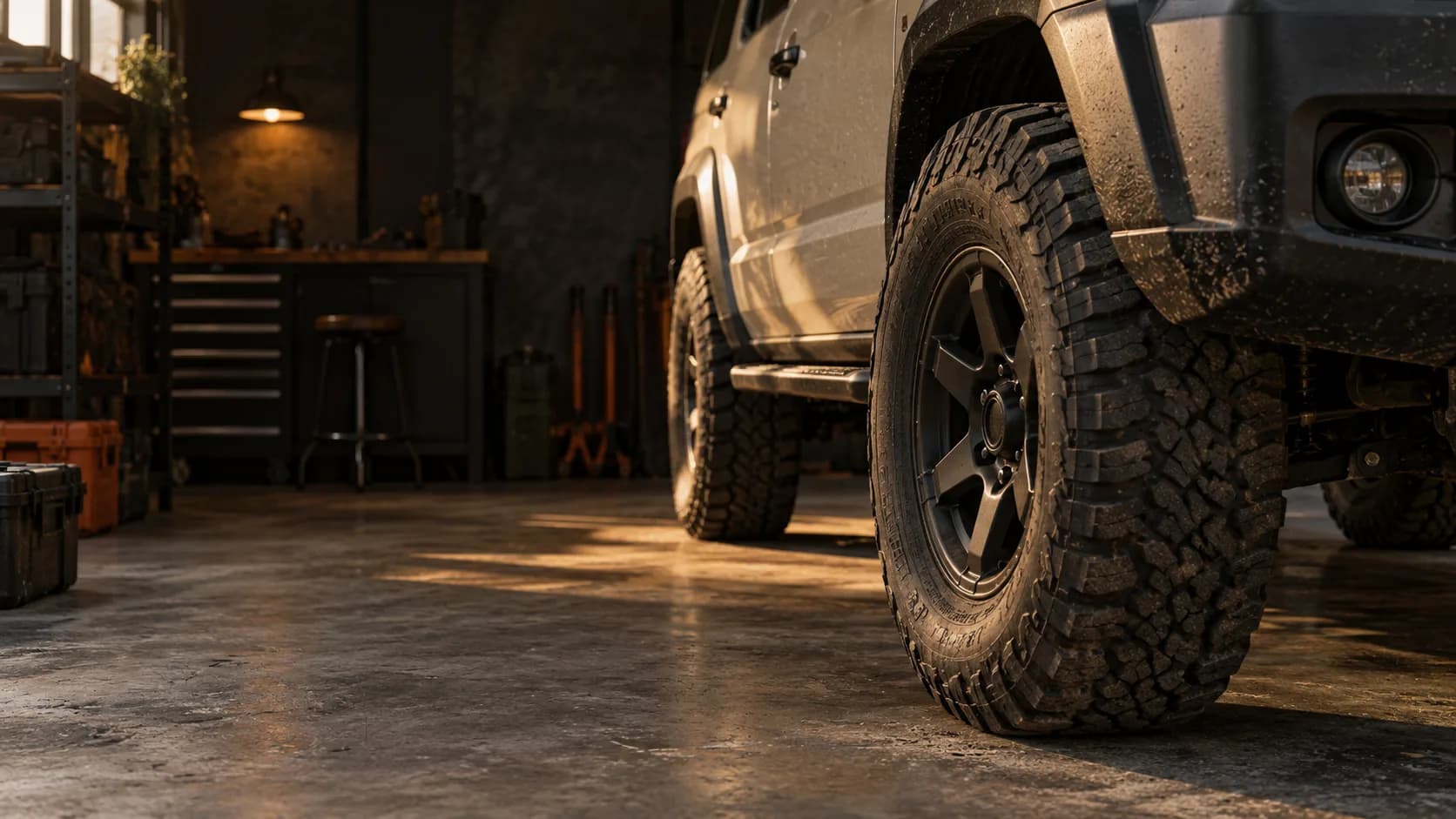
AI-generated representative scene
Quick answer
Get the fitment right first — the wheel has to match your vehicle's bolt pattern and hub (the advisor checks this for you). For off-road, a smaller diameter gives more sidewall; pick an alloy for road-plus-trail or a steel wheel for tough, remote travel. Tell the advisor your vehicle below and it matches a wheel across 15 ranges and 10 brands.
Get a wheel recommendation in 10 seconds
No forms — tap how you driveWhy we recommend this
- The right wheel size and fitment lets you run the tyres you want while keeping steering and braking safe.
- Stronger construction — or a simple steel spare — survives rocks and potholes that would crack a road wheel.
- Correct fitment (bolt pattern, centre bore, offset) means no vibration and a wheel that seats properly.
Things to consider
Cost
- Forged and beadlock wheels cost a lot more; a good cast or flow-formed alloy suits most owners.
- New wheels are often needed to fit bigger tyres or the right offset.
Trade-offs
- Wider wheels and tyres can add steering effort and road noise and cut economy.
- Heavier wheels dull ride comfort and braking.
Common beginner mistakes
- The wrong nut/bolt seat type, which can let wheels loosen.
- Extreme offset that stresses bearings and causes rubbing.
- A mismatched spare that upsets the 4WD system.
Legal
- Wheel and tyre size changes can be registered specs — check current rules and tell your insurer.
Get a detailed recommendation
Answer a few questions for a full fitment match — size, offset, rim type and spacer guidance — or compare brands and models directly.
Choose your path
Start with guidance, compare options, or run the numbers. Your place stays visible.
Guided advisor
Which vehicle?
Fitment and legality vary. Lifts, oversized tyres or wheel changes beyond manufacturer spec may require RTO/ARAI approval and an updated RC, must be disclosed to your insurer, and can affect warranty and roadworthiness. Verify with your RTO, insurer and a qualified fitter before modifying.
No-jargon fitment flow
Choose wheels in the right order
A wheel that looks right can still hit a brake caliper, rub a control arm or sit badly on the hub. Treat the stamp as a checklist, not a style code.
- 01 · MUST MATCH
Mounting basics
PCD, centre bore, nut/bolt seat, brake clearance and load rating must suit the exact vehicle and wheel. Do not use the calculator to substitute those checks.
- 02 · MAKE IT FIT
Width, ET and tyre
Select a rim width inside the tyre maker's approved range, then use ET and any spacer to keep the inner and outer edges clear. Measure your current setup first.
- 03 · PROVE IT
Test under movement
A static fit is not enough. Check full steering lock and suspension travel, then re-torque to the vehicle maker's procedure after installation.
- 7.5J
- 7.5 is rim width in inches; J is the rim-flange contour.
- 17
- The tyre's bead-seat diameter in inches, not the outside diameter of the tyre.
- ET35
- Offset in millimetres. Higher positive ET tucks the wheel inward; lower ET moves it outward.
- 5×114.3
- Five mounting holes on a 114.3 mm pitch circle. It must match exactly.
Rim types at a glance
Three everyday rim categories, and who each one is really for.
Alloy
Most popularThe broadest choice for daily driving and weekend trails.
Best for
- Daily driving + weekend trails
- Road-and-trail combos
- Wide choice of designs, sizes and vehicle applications
Avoid if
- A wheel without a published load rating or vehicle application
- Very low PSI air-down without a beadlock
- Weight
- Varies by design
- Daily use
- Yes
- Off-road
- Good
- India availability
- Excellent
Steel
Bends rather than cracks — field-repairable for remote work.
Best for
- A dedicated spare in the correct approved size
- Utility-focused builds with a proven vehicle application
- A budget-conscious replacement when load and fitment match
Avoid if
- When the wheel's load rating, brake clearance or hub fit is unknown
- If the tyre maker does not approve the rim width for your tyre
- Weight
- Often higher
- Daily use
- Fitment-led
- Off-road
- Application-led
- Priority
- Rating + clearance
Beadlock
Clamps the bead for very low PSI — a specialist tool.
Best for
- Technical off-road use with a vehicle-specific, specialist plan
- Competition or closed-course use where it is permitted
Avoid if
- Daily road use without confirming rules, insurance and inspection requirements
- Budget builds or daily commuters
- If you need fitment at any tyre shop
- Weight
- Heavier
- Road use
- Confirm locally
- Daily use
- Specialist
- Fitment
- Specialist
Safety, ownership & compliance(fitment, torque, legal & warranty)
Fitment fundamentals
- Verify PCD/stud pattern, centre bore and hub fitment before buying — mismatches cause vibration and poor seating.
- Use hub-centric wheels or correctly sized centring rings so the wheel seats on the hub, not the studs.
- Choose a load rating equal to or greater than the manufacturer's specification.
- Not every tyre size suits every rim width — always choose a wheel width approved for the tyre by its manufacturer to avoid unsafe stretched or over-pinched fitments.
- Offset and backspacing affect steering geometry, suspension clearance, braking and bearing loads — avoid extremes unless engineered for your vehicle. Wider wheels and tyres can also increase steering effort, tramlining and fuel consumption, especially on-road.
Construction choices
- Cast alloys suit most daily and moderate off-road use; flow-formed alloys are lighter and stronger for mixed terrain.
- Forged wheels offer the best strength-to-weight (at higher cost); steel wheels bend rather than crack and are field-repairable, making them practical expedition spares.
- Strength depends on design and manufacturing quality as much as construction method — a well-made cast wheel can beat a poorly made forged one, so buy from reputable manufacturers rather than assuming 'forged = always better'.
- Beadlock wheels clamp the bead to run very low pressures — specialist equipment, often not road-legal; source via a specialist.
Installation & torque
- Use the correct wheel nut/bolt seat type (cone, ball or flat seat) — the wrong hardware prevents proper clamping and can let wheels loosen.
- Torque wheel nuts/bolts to the manufacturer's specification with a calibrated torque wrench — not by feel.
- Re-check torque after roughly 50–100 km following installation or rotation.
- Avoid stacking spacers — if a spacer is needed, use a single hub-centric spacer of the correct thickness with adequate stud thread engagement (longer studs may be needed), and re-torque after the first drive.
- Replace damaged valve stems when changing wheels, and use metal valve stems where appropriate for heavy off-road use.
Weight, clearance & inspection
- Heavier wheels add unsprung mass, dulling ride, suspension response and braking, and hurting economy — choose the lightest wheel that meets strength/load needs.
- Test-fit for brake, suspension and steering clearance at full lock and full articulation before buying.
- After significant off-road use, inspect for cracks, bent rims, damaged bead seats, corrosion and loose nuts; replace damaged wheels immediately. A dented bead seat can cause slow air leaks even if the wheel looks fine.
- After heavy impacts with rocks or potholes, check the wheel for bends and rebalance the wheel/tyre assembly if vibration develops.
- Clean wheels after beach or salt exposure and repair chipped coatings promptly to stop corrosion spreading; avoid strong acidic wheel cleaners on coated alloys unless the manufacturer approves them, as they can damage protective finishes.
Legal & warranty
- Keep dimensions, offset, tyre fitment and overall vehicle width within legal limits; wheel/tyre size changes are registered specifications — verify current RTO requirements before changing.
- Aftermarket wheels may limit warranty claims for bearings, suspension and steering — check your manufacturer's policy.
- Disclose significant modifications to your insurer where required, and keep a record of wheel specifications.
Informational guidance only — not professional advice or a safety guarantee. Follow your vehicle and component manufacturers' instructions, verify against current local regulations, and consult a qualified specialist for safety-critical work.
Where to next
Buy it · get it installed
Advanced technical notes — the complete India off-road wheel reference(deep dive)
The complete India off-road wheel reference
Off-road wheels for India — diameter, width, offset, PCD & bore decoded; steel vs alloy vs beadlock; fitment per vehicle, beadlock legality and monsoon care.
Key takeaways
- PCD mismatch of even 1mm means a wheel will not mount — verify PCD (stud count × bolt-circle diameter) against your OEM brochure or RTO registration certificate before any purchase, never from aftermarket data sites alone.
- Construction determines failure mode: cast alloy shatters on rock impact without warning, flow-formed cracks (safer), and steel bends and can be trail-repaired. For any rocky or serious off-road terrain, flow-formed is the minimum — cast is not acceptable.
- Indian 4x4s use several different bolt patterns: 5x139.7mm (Gypsy, India Jimny, Scorpio-N, 62hp pre-2020 Thar MDi — shared globally with Nissan Patrol and Jeep Wrangler), 5x114.3mm (2020+ Thar and Thar ROXX), 5x160mm (Force Gurkha and the pre-2020 Thar 2.5 CRDe 4x4) and 6x139.7mm (Fortuner, Hilux). They do not interchange — confirm your exact PCD from the RC before buying.
- Offset spacers above roughly 30mm carry real risk: they change scrub radius and add bearing load, and a meaningful share of owners report bearing noise, vibration or steering-feel degradation over time (anecdotal, not a precise statistic). PCD adapters (cross-pattern conversions) are a documented high-risk single point of failure — never use them.
- True beadlock wheels are not ARAI-approved for Indian public roads. Using them on public roads violates Motor Vehicles Act Sections 52 (₹5,000) and 182A (₹10,000). Most users do not need true beadlocks — aesthetic beadlock-style wheels provide the look without legal risk or maintenance burden.
- There is no CMVR numeric tyre-size limit (Rule 127 is the recall rule); legally, MV Act Section 52 restricts any deviation from manufacturer spec and the 2019 Supreme Court ruling confirmed oversize tyres are a prohibited alteration. The ~±3% figure is an industry/speedo guideline — stay close to OEM and declare any change to your insurer and RTO, or risk voided cover.
- Down-sizing from 18 to 16-inch diameter (while maintaining overall rolling circumference) is often the single most effective off-road upgrade: taller sidewall, more compliance, lower ground pressure, and a worthwhile traction gain widely reported in the Indian community (anecdotal, not a controlled measurement) — at a fraction of the cost of suspension upgrades.
Off-Road Wheels in India: What Actually Matters
A wheel is not a cosmetic upgrade. On a Thar threading through Spiti boulders or a Gurkha navigating a Coorg monsoon trail, the wheel is the structural link between the drivetrain and the ground. Get it wrong and you are dealing with a cracked rim at 4,000 metres or a de-beaded tyre halfway through a river crossing with no cell signal.
Indian 4x4 culture has exploded since 2019, but wheel knowledge has not kept pace. Most buyers chase looks: wide, low-profile alloys that look aggressive in a parking lot and shatter on the first serious rock garden. This guide corrects that. Every recommendation here is grounded in verified mechanical data, Indian regulatory reality, and the failure modes documented by the Indian off-road community.
The hierarchy is simple: fitment first (wrong PCD = wheel does not mount), construction second (wrong material = wrong failure mode for your terrain), sizing third (wrong diameter trades traction for clearance problems), then legality, then maintenance. Read in that order.
A wheel carries the full weight of the vehicle and transmits every braking, steering and impact load. A wrong PCD, an under-rated load capacity, a lug-centric fit run without hub rings, an over- or under-torqued lug nut, or an aggressive offset change can cause a wheel to separate, crack or de-bead — at speed this can be fatal. Treat every figure below as a starting point, not a final answer.
All numbers in this guide (offsets, PCDs, bore sizes, load ratings, torque values, tensile strengths, prices and community statistics) are indicative ranges for orientation only and may be wrong for your exact vehicle, variant or product. The ONLY authoritative sources are your vehicle owner's manual / registration certificate, the wheel manufacturer's stamped/published fitment and load-rating data, and your tyre maker's load and pressure tables. Verify every spec against those before you buy, fit or drive.
Wheel and tyre fitment, torquing, offset/spacer changes and beadlock servicing should be carried out or checked by a qualified 4x4 workshop. This guide is general educational information, not engineering, legal or insurance advice. If a value is not verified against the manufacturer, do not rely on it.
Every spec in this guide is cross-referenced against Indian vehicles (Thar, Gurkha, Gypsy, Jimny, Fortuner, Hilux), Indian road conditions (potholed monsoon tarmac, high-altitude loose scree, river crossings, laterite trails), and the Indian regulatory framework (Motor Vehicles Act — notably Section 52 — and ARAI type-approval).
Prices are in INR and are indicative ranges only — verify current pricing with the seller. Dimensions are metric. Pressure is in PSI and bar.
Wheel Anatomy and Every Spec Decoded
A wheel's part number, stamped on the back face, contains all fitment information. Reading it correctly is non-negotiable before any purchase.
| Specification | What It Means | How to Read It | Off-Road Impact |
|---|---|---|---|
| PCD (Pitch Circle Diameter) | Diameter of the circle passing through all stud centres | Written as 5x139.7 — first number is stud count, second is diameter in mm | Zero tolerance: 1mm mismatch and the wheel physically will not mount. Non-negotiable first check. |
| Offset (ET) | Distance in mm from wheel centreline to mounting face | ET+20 = positive (wheel sits inward); ET-10 = negative (wheel sits outward/concave) | Affects brake clearance, fender clearance, track width, scrub radius, and steering feel. Stay within ±15–20mm of OEM or consult a suspension specialist. |
| Wheel Width (J) | Internal width of the barrel between bead seats | 7J, 8J, 9J — measured in inches | Dictates minimum and maximum tyre width. Too narrow: tyre bulges outward (heat, instability). Too wide: tyre pinches (sidewall cracks on rocks). |
| Centre Bore | Diameter of the central hole in the wheel | Stamped in mm, e.g. 110.1mm | Hub-centric fit requires bore to match hub exactly. Oversized bore = lug-centric = vibration at speed and uneven stud stress. |
| Backspacing | Distance from wheel rear edge to mounting face (inches) | Calculated: Backspace = (Width × 25.4 / 2) + Offset | Determines how close the wheel sits to suspension components. Too little backspace on a lifted vehicle = shock/spring interference. |
| Load Rating | Maximum load each wheel is rated to carry | DOT-marked on wheel: check against GAWR ÷ 2, add 20–30% margin | Under-rated wheel at off-road loads (heavy vehicle + recovery gear + passengers) risks structural failure without warning. |
| Stud Count | Number of wheel bolts | First number in PCD: 5x139.7 = 5 studs | Fewer studs = higher load per stud. 6-stud patterns (Fortuner) distribute load better on heavy vehicles. |
| Material / Construction | Cast, flow-formed, forged, or steel | Stamped or supplied by manufacturer | Determines failure mode under impact. Cast shatters; steel bends. Choose based on terrain severity. |
| Wheel Diameter | Rim diameter in inches | 15, 16, 17, 18 in Indian 4x4 context | Smaller diameter allows taller tyre sidewall = better compliance and ground conformity off-road. 15–17 inch is the practical sweet spot. |
Backspace (inches) = (Wheel Width in inches ÷ 2) + (Offset in mm ÷ 25.4).
Example: Thar OEM 18x8 ET+20 → Backspace = (8 ÷ 2) + (20 ÷ 25.4) = 4 + 0.79 = 4.79 inches (≈ 122mm).
Every aftermarket wheel change should be run through this formula before purchase to verify suspension clearance.
Wheel Construction: Steel vs Cast vs Flow-Formed vs Forged vs Beadlock
Construction determines how a wheel fails. On-trail, this is the difference between a wheel that bends and can be hammered back, and one that shatters and strands you. Choose based on your terrain severity and recovery plan, not aesthetics.
Wheel Construction Comparison for Indian Off-Road Use
- Strength (Tensile MPa)
- 5
- Weight Saving
- 3
- Impact Failure Mode
- 9
- Trail Repairability
- 10
- Monsoon Durability
- 7
- Cost (per wheel INR)
- 9
- Best Use Case
- 7
Made from structural steel (tensile strength varies by grade — treat any single figure as approximate). Heaviest option (typically a few kg more per wheel than alloy). Bends rather than shatters — trail-repairable with a hammer. Rusts without paint; protect during monsoon. Roughly ₹2,000–8,000/wheel (indicative; verify). Best for: daily drivers, casual off-road, rural use where repair shops are distant.
- Strength (Tensile MPa)
- 4
- Weight Saving
- 5
- Impact Failure Mode
- 2
- Trail Repairability
- 3
- Monsoon Durability
- 8
- Cost (per wheel INR)
- 7
- Best Use Case
- 3
Lowest tensile strength of the alloy options and the heaviest alloy (exact figures vary by manufacturer — treat as approximate). Air pockets from casting make it brittle under impact. Risk of catastrophic shattering on rocks — high danger if it lets go at speed. Roughly ₹4,000–20,000/wheel (indicative; verify). Adequate for light road use only; avoid for serious off-road.
- Strength (Tensile MPa)
- 7
- Weight Saving
- 7
- Impact Failure Mode
- 6
- Trail Repairability
- 5
- Monsoon Durability
- 8
- Cost (per wheel INR)
- 6
- Best Use Case
- 8
Higher tensile strength and meaningfully lighter than cast (commonly cited as roughly 15–25% lighter — figures vary by manufacturer; verify). Barrel compressed by rollers: better impact resistance in the barrel than cast. Face/spokes retain some porosity. Cracks (safer) rather than shatters. Roughly ₹10,000–35,000/wheel (indicative; verify). Best for: weekend trail enthusiasts, overlanders, lifted trucks. Sweet spot of cost vs. safety.
- Strength (Tensile MPa)
- 10
- Weight Saving
- 9
- Impact Failure Mode
- 10
- Trail Repairability
- 4
- Monsoon Durability
- 8
- Cost (per wheel INR)
- 2
- Best Use Case
- 9
Highest strength and lowest weight of the options (typically forged from 6061-T6 billet under a high-tonnage press; exact tensile and weight figures vary by manufacturer — verify). Effectively zero porosity: bends (ductile failure) rather than shatters. Non-repairable on-trail if severely bent. Roughly ₹35,000–1,75,000/wheel (indicative; verify). Best for: expedition builds, competition, high-speed trail use where weight and safety margin both matter.
- Strength (Tensile MPa)
- 6
- Weight Saving
- 2
- Impact Failure Mode
- 9
- Trail Repairability
- 10
- Monsoon Durability
- 6
- Cost (per wheel INR)
- 7
- Best Use Case
- 6
Combines steel durability with mechanical bead clamping. Heavier (roughly a few kg penalty per wheel over standard alloy — verify the actual weight). Trail-repairable. Requires periodic bolt re-torquing before every trip. Roughly ₹25,000–35,000/set as an indicative range (verify current pricing with the seller). Not ARAI-approved for road use. Best for: dedicated rock crawlers and competition vehicles on private/competition terrain only.
Cast alloy wheels shatter on high-impact hits — they do not bend first. At the moment of failure there is no warning: the rim disintegrates, the tyre instantly loses pressure, and the vehicle drops onto the brake disc or axle casing.
If your build includes rock crawling, boulder fields, or high-speed loose terrain, flow-formed is the minimum acceptable construction. Forged is preferred. Cast is not appropriate for these conditions regardless of the brand name on the wheel.
Fitment Fundamentals: PCD, Offset, Centre Bore, and Width
Fitment errors are the most common and most dangerous wheel mistakes in India. They range from 'wheel physically will not mount' (PCD mismatch) to 'wheel mounts fine but fails at highway speed' (bore mismatch without hub rings) to 'tyre rubs on suspension at full articulation' (offset error on a lifted vehicle).
How to Verify Fitment Before Buying Any Aftermarket Wheel
Step 1
1Check PCD Against Your Vehicle Registration Certificate
Look up the PCD from your OEM brochure or RTO registration document — not from aftermarket data sites, which sometimes list incorrect values.
Common Indian 4x4 PCDs: 5x114.3mm (Thar 2020+ and Thar ROXX), 5x139.7mm (Maruti Gypsy, Jimny India 2023+, Scorpio-N, and the 62hp pre-2020 Thar MDi), 5x160mm (Force Gurkha 2021+, and the pre-2020 Thar 2.5 CRDe 4x4), 6x139.7mm (Fortuner, Hilux).
PCD tolerance is zero. Even 1mm mismatch means the wheel will not mount. Do not try to force-fit.
Step 2
2Measure Centre Bore and Order Hub Rings If Required
Aftermarket wheels typically use an oversized bore to fit multiple vehicles. If the wheel bore is larger than your hub diameter, it is lug-centric.
Lug-centric wheels place the centring load on the stud threads rather than the hub face, substantially increasing stud stress and causing high-speed vibration.
Solution: fit aluminium hub-centric rings (6061-T6, ₹3,000–6,000 per set) to fill the gap. Verify bore match to within 0.5–1mm.
Never run lug-centric wheels without hub rings above 60 km/h. Vibration that feels minor at low speed becomes dangerous at highway speeds and causes irregular tyre wear.
Step 3
3Calculate the Offset Change from OEM and Check Clearances
Note your OEM offset (ET value) from the vehicle brochure.
Calculate the proposed change: if going from ET+20 to ET-10, that is a 30mm offset decrease, which pushes the wheel 30mm further outboard.
Check: (a) tyre-to-inner-arch clearance at full lock, (b) tyre-to-suspension-arm clearance at full droop, (c) brake calliper-to-spoke clearance.
Step 4
4Verify Wheel Width Against Tyre Width Compatibility
Tyre manufacturers publish a minimum and maximum rim width for each tyre size. Mounting a wide tyre on a narrow rim causes bead instability; mounting a narrow tyre on a wide rim causes handling instability.
Rule of thumb: rim width should be 70–85% of tyre tread width. A 265mm-wide tyre suits a 7.5–9J rim.
Step 5
5Verify Load Rating Against Vehicle GAWR
Find your vehicle's GAWR (Gross Axle Weight Rating) on the tyre placard or registration document.
Minimum wheel load rating per wheel = GAWR ÷ 2. For off-road use with recovery gear and full passengers, add 20–30% safety margin.
Request written SAE J2530 test documentation from the wheel supplier before purchase.
A large offset reduction (for example via thick spacers) can change or even reverse the scrub radius. Effects reported with such changes: (a) heavy steering at low speed, (b) pulling under hard braking, (c) premature uneven tyre wear, and (d) increased load on the wheel bearings, which can shorten bearing life. The exact factory scrub radius and the magnitude of any change are vehicle- and geometry-specific — have a suspension specialist measure it for your build rather than relying on a generic figure.
A meaningful share of owners running large spacers report steering-feel degradation and, less often, bearing noise or vibration within a couple of years. Treat these as well-documented risk patterns, not precise statistics — the real rate depends on spacer quality, fitment and use.
Hub-centric spacers of a few mm are generally safe for fine-tuning clearance. Thick spacers (roughly 30mm and above) on any Indian 4x4 are high-risk: they shift scrub radius, add bearing load and introduce a second bolted joint, and require expert suspension re-evaluation before use.
Adapters that convert one PCD to another (e.g., 5x100 to 5x139.7) introduce a secondary bolted joint into the wheel attachment. Under off-road dynamic loads — rock crawl, water crossings, aggressive terrain — adapter bolts can loosen and the wheel can slip or separate.
Adapter failures are documented within the Indian and global off-road community and have caused loss of steering and rollovers. This is a known, serious failure mode — not a theoretical one.
Rule: only use wheels with your vehicle's native PCD. If you cannot find a design you like in 5x139.7mm, look at Nissan Patrol, Jeep Wrangler, or dedicated 5x139.7mm aftermarket suppliers — they share the 5x139.7mm Gypsy/Jimny pattern (note: the 2020+ Thar is 5x114.3mm and the Gurkha is 5x160mm).
Per-Vehicle Wheel Specifications: India's Key 4x4s
Use this table as a quick reference before purchasing any wheel or tyre. Always cross-verify against your specific variant's RTO registration — sub-variants within the same nameplate can differ.
| Vehicle | PCD | OEM Offset | OEM Wheel Size | OEM Tyre Size | Notes |
|---|---|---|---|---|---|
| Mahindra Thar (2020+) & Thar ROXX | 5x114.3mm | ET+20 | 18×8.0J | 255/65R18 or 245/75R16 | The 2020+ Thar uses 5x114.3mm. The pre-2020 gen-1 Thar is variant-dependent — the 2.5 CRDe 4x4 is 5x160mm, the 62hp 2.5 MDi is 5x139.7mm — so verify against your RC before buying. |
| Force Gurkha (2021+) | 5x160mm | ET+20 (approx) | 16×7J variant | 245/70R16 | G-Wagen-derived 5x160mm hub (large centre bore — confirm the exact bore against your wheel and hub) — NOT the Thar/Gypsy pattern. Limited wheel choice; verify offset for your variant. |
| Maruti Gypsy Gen 2 & 3 (1985–2020) | 5x139.7mm | ET+15 to ET+20 | 16×7J | 225/75R16 or 235/70R16 | Shares 5x139.7mm with the India Jimny, Scorpio-N and the 62hp pre-2020 Thar MDi — but NOT the 2020+ Thar (5x114.3mm), the Gurkha, or the pre-2020 Thar 2.5 CRDe 4x4 (both 5x160mm). Verify offset. |
| Maruti Suzuki Jimny (India 2023+) | 5x139.7mm | ET+20 | 15×5.5J | 195/80R15 | 5x139.7mm — the same pattern as the Gypsy and the 62hp pre-2020 Thar MDi (NOT the 2020+ Thar's 5x114.3mm). Verify offset before fitting. |
| Toyota Fortuner Gen 2 & 3 | 6x139.7mm | ET+25 | 18×8.0J | 265/60R18 or 265/50R20 | 6-lug pattern: incompatible with all 5-lug Indian vehicles. Do not mix with adapters. |
| Toyota Hilux (India) | 6x139.7mm | ET+25 (approx) | 18×8.0J | 265/60R18 | Same 6-lug Toyota pattern as Fortuner. Shares wheel pool with Fortuner. |
Reference figures only — always verify against your specific variant's registration certificate (RC) before buying wheels.
Both the Gypsy (5x139.7) and the Fortuner (6x139.7) share the same bolt-circle diameter — 139.7mm. The numbers look nearly identical in listings. The difference is the stud count: 5 vs 6.
A 5-stud wheel will not mount on a 6-stud hub. A 6-stud wheel will not mount on a 5-stud hub. Always confirm stud count separately from the diameter figure.
Diameter and Sizing: Plus-Sizing, Down-Sizing, and the Off-Road Sweet Spot
Wheel diameter choice is a trade-off between tyre sidewall height (compliance, protection), ground clearance, and speedometer accuracy. Indian off-road use generally favours smaller diameter wheels with taller tyres over large-diameter, low-profile setups.
Going from 18-inch to 16-inch wheels on a Thar (e.g., OEM 255/65R18 → 285/65R16) increases sidewall height from ~163mm to ~185mm. Benefits: more tyre flex on rocks and roots, lower ground pressure on sand and mud, the tyre absorbs rock strikes before the rim does.
Indian 4x4 community experience consistently reports a worthwhile traction gain when down-sizing diameter and increasing sidewall height (anecdotal, not a controlled measurement — your result depends on tyre, terrain and pressure). The 15–17 inch range is the practical sweet spot for serious Indian off-road.
| Direction | Industry Limit | Effect on Diameter | Legal position (MV Act §52) | Key Risk |
|---|---|---|---|---|
| Plus-sizing (larger diameter) | Max +2 inches from OEM | Keep rolling circumference within ±3% | Deviation from OEM spec is restricted under MV Act §52; ~±3% is an industry/speedo guideline, not a statute | Tyre bulge into fenders; ABS/ESP sensor errors; speedometer error >5%; suspension bottoming. |
| Down-sizing (smaller diameter + taller sidewall) | Generally safe to -2 inches if circumference maintained | Keep rolling circumference within ±3% | Same — ±3% is an industry guideline; MV Act §52 restricts deviation from OEM | Requires suspension re-tuning. Smaller diameter raises the suspension's natural frequency. Mismatched stiff springs cause body roll and instability. |
| Width increase | Max +25mm from OEM tread width | Does not affect diameter | No specific rule but must not protrude beyond wheel arch | Tyre rub at full articulation. Increased rolling resistance. Insurance non-disclosure risk. |
There is no CMVR rule that sets a numeric tyre-size tolerance — Rule 127 actually covers defective-vehicle recalls. The real legal control is Motor Vehicles Act Section 52, which prohibits altering a vehicle so it varies from the manufacturer's certified specification; the 2019 Supreme Court ruling (RTO v. K. Jayachandra) confirmed that even fitting larger tyres is a prohibited alteration. The widely-quoted ±2–3% figure is a tyre-industry/speedometer guideline, not a statute.
RTO enforcement is inconsistent — metros enforce more rigorously than rural areas — but exceeding this range can void your insurance. Any modification must be declared in writing to your insurer. Keep documentation of every change.
Wheel and tyre changes are not just a fitment question in India — they can breach motor-vehicle law. Three areas carry real legal and financial risk and should be checked against the current rules before you fit anything:
Track width and poke: a more negative offset, wider wheels or spacers push the tyre outward and can leave it protruding beyond the wheel arch ("poke"). A tyre that extends past the bodywork, or a changed track width, is a deviation from the manufacturer's certified specification — restricted as an unauthorised alteration under the Motor Vehicles Act (notably Section 52). Treat any poke beyond the arch line as non-compliant.
Diameter change and speedometer error: changing rolling diameter makes the speedometer and odometer read incorrectly (an oversize tyre makes you travel faster than indicated). The commonly-quoted ±2–3% is an industry/speedometer guideline for staying close to OEM, not a statutory tolerance — the legal control is the MV Act prohibition on altering the vehicle from its certified spec. A large diameter change can also affect ABS/ESP calibration. Verify the exact diameter and rolling circumference before ordering and keep the change minimal.
Insurer disclosure: any wheel, tyre, offset or suspension modification must be declared in writing to your motor insurer. Undeclared modifications can let the insurer reduce or repudiate a claim — including for an unrelated accident. Get written acknowledgement of the declared modification and keep it with your policy.
Enforcement and the precise limits vary by state, RTO and over time. Confirm the current position with the Ministry of Road Transport & Highways / CMVR (https://morth.nic.in), your RTO and your insurer before relying on any figure here.
Beadlock Wheels: How They Work, When You Actually Need One, and India Legality
Beadlock wheels are the most misunderstood product in Indian off-road culture. They are photographed constantly, fitted regularly, and genuinely needed by very few people. Understanding what they actually do — and what the Indian law says about them — is essential before spending money.
How a Beadlock Works
Mechanism
1Standard Wheel: Air Pressure Holds the Bead
On a standard wheel, the tyre bead (inner lip of the tyre) seats against a shelf on the rim. Air pressure inside the tyre pushes the bead outward and holds it against the shelf.
Below a threshold pressure (typically 12–20 PSI depending on tyre size and load), air pressure is insufficient to keep the bead seated. The tyre de-beads — separates from the rim — and instantly loses all pressure.
- 2
Beadlock: A Mechanical Clamp Replaces Air Pressure
A beadlock wheel adds a metal ring (16–32 bolts) around the outer bead shelf. When bolted down in a star pattern, this ring physically clamps the tyre bead against the rim — no air pressure required to maintain bead contact.
This allows tyre pressure to be dropped to 5–7 PSI safely. At this pressure, the tyre footprint expands significantly, improving traction on sand, mud, loose rock, and soft terrain.
Maintenance
3Maintenance Requirement: Re-torque Before Every Outing
Beadlock ring bolts fatigue and loosen with vibration and heat cycling. They must be re-torqued to the manufacturer's specification (typically 65–90 N·m) before every off-road trip.
For India's monsoon season: use stainless steel (300-series) or Zn-Ni plated fasteners only. Standard steel bolts rust within 2–3 monsoon seasons, weakening clamping force and seizing during removal.
A beadlock with loose or corroded bolts is more dangerous than a standard wheel. The ring provides false confidence while offering no actual bead retention.
True beadlock wheels are not ARAI-approved for road use. Operating them on public roads violates Motor Vehicles Act Section 52 (₹5,000 fine for unauthorized alterations) and Section 182A (₹10,000 for non-compliance). If deemed unsafe, the RTO can suspend registration under Section 53.
Indian RTOs do not pre-authorise beadlock conversions. Most tyre repair shops in India do not have beadlock-specific tooling and will refuse to service beadlock-equipped vehicles — plan your workshop access before committing.
Legal use: private land, dedicated off-road parks, and sanctioned motorsport competition only.
| Use Case | Typical Tyre Pressure Used | Beadlock Needed? | Alternative |
|---|---|---|---|
| Extreme rock crawling competition (below 10 PSI) | 5–8 PSI | Yes — genuinely necessary | No safe alternative at these pressures |
| Serious sand/mud off-road (expedition) | 10–12 PSI | Beneficial but not mandatory | Tyre deflator + standard wheel works at 12+ PSI |
| Weekend trail driving (recreational) | 15–20 PSI | No | Standard alloy or steel wheel adequate |
| Overlanding on graded tracks | 20–25 PSI | No | Standard wheel; tyre deflation for loose sections |
| Daily driving with occasional mild off-road | 28–35 PSI (road); 18–22 PSI (light off-road) | No | Aesthetic beadlock-style wheel (road-legal, no maintenance burden) |
| High-altitude (Ladakh, Spiti) gravel roads | 22–28 PSI | No | Standard steel or flow-formed alloy |
| Type | Material | Indicative Price Range | Notes |
|---|---|---|---|
| Steel beadlock rims (e.g. Gypsy/16-inch fitments) | Steel | Roughly ₹25,000–35,000 per set of 4 (verify) | Domestic fabricators and online marketplaces; price and quality vary by seller — verify load rating and fitment before ordering. |
| Alloy beadlock (imported) | Alloy | Roughly ₹50,000–1,00,000+ per set (verify) | Import pricing; not frequently listed domestically; confirm before ordering. |
Indicative ranges only — beadlock pricing varies widely by seller, material, size and import status. Confirm current prices and exact specifications directly with the supplier before buying.
Choosing the Right Wheel: A Decision Framework
Work through the decision tree below based on your primary use case and budget. The outcome is a wheel type recommendation with rationale — not a brand endorsement.
Which Wheel Type Is Right for You?
What is your primary use case?
Wheel Care in India's Monsoon
India's monsoon season is uniquely destructive to wheels. Salt-laden water spray, persistent humidity, deep puddle crossings, and mud caking create conditions that accelerate every known failure mode. A wheel that would last a decade in a dry climate may develop problems within one monsoon season if neglected.
Monsoon Wheel Maintenance Protocol
Pre-Season
1Pre-Monsoon Inspection (April–May)
Inspect all wheel faces, spokes, and inner barrels for hairline cracks, pitting, or corrosion blisters. Cast wheels showing any cracking must be replaced before monsoon off-road use.
Check tyre bead-seat area on the rim for corrosion lips or raised edges — these prevent proper bead seating in wet conditions.
Apply wheel sealant or clear lacquer to bare alloy edges and spoke-to-barrel junctions.
During Season
2During Monsoon: Post-Mud-Run Protocol
Wash wheels within 4 hours of returning from a mud run. Packed mud traps moisture and accelerates corrosion, especially in spoke cavities and lug nut recesses.
Dry lug nut recesses and torque lug nuts to spec (check your vehicle's torque specification — typically 100–130 N·m for 5x139.7 vehicles) after each wet run. Lug nuts loosen when wheel/hub interfaces are contaminated with mud.
For beadlock rings: re-torque ring bolts after every monsoon off-road session. Water ingress accelerates fatigue.
Steel Specific
3Steel Wheel Monsoon Defence
Touch up paint chips immediately — bare steel rusts within 48 hours in monsoon humidity.
Apply rust-inhibiting primer to any exposed metal. Cold-galvanising compound works well for wheel inner barrels.
Inspect hub bore contact surface: surface rust here creates a gap that allows the wheel to shift on the hub under load.
Year-round
4Hub and Bearing Temperature Check
After any 50–100 km off-road run in wet conditions, perform the hand-feel test: carefully touch the hub centre after stopping. Warm is normal. Hot (cannot hold for 2 seconds) indicates bearing stress, contamination, or spacer-induced overload.
Water crossings flush grease from unsealed bearings. If your vehicle regularly crosses rivers, inspect and re-grease wheel bearings every 10,000 km or annually, whichever is sooner.
Alloy wheels resist surface corrosion better than bare steel because aluminium forms an oxide layer. However, alloy wheels are not immune: road salt and alkaline mud (common in Western Ghats laterite) attack the oxide layer and cause pitting.
For alloy wheels in monsoon: clear protective lacquer coat, monthly wash with pH-neutral soap, wax polish every 2–3 months. Do not use acid-based wheel cleaners — they strip the oxide layer.
For steel wheels: consistent paint maintenance is simpler and cheaper than alloy restoration. Rattle-can primer + topcoat touch-ups after every trail run is a valid strategy.
25+ Off-Road Wheel Mistakes Made in India (and How to Avoid Them)
These are documented failure patterns from the Indian off-road community, RTO inspection records, and mechanic accounts. Each one has caused a preventable incident.
| Mistake | Why It Happens | Consequence | Correct Action |
|---|---|---|---|
| Buying wheels by looks, not PCD | Seller quotes 'fits Thar' without specifying PCD | Wheel does not mount. Return/re-order delay. Wasted cost. | Always verify PCD (number × diameter) against RTO document before payment. |
| Using PCD adapters for cross-pattern conversion | Want a specific design not available in native PCD | Documented Indian and global failures; loss of steering or rollover. | Source native PCD wheels only. Look at Nissan Patrol/Jeep Wrangler suppliers for 5x139.7 options. |
| Skipping hub rings on lug-centric aftermarket wheels | Not aware of bore mismatch | High-speed vibration, uneven stud stress, accelerated bearing wear. | Measure bore vs. hub diameter. Fit 6061-T6 aluminium hub rings (₹3,000–6,000 per set). |
| Fitting 50mm+ offset spacers without suspension review | Want wider stance | Scrub radius change/reversal, added bearing load, steering feedback loss, and bearing wear/noise over time. | Keep spacers to a few mm for fine-tuning. Any larger: get suspension specialist sign-off. |
| Running cast alloy wheels on rocky trails | Budget constraint or aesthetics priority | Catastrophic shattering on hard rock impact. Sudden tyre/rim failure at speed. | Flow-formed minimum for rocky terrain. Cast is road-only. |
| Exceeding ±3% OEM diameter without RTO declaration | Size looks better / more traction | Insurance void on claim. RTO fine. ABS/ESP sensor errors. | Keep close to OEM size (~±3% is the industry/speedo guideline); any deviation from OEM is restricted under MV Act §52 — declare modifications to your insurer and RTO. |
| Not re-torquing beadlock ring bolts | Forgot / assumed they stay tight | Ring loosens, tyre de-beads on-trail, sudden pressure loss. | Re-torque (65–90 N·m star pattern) before every off-road trip. |
| Using standard steel bolts in beadlock rings during monsoon | Came with kit | Rust within 2–3 monsoons. Bolt seizure during removal. Clamping force loss. | Replace immediately with 300-series stainless or Zn-Ni plated hardware. |
| Running beadlock wheels on public roads | Unaware of legality | Section 52 fine ₹5,000; Section 182A fine ₹10,000; potential registration suspension. | Road = road-legal wheels. Beadlocks = private/competition land only. |
| Downsizing diameter without re-tuning suspension | Traction advice followed in isolation | Smaller diameter raises suspension natural frequency. Body roll, instability, rollover risk. | Downsize only with matching suspension spring/damper re-tune. |
| Ignoring load rating on aftermarket wheels | Seller does not highlight it | Under-rated wheel at full passenger + recovery gear load fails without warning. | Calculate GAWR ÷ 2 + 20–30% margin. Request J2530 test documentation. |
| Trusting aftermarket data sites over OEM documents for PCD | Convenience | Data errors on these sites documented; fitment failures result. | Primary source is always the OEM brochure or RTO certificate. |
| Mixing wheel brands/constructions on same axle | Replacement after one damage | Different stiffness and weight = handling imbalance, uneven braking. | Match all four wheels in brand, construction, and specification. |
| Over-tightening lug nuts without torque wrench | Impact gun without torque check | Stud stretching/breakage. Warped brake disc. Thread damage. | Use torque wrench. Typical spec: 100–130 N·m for 5x139.7 vehicles (verify your model). |
| Under-tightening after tyre change at roadside shops | Assumed tech followed spec | Wheel loosening. Loss of steering. Audible click-clack before failure. | Re-torque after first 50 km following any wheel removal. |
| Not checking tyre-to-suspension clearance after offset change | Visual check only in static position | Tyre contacts suspension arm at full droop/full articulation. Blowout on trail. | Check clearance at full droop, full lock, and full compression before driving. |
| Painting wheel inner barrel before hub ring fitment | Cosmetic upgrade | Paint thickness adds runout to hub contact surface. Vibration at speed. | Hub ring contact surface must be bare metal, flat, and clean. |
| Buying 'ARAI certified' claim without documentation | Trusts seller's claim | Many sellers make this claim without documentation. Fake certifications circulate. | Request physical test certificate (J2530 / IS 9436). Match certificate number to wheel lot. |
| Ignoring tyre speed rating when downsizing | Focused on diameter, not rating | Smaller rim + taller tyre can shift rating from H (130 mph) to T (118 mph). Highway use becomes unsafe. | Verify speed rating on new tyre. Must meet or exceed vehicle's rated maximum speed. |
| Storing spare wheel in external carrier without checking weight limit | Standard modification | External spare carriers have load limits. Oversized / heavy wheel exceeds limit; carrier fails. | Weigh upgraded wheel + tyre. Verify against carrier manufacturer's rated capacity. |
| Running wheels with damaged valve stems after water crossings | Not inspected post-crossing | Water-damaged or clogged valve stem causes slow leak. Undetected until pressure critically low. | Inspect and blow out valve stems after every river or deep mud crossing. |
| Fitting wider wheels without checking brake calliper clearance | Assumed cast iron callipers fit everything | Spoke contacts calliper during wheel rotation. Brake failure. | Check calliper-to-spoke clearance with wheel at ride height, not just by eye. |
| Using chrome wheels off-road in monsoon | Aesthetics | Chrome plating delamination in mud/salt/acid-rain environments. Pitting beneath. Structural integrity loss. | Chrome is road-only. Powder coat or painted finishes for off-road use. |
| Not carrying a matching spare (size and PCD) | Carrying a standard steel spare with aftermarket alloys | Cannot mount spare in emergency. Stranded. | Your spare must match OEM PCD and offset, even if it is a different design. Check before every trip. |
| Ignoring water ingress into hub-spacer gap | Fitted spacer, never inspected gap | Rapid corrosion inside gap. Bearing play. Noise. Eventual failure. | Inspect gap monthly. Apply silicone sealant around bore perimeter. Replace corroded hub immediately. |
| Buying second-hand aftermarket wheels without crack inspection | Price-driven | Hidden cracks from previous impact. Wheel fails under first trail load. | Under UV light (dye-penetrant test) or at minimum a professional visual inspection of all spokes and barrel. |
Expert Tips from Experienced Indian Trail Builders
These are the non-obvious insights that only emerge after years of Indian off-road experience — the things that do not appear in product brochures.
After any 50–100 km off-road run, stop and carefully touch the hub centre (not the disc — it is very hot). Warm = fine. Hot = bearing stress. This is free and catches problems before they become catastrophic failures. Elevated bearing temperature is the first sign of oversized spacers, lug-centric vibration, or water ingress into the bearing.
Most Indian 4x4 owners carry an OEM-size spare. If you are running upgraded tyres and offset, the OEM spare may not mount safely or may cause handling imbalance if fitted at one corner. Your spare should match your running wheels in PCD, offset, diameter, and load rating. The weight difference between your upgraded wheel and the OEM spare must also be checked against your spare carrier's load rating.
Optimal off-road tyre pressure changes with terrain: graded gravel road (22–26 PSI), hard-pack dirt trail (20–24 PSI), loose sand/mud (14–18 PSI without beadlock, 10–14 PSI with), rocky boulder field (16–20 PSI — balance compliance vs. side-cut risk).
Always carry a quality digital pressure gauge and a 12V compressor. Drop pressure for the hard sections and re-inflate before returning to tarmac. Every 5 PSI of under-inflation on the highway increases tyre heat and rolling resistance significantly.
India's 4x4s split across several bolt patterns: the Gypsy, India Jimny and Scorpio-N use 5x139.7mm (shared globally with Nissan Patrol, Navara and Jeep Wrangler/Cherokee — a huge aftermarket); the 2020+ Thar and Thar ROXX use 5x114.3mm; the Force Gurkha uses 5x160mm; the Fortuner and Hilux use 6x139.7mm. Confirm your exact PCD from the RC/owner's manual before searching — and for 5x139.7mm vehicles, add 'Nissan Patrol' and 'Jeep Wrangler' to multiply options.
Wheels have different lug nut seat shapes: conical (tapered), ball (rounded-none), or flat-seat. Using the wrong seat type means the nut contacts only a small edge instead of full surface — it loosens under vibration and off-road load, with no warning before the wheel detaches.
When fitting aftermarket wheels, always replace lug nuts with the type specified for that wheel. Do not re-use OEM lug nuts on wheels with a different seat design.
Myths and Facts: What the Indian Off-Road Community Gets Wrong
10 Wheel Myths Debunked
Myth: Bigger wheels always give better off-road performance.
Fact: Larger diameter wheels require lower-profile tyres (less sidewall) to maintain overall diameter within legal limits. Less sidewall means less flex, less compliance on rocks and roots, and more rim exposure to rock strikes. For Indian off-road, 15–17 inch diameter with taller sidewalls outperforms 18–20 inch wheels in most trail situations.
Myth: Any Indian 4x4 with a 5-stud hub shares the same bolt pattern.
Fact: Not true. The 2020+ Thar is 5x114.3mm, the Gypsy/India-Jimny/Scorpio-N are 5x139.7mm, and the Force Gurkha is 5x160mm — three different 5-stud patterns that will not interchange. Even within one pattern, offset, centre bore and load rating differ, so verify every spec for your exact variant.
Myth: Wider wheels give better traction in all off-road conditions.
Fact: Width increases flotation on sand and mud. On rock and hard-pack, a narrower tyre with higher PSI focuses pressure better. And on clay soil — common in Maharashtra and parts of Tamil Nadu — a narrower tyre digs through to a firm layer rather than floating on the surface. Width choice depends on your dominant terrain.
Myth: Chrome-finished alloy wheels look premium and are fine for off-road.
Fact: Chrome plating delaminates in the mud, salt, and acid-rain environment of Indian monsoons. Once the chrome layer lifts, moisture penetrates and the substrate corrodes. Chrome wheels are road-only. Powder-coated or painted wheels are the correct choice for any off-road use.
Myth: Beadlock wheels are legal in India because they are sold openly.
Fact: Many products are sold that do not comply with regulations. True beadlock wheels are not ARAI-approved for road use and violate Motor Vehicles Act Sections 52 and 182A. The fact that shops sell them does not make them road-legal.
Myth: Flow-formed wheels are just marketing — they are the same as cast.
Fact: Flow-forming is a verified manufacturing process (rollers compress the barrel under heat) that measurably increases the barrel's tensile strength over cast and reduces weight (commonly cited as roughly 15–25% — exact figures vary by manufacturer). The difference is real and documented. Request the manufacturer's material certification to confirm the actual figures.
Myth: You only need to re-torque lug nuts after fitting new wheels.
Fact: Lug nuts should be re-torqued after the first 50 km following any wheel removal or tyre change, and checked every 10,000 km or before any off-road trip. Vibration and thermal cycling loosen them over time, particularly on unpaved surfaces.
Myth: A wheel 'balances out' over time if there is slight vibration after fitting.
Fact: Vibration does not resolve itself. It indicates runout (wheel not perfectly round), imbalance (mass distribution off-centre), hub/bore mismatch, or a bent wheel. Continuing to drive with vibration accelerates bearing wear and stud fatigue. Diagnose and fix immediately.
Myth: Spacers are a safe and cheap alternative to offset wheels.
Fact: Hub-centric spacers of a few mm are safe for fine-tuning. Thick spacers (roughly 30mm and above) change scrub radius, increase bearing load, and introduce a second bolted joint that can work loose off-road; a meaningful share of owners report bearing noise or vibration over time. They are not equivalent to a purpose-built offset wheel.
Myth: Forged wheels are the best choice for every off-road vehicle.
Fact: Forged alloy is the strongest and lightest option but cannot be repaired on-trail if severely bent. On a remote India expedition (Zanskar, deep Northeast) far from any workshop, a steel wheel that can be hammered back into a usable shape may be more practical than a forged wheel that requires specialist tooling to repair. Choose based on terrain remoteness, not just performance specs.
Frequently Asked Questions
Off-Road Wheels in India: 16 Questions Answered
Can I fit Fortuner wheels on my Thar or Gypsy?
No. The Fortuner uses 6x139.7mm (6 lugs). The 2020+ Thar uses 5x114.3mm and the Gypsy uses 5x139.7mm — all three are different and none interchange. Do not use PCD adapters — they are a documented high-risk single point of failure in Indian off-road conditions.
Is the Maruti Jimny (India 2023+) the same PCD as the Gypsy?
Yes — both the India Jimny (2023+) and the Maruti Gypsy use 5x139.7mm, so the bolt pattern matches. Still verify offset, centre bore and load rating before fitting, as those differ between the two.
What does hub-centric vs. lug-centric mean and does it matter for off-road?
Hub-centric: the wheel's centre bore matches the vehicle hub exactly; the hub face supports the vehicle's weight. Lug-centric: the bore is oversized; all load is on the lug studs. Off-road, the dynamic loads (rocks, ruts, water crossings) put far more stress on the attachment points than highway driving. Lug-centric wheels without hub rings risk stud bending, vibration, and uneven wear. Fit aluminium hub rings (₹3,000–6,000 per set) whenever the bore exceeds the hub diameter.
What is the legal position on changing tyre size on a Thar?
There is no CMVR rule that sets a numeric tyre-size limit (Rule 127 is the defective-vehicle recall rule). Legally, Motor Vehicles Act Section 52 prohibits altering a vehicle from its manufacturer-certified specification, and the 2019 Supreme Court ruling held that fitting larger tyres is itself a prohibited alteration. The commonly-quoted ±2–3% (≈28.2–29.9 in on the Thar's 255/65R18) is an industry/speedometer guideline for staying close to OEM — not a statutory limit. Declare any change to your insurer; undeclared modifications can void cover.
Do I need to declare wheel or tyre changes to my car insurer?
Yes. Any modification must be declared in writing to your insurer. Non-disclosure or changes exceeding ±3% OEM spec can void your comprehensive insurance cover in the event of a claim. This is widely ignored in the Indian 4x4 community but the legal risk is real. Keep a copy of all modification records.
Are there quality standards for aftermarket wheels in India?
India's Bureau of Indian Standards has published IS 9436 (passenger car wheels), IS 16192 (light alloy rims), and a Wheel-Rim QCO (Quality Control Order). Internationally, SAE J2530 governs aftermarket wheel safety testing. Request written J2530 test documentation from any aftermarket wheel supplier before purchase, especially for vehicles used in serious off-road conditions.
What are hub rings and where can I get them in India?
Hub rings (also called hub-centric rings) are precision-machined aluminium or plastic rings that fill the gap between an oversized wheel bore and the vehicle hub. 6061-T6 aluminium rings cost approximately ₹3,000–6,000 per set of four in India. Source them from aftermarket wheel specialists in Mumbai, Bengaluru, Delhi, and Pune, or from online suppliers. Specify both the outer diameter (wheel bore) and inner diameter (hub diameter) when ordering.
Can I use alloy wheels off-road in monsoon conditions?
Yes, with proper maintenance. Alloy wheels resist corrosion better than bare steel but are not immune. Protect them with clear lacquer coating, wash monthly with pH-neutral soap during monsoon, and polish with wax every 2–3 months. Avoid acid-based wheel cleaners. Alloy also dissipates brake heat slightly better than steel (2–3% improvement), which is useful on long descents.
Is flow-forming really better than casting?
Yes, measurably. Flow-forming compresses the wheel barrel under roller pressure, increasing barrel tensile strength over cast and reducing weight (commonly cited as roughly 15–25% lighter — exact figures vary by manufacturer; verify the maker's certification). The barrel — where most off-road impacts occur — is significantly stronger. The face and spokes retain some cast characteristics, but overall impact resistance is substantially improved. For trail use, flow-formed is the minimum recommended construction.
Should I go from 18-inch to 16-inch wheels for off-road (down-sizing)?
For most Indian off-road terrain, yes — down-sizing from 18 to 16 inches while maintaining overall diameter (e.g., 255/65R18 → 285/65R16) increases sidewall height by roughly 20mm. The taller sidewall provides more compliance on rocks, lower ground pressure on sand, and better protection for the rim. Indian community experience reports a worthwhile traction gain from this change (anecdotal, not a controlled measurement). Critically: re-tune suspension damping after down-sizing; factory stiff springs with smaller wheels cause handling instability.
What is scrub radius and why should I care about it?
Scrub radius is the distance between the steering axis and the tyre contact patch at ground level. Changing wheel offset changes scrub radius. The Thar runs a mildly positive scrub radius from the factory (the exact figure is a vehicle-geometry value — confirm it for your build rather than relying on a quoted number). A large offset change (e.g. thick spacers) can reduce or reverse it, causing heavy steering at low speed, pulling under hard braking, premature tyre wear and extra bearing load. Any offset change beyond roughly ±15–20mm from OEM should be reviewed by a suspension specialist.
What happens if I mount a lug nut with the wrong seat type on an aftermarket wheel?
The lug nut contacts only the edge of the seat instead of the full bearing surface, dramatically reducing clamping force. Under vibration and off-road dynamic loads, the nut will work loose — sometimes rapidly. This can cause wheel separation while driving. When fitting any aftermarket wheel, replace all lug nuts with the type specified by the wheel manufacturer (conical/tapered, ball, or flat-seat). Never re-use OEM nuts on wheels with different seat geometry.
My workshop says I need 5mm spacers for clearance after a lift kit. Is that safe?
5mm hub-centric spacers are generally safe for fine-tuning clearance — they distribute load properly across the hub bore (similar to a hub-centric ring). Ensure they are made from 6061-T6 aluminium (not plastic or low-grade alloy), that they match your hub bore exactly, and that lug nuts are re-torqued after the first 50 km. Never use 5mm spacers as a stacking base — one spacer maximum per hub.
How do I find matching wheels for my Gypsy now that it is discontinued?
The Gypsy uses 5x139.7mm PCD — the same as the India Jimny, Scorpio-N and the 62hp pre-2020 Thar MDi, and globally shared with Nissan Patrol, Nissan Navara, Jeep Wrangler, and Jeep Cherokee. Note it is NOT the same as the 2020+ Thar (5x114.3mm), the Gurkha (5x160mm), or the pre-2020 Thar 2.5 CRDe 4x4 (also 5x160mm). Verify offset (Gypsy OEM: ET+15 to ET+20) before purchasing, and confirm against your specific variant.
What is the minimum information I need before buying any aftermarket wheel?
Five mandatory data points: (1) PCD (stud count × bolt circle diameter in mm), (2) Wheel offset in mm (ET value), (3) Centre bore diameter of both the wheel and your vehicle hub, (4) Load rating per wheel vs. your vehicle's GAWR ÷ 2 + margin, and (5) Construction type (cast/flow-formed/forged) matched to your terrain severity. Any supplier who cannot provide all five should not receive your order.
Are beadlock-style (aesthetic ring, no mechanical clamping) wheels road-legal in India?
Yes. Aesthetic beadlock-style wheels — where the outer ring is purely decorative and does not mechanically clamp the tyre bead — are road-legal because they do not alter the wheel's structural function or tyre mounting method. They look identical to functional beadlocks and carry none of the legal risk, maintenance burden, or service access problems. They are the correct choice for any vehicle that uses public roads.
Trail Emergency Reference: Wheel and Tyre Failures
These are the four wheel-related emergencies most commonly encountered on Indian off-road trails. Each section covers: what you will see, what to do immediately, what not to do, and when to call for recovery.
On-Trail Wheel Emergency Handbook
Tyre De-Bead (Bead Separates from Rim)
Symptoms
- Sudden loud pop followed by instant pressure loss
- Vehicle pulls violently to one side
- Sloshing or flapping sound from tyre area
- Flat tyre visible — tyre slumped sideways off the rim at the bead
Do immediately
- Do not panic. Hold steering firmly and reduce speed gradually — do not brake hard.
- Steer to the safest flat surface. Stop completely.
- Mark your position with GPS or note landmarks for recovery communication.
- Assess: is the rim undamaged? A de-beaded tyre without rim damage can be re-seated.
Do NOT
- Do not drive on a de-beaded tyre. The rim will dig into the ground and cause loss of directional control.
- Do not attempt to re-seat the bead without a compressor that can deliver a fast air burst (ratchet strap method) — slow inflation will not re-seat.
- Do not over-pressurise during re-seating (risk of tyre explosion).
Recovery
- If you have a compressor: wrap a ratchet strap around tyre circumference, tighten until beads contact rim, inflate rapidly to seat both beads simultaneously (listen for the pop), then release strap and inflate to trail pressure.
- If no compressor: fit the matching spare wheel. Strap the de-beaded tyre to the vehicle for later repair.
- Return to tarmac and visit a tyre shop before continuing any trail use.
Call a pro when: Call recovery if: the rim is bent or cracked, you have no matching spare and the re-seat fails, or the trail prevents safe spare wheel access (slope, water).
Cracked or Bent Rim (Discovered on Trail)
Symptoms
- Gradual or slow pressure loss in one tyre over 20–60 minutes
- Tyre bead area shows air bubbling when soaped
- Visible crack, weld failure, or pronounced flat spot on rim
- Vibration that did not exist before a rock impact
Do immediately
- Stop immediately. Running on a cracked rim accelerates the crack; the tyre will de-bead or the rim will fail completely.
- Inspect the rim under the tyre bead by deflating completely and pushing the bead inward.
- Note the crack location: a crack through a spoke is structural failure. A crack at the bead seat may be temporarily sealable.
Do NOT
- Do not continue driving on a cracked rim even at low speed on dirt — the crack propagates under load.
- Do not weld a cracked alloy wheel in the field (alloy welding requires inert gas, not achievable with standard trail welding kit).
- Do not attempt to beat out a severely bent steel rim without first deflating the tyre completely.
Recovery
- Steel wheel with minor bend: deflate tyre, use a large rock or tyre iron as an anvil, hammer the bent section back to approximate shape (it does not need to be perfect, just round enough to hold pressure for slow evacuation). Inflate to 50% normal pressure. Drive out slowly.
- Cracked alloy wheel: no field repair possible. Fit matching spare. Strap damaged wheel to vehicle.
- No spare: call recovery. Do not rig a cracked alloy wheel — it will fail unpredictably.
Call a pro when: Call recovery if: no usable spare is available, or the vehicle is on a slope or water crossing making wheel change unsafe.
Loose Lug Nut / Wobbling Wheel
Symptoms
- Rhythmic knocking or clicking from one wheel area
- Steering wheel vibration at specific speeds (often 60–80 km/h)
- Vehicle pulls to one side intermittently
- Loose feeling in the wheel (detected by 3 o'clock and 9 o'clock push-pull test)
Do immediately
- Stop immediately. A loose wheel can separate from the hub without further warning.
- Do not drive any further. Even 500 metres on loose wheel studs can damage the stud threads and the hub mating surface.
- Check all five lug nuts with the wheel brace. If any are loose, tighten all to spec in a cross (star) pattern.
Do NOT
- Do not over-tighten with an impact gun or excessively long bar — stud breakage or thread damage.
- Do not assume tightening fixes the problem if there is play: a hub-centric bore mismatch, bent stud, or damaged hub face requires professional repair.
Recovery
- If all lug nuts are simply loose (common after off-road vibration with lug-centric wheels): torque to spec in cross pattern. Re-check after 10 km.
- If a stud is broken: tighten remaining nuts evenly. Drive at reduced speed (under 40 km/h) directly to a workshop. Do not continue the trail.
- If the wheel has any perceptible play after tightening all intact nuts: do not drive. Call recovery — the hub or bearing may be damaged.
Call a pro when: Call recovery if: more than one stud is broken, the wheel has play with all nuts tight, or the hub face is visibly damaged.
Bent Rim Causing Slow Leak in Remote Terrain
Symptoms
- Gradual pressure loss over several hours (1–5 PSI per hour)
- Need for repeated inflation to maintain trail pressure
- Slight vibration at speed that was not present earlier in the day
- On inspection: slight non-roundness of rim or tyre bead gap visible on one section
Do immediately
- Do not ignore slow leaks on-trail — they accelerate under load and heat.
- Fully deflate and reinflate to check bead seating. If pressure holds at re-inflation, the bead may have been slightly dislodged.
- Mark your GPS position and assess: distance to safety, trail conditions ahead, and available spares.
Do NOT
- Do not continue into increasingly difficult terrain with a slow leak — difficulty of recovery increases dramatically.
- Do not use a tyre plug on a slow rim-leak (tyre plug only seals tyre punctures, not rim-interface leaks).
- Do not over-inflate to compensate — reduces tyre compliance, increases rock-strike risk, and masks the severity of the leak.
Recovery
- If a compressor is available and leak is slow: inflate to trail pressure, continue at reduced pace to flatter terrain for a safe wheel change.
- Fit the matching spare. Save the leaking wheel for repair — do not discard it.
- Commercial bead sealer (carried as a trail kit item) can temporarily arrest a slow bead-area leak on a bent rim — inflate through stem while applying sealer.
Call a pro when: Call recovery if: leak rate prevents maintaining minimum safe tyre pressure, no matching spare is available, or terrain makes wheel change physically dangerous.
Pre-Purchase Wheel Buying Checklist
Run every item on this checklist before finalising any wheel purchase. A single missed item can result in a wheel that will not mount, will not pass RTO inspection, or will fail on-trail.
Request all specifications in writing from the seller. If they cannot or will not provide written specs (PCD, offset, bore, load rating, construction type, test certification), do not purchase. Verbal assurances and 'fits Thar' claims are not sufficient for safety-critical components.
Sources & further reading
This guide is general educational information for an Indian off-road audience, not engineering, legal or insurance advice. Every specification quoted here (PCD, offset, centre bore, wheel/tyre size, load rating, torque value, tensile strength, price and community statistic) is indicative only and must be verified against the primary sources below for your exact vehicle, variant and product before you buy, fit or drive. Regulations, enforcement and pricing change over time and vary by state and RTO — confirm the current position yourself.
Last reviewed: 2026-06-21. No named individual reviewer; reviewed editorially against the sources listed below. When in doubt, defer to your vehicle manufacturer, the wheel/tyre maker, a qualified 4x4 workshop, MoRTH/your RTO, and your insurer.
- Wheel manufacturer load-rating & fitment specs
- Vehicle owner's manual — OE wheel size, offset, PCD, bore, torque
- Tyre & Rim Association / tyre maker load tables
- Ministry of Road Transport & Highways (MoRTH) — CMVR on alterations (https://morth.nic.in)
- Your insurer's policy terms on declared modifications