Free No Tarmac tools / Suspension · build & fitment
Suspension Advisor
Tell us your rig, terrain and how you drive, and we'll recommend the right shocks, springs and suspension setup.
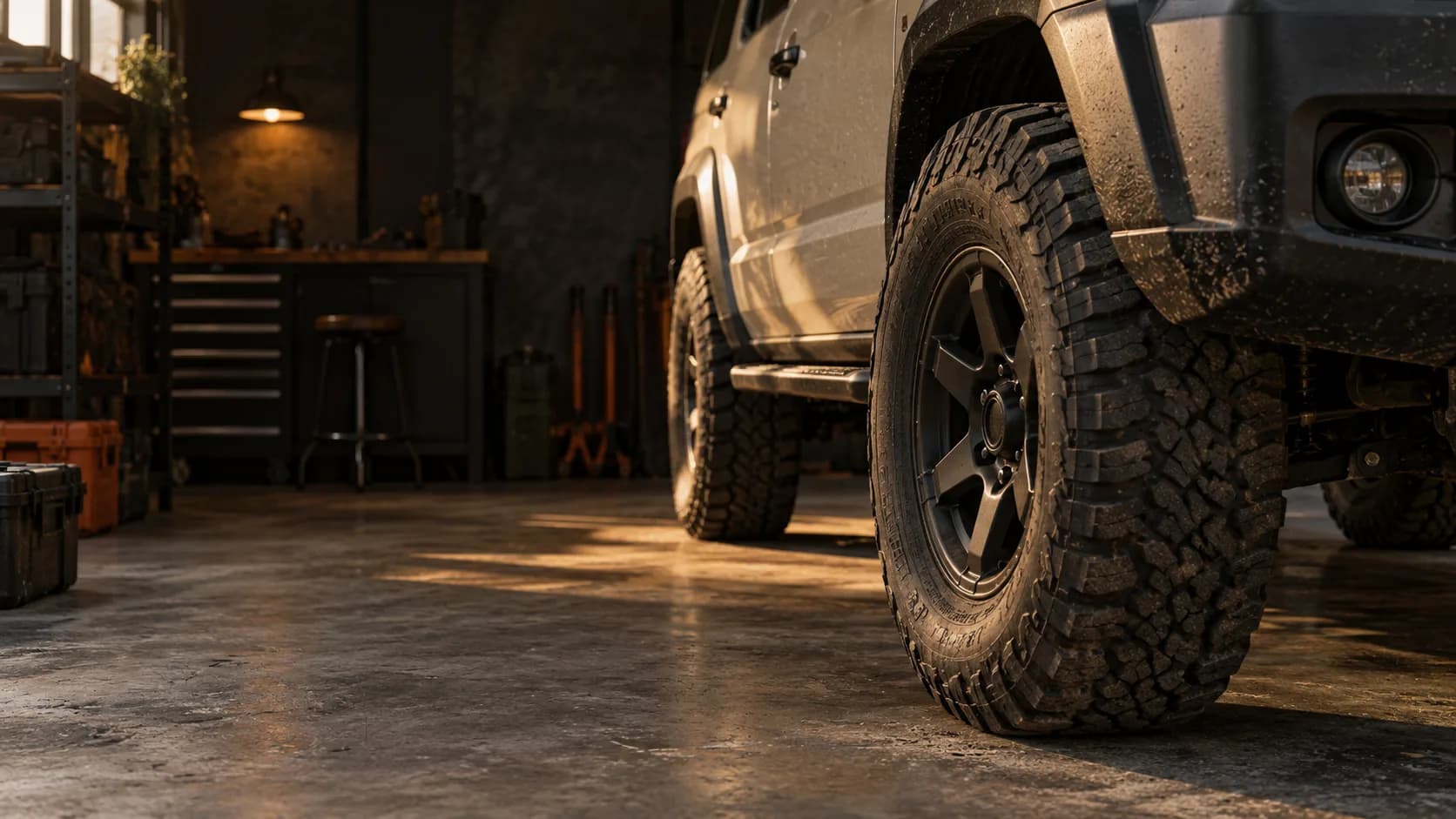
AI-generated representative scene
Quick answer
For most Indian 4x4s, a set of better shocks is the best first move — you feel it straight away. Add matched springs when you carry load, and a vehicle-tuned lift kit only when you genuinely want more clearance and travel. Tell the advisor your vehicle below and it matches a setup across 24 products and 24 brands.
Get a suspension recommendation in 10 seconds
No forms — tap how you driveWhy we recommend this
- The right springs and shocks for your load and terrain give a controlled, comfortable ride instead of a bouncy or saggy one.
- Good damping keeps the tyres planted, so you get more grip and confidence off-road.
- Matching the setup to your real use often beats simply lifting for the sake of height.
Things to consider
Cost
- A quality matched kit and fitting costs more than budget parts — but cheap spacer-led kits often ride worse and wear out fast.
- Heavy accessories may mean upgraded springs to carry them.
Trade-offs
- Firmer, load-rated setups can ride harder when the vehicle is empty.
- Bigger changes bring alignment, geometry and sometimes electronic recalibration work.
Common beginner mistakes
- Choosing height over the right spring rate for your load.
- Skipping alignment and wheel balancing after fitting.
- Using a steering damper to hide worn parts.
Legal
- Ride-height changes may need approval and affect insurance — verify before public-road use.
Choose your path
Start with guidance, compare options, or run the numbers. Your place stays visible.
Guided advisor
Which vehicle? (sets ladder-frame vs soft-roader)
Fitment and legality vary. Lifts, oversized tyres or wheel changes beyond manufacturer spec may require RTO/ARAI approval and an updated RC, must be disclosed to your insurer, and can affect warranty and roadworthiness. Verify with your RTO, insurer and a qualified fitter before modifying.
Suspension setups at a glance
From the cheapest capability win to a full lift — pick the row that matches how you drive.
Keep stock + better tyres
Cheapest winThe cheapest capability win for a mostly-tarmac 4x4.
Best for
- Mostly highway + light trails
- Budget-first builds
- Stock ride comfort
Avoid if
- You carry heavy loads and sag
- You want more clearance/travel
- Height change
- None
- Legality
- No mod
Refresh shocks
Upgraded gas shocks (monotube / foam-cell) — control without a lift.
Best for
- Tired OEM shocks
- Fade-free control on long trails
- Better composure when loaded
Avoid if
- You specifically need clearance
- Height change
- None
- Legality
- Low risk
Matched springs + shocks
Load-rated springs with matched dampers for constant weight.
Best for
- Bull bar / winch / drawers
- Overlanding with load
- Fixes rear sag
Avoid if
- Mostly empty city driving
- Height change
- Levels sag
- Legality
- Low–moderate
Full lift kit (2"+)
Max capabilityVehicle-tuned kit for real clearance, travel and bigger tyres.
Best for
- Bigger tyres + clearance
- Articulation on rock
- Serious trails
Avoid if
- Mostly city / budget builds
- Height change
- 2"+
- Legality
- RTO approval
Safety, ownership & compliance(install, alignment, legal & warranty)
Post-installation checks
- Re-torque suspension fasteners after roughly the first 500–1000 km, and again after major impacts or off-road trips.
- Get a professional wheel alignment immediately after any lift, spring or shock change, and ensure the wheels are correctly balanced after fitting new tyres or wheels to minimise vibration and steering issues.
- Where the manufacturer requires it, recalibrate steering angle sensors and driver-assistance systems (ESC/traction control/ADAS) after suspension modifications.
- Check brake hoses at full lock and maximum droop — they must not stretch, twist or contact moving parts.
- Check driveline angles (CV, propshaft, universals, diff) and investigate any new vibration immediately.
Geometry & steering
- Modifications can shift caster — adjustable control arms or caster plates restore self-centring.
- On solid-axle vehicles a lift can shift the axle; an adjustable panhard rod restores centring.
- Wrong wheel offset increases steering effort, bearing loads and tyre wear — verify compatibility.
- A steering stabiliser may reduce steering kickback and wander on lifted solid-axle vehicles with larger tyres, but should never be used to mask worn steering/suspension components or poor alignment.
Travel, springs & shocks
- Verify bump-stop clearance whenever changing tyre size or height to prevent rub, shock damage and coil bind.
- Articulation comes from shocks, arms, sway bars and geometry — not height alone.
- Match spring rate to your permanent load; select shock type for your use (daily comfort, heat resistance, touring, or extreme).
- If you tow regularly, base spring rates on your typical towing and payload (trailer/caravan/camping-trailer tongue weight), not on lift height alone.
- On independent (IFS/IRS) platforms, lift limits and geometry differ from solid-axle rigs — use components designed for your vehicle type.
Tyres, clearance & load
- Maximum tyre size depends on travel, offset, steering lock, bump stops and body clearance — verify through full lock and articulation.
- Suspension upgrades do not increase manufacturer-approved payload or GVM unless specifically certified — stay within legal weight limits.
- Correct pressures and the right tyres often deliver more real-world capability than a lift — prioritise them first.
- Check overall vehicle height after modifications — particularly with roof racks or a roof-top tent fitted — as it affects parking, ferries and low-clearance structures.
Maintenance & compliance
- Inspect bushes, ball joints and shocks regularly for wear, cracking or leaks; lubricate serviceable parts per the kit.
- Raising ride height beyond the manufacturer's specification generally requires regulatory approval — verify current RTO requirements and keep components within legal limits before public-road use.
- Disclose significant modifications to your insurer in writing — undisclosed modifications may void cover.
- Keep records of torque checks, alignments and inspections to support future warranty or insurance claims.
Informational guidance only — not professional advice or a safety guarantee. Follow your vehicle and component manufacturers' instructions, verify against current local regulations, and consult a qualified specialist for safety-critical work.
Where to next
Buy it · get it installed
Advanced technical notes — the complete India off-road suspension reference(deep dive)
The complete India off-road suspension reference
Off-road suspension for India — how travel, articulation & damping work; shock & spring types; load-carrying and lift; install, geometry and RTO/ARAI legality.
Key takeaways
- Articulation and wheel travel — not lift height — are the primary determinants of off-road capability. A 25 mm lift with quality long-travel progressive springs and matched monotube shocks outperforms a 100 mm lift with mismatched components.
- India's Motor Vehicles Act Section 52 makes any suspension modification beyond OEM specification subject to prior RTO approval and ARAI certification. There is no legally permitted DIY lift — and non-disclosure to your insurer voids all claims, including third-party liability.
- Spring rate and damper damping must be matched to each other and to your actual load. Progressive-rate coil springs are the best compromise for Indian vehicles that alternate between daily tarmac commuting and weekend off-road use.
- Stock suspension on India-market 4x4s typically degrades within 40,000–50,000 km under sustained pothole, corrugation, and monsoon conditions — earlier than European or Japanese highway use cases.
- Several reputable overland suspension makers offer kits with India availability for major platforms. Indicative kit pricing ranges from around ₹1,00,000 to ₹2,70,000 depending on vehicle, kit type (monotube gas vs. remote-reservoir), and supplier — confirm a current quote with an authorized dealer before purchasing. Prioritize kits that publish spring rates and damping curves for your specific variant.
- Every suspension lift — regardless of size — requires a professional four-wheel alignment including caster and camber correction, not just toe adjustment. Skipping alignment is the leading cause of uneven tyre wear, steering instability, and handling failures on lifted Indian vehicles.
- Remote-reservoir monotube shocks are not overkill for Indian Himalayan expeditions or full-day forest track driving — they are the minimum standard. Standard twin-tube shocks fade on sustained high-energy use, losing damping force precisely when terrain becomes most demanding.
What Is Off-Road Suspension — and Why India Is Different
Suspension is the system of springs, dampers, linkages, and bushings that connects your wheels to your chassis. Its job is deceptively simple: keep all four tyres on the ground over uneven terrain while isolating the cabin from shock. Off-road suspension takes that job to an extreme — it must cope with axle-twisting rocky trails, chassis-racking corrugations, and wheel-swallowing monsoon ruts, sometimes in the same 10-kilometre stretch.
India adds layers of complexity found nowhere else. Speed breakers range from 12 to 15 cm high with no warning. Western Ghats forest tracks alternate between river crossings and exposed bedrock. High-altitude Himalayan roads combine loose scree with sub-zero temperatures that stiffen rubber and thicken damper oil. Monsoon seasons saturate sub-bases and accelerate bushing degradation. And underneath all of it sits the Motor Vehicles Act, 1988 — which makes any suspension modification without RTO and ARAI approval technically illegal.
This guide covers every layer: the physics, the components, the legal framework, the India-specific brands and verified pricing, vehicle-specific factory baselines, and the decisions that separate a safe, capable build from an expensive mistake.
Suspension modifications directly change how your vehicle handles, brakes, corners, and resists rollover. A lift raises the centre of gravity; mismatched springs and dampers can cause loss of control; an incorrectly installed component can fail under load and cause a crash. Get suspension work done by a qualified 4x4 specialist, and have a professional four-wheel alignment performed afterward — this is not a job to learn on your own vehicle.
This guide is general educational information for India, not professional engineering, legal, or insurance advice. Specifications, prices, brand availability, and legal interpretations change and vary by state, vehicle, and source — verify every figure against the manufacturer, your installer, your RTO, and your insurer before acting. You alone are responsible for the legality, safety, and roadworthiness of any modification you make; you assume all risk.
Under the Motor Vehicles Act, 1988 — Section 52 (no alteration that varies from the manufacturer's original specification) and Section 190 / 182A (penalties for using an unsafe or non-compliant vehicle) — modifying suspension beyond OEM specification is restricted. The Supreme Court of India, in Regional Transport Officer v. K. Jayachandra (Civil Appeal Nos. 219–222 of 2019, 9 January 2019), held that owners may not alter a vehicle so its registered particulars differ from the manufacturer's original specification, and the Court noted that the Section 52 amendment was enacted to prohibit changes including tyres of higher capacity; structural lifts have no blanket exemption. Verify the full judgment text via indiankanoon.org or the official court record before relying on any specific citation.
Before any lift: obtain written Regional Transport Office (RTO) approval for your specific vehicle and modification (approval is discretionary and varies state to state), confirm whether Automotive Research Association of India (ARAI) certification is needed, and separately get your motor insurer to endorse the modification in writing on your policy. An undisclosed or unapproved modification can attract fines, vehicle seizure, and denial of insurance claims — including third-party liability. Verify the current rules with your RTO, insurer, and a 4x4 legal specialist; do not assume any lift is automatically road-legal. See the dedicated legality section below for detail.
Exact case citations and section numbers should be confirmed against the official text at https://morth.nic.in before you rely on them.
Every recommendation in this guide is filtered through three India-specific lenses: monsoon durability (sustained wet, corrosive conditions), load reality (overlanding gear + passengers on long-distance trips), and legal compliance (Motor Vehicles Act Section 52 + state RTO discretion). A setup perfect for Arizona desert trails may be dangerous or illegal here.
How Suspension Works: Travel, Articulation, and Damping
Three concepts govern off-road suspension performance: wheel travel, articulation, and damping. Confuse any one of them and your build will underperform or fail.
Wheel travel is the total vertical distance a wheel moves from full compression (bump) to full droop (extension). Coil-sprung suspensions typically deliver 250–350 mm (10–14 inches) of total travel; leaf-sprung systems manage 150–200 mm (6–8 inches). More travel means more time the tyre stays in contact with the ground over uneven terrain.
Articulation — sometimes called flex — is how independently each wheel can travel without lifting an opposite wheel. It is quantified by the Ramp Travel Index (RTI). High articulation keeps all four tyres planted on off-camber, undulating terrain. Coil-sprung solid axles and multi-link rear suspensions articulate dramatically better than leaf setups because leaf geometry restricts droop travel and risks axle-wrap under extreme flex.
Damping controls the speed at which your springs compress and return. Without damping, a spring stores energy and releases it violently, bouncing the vehicle. A damper (shock absorber) converts kinetic energy into heat through hydraulic fluid passing through calibrated valving. Compression damping controls how fast the wheel moves upward into the body; rebound damping controls how fast it returns. Getting these rates wrong — even with perfect springs — produces pogo bouncing, loss of traction, or a vehicle that feels rigid on tarmac and uncontrolled on trails.
Wheel rate — not spring rate — is what you actually feel. The formula: Wheel Rate = Spring Rate × (Motion Ratio)². A 400 lb/in spring with a 0.7 motion ratio delivers just 196 lb/in at the wheel. This is why spring rate labels alone are meaningless without knowing where the spring mounts relative to the suspension pivot.
Before comparing spring rates across different vehicles or kits, always calculate wheel rate. A 'heavy-duty' spring with a poor motion ratio can deliver a softer wheel rate than a 'standard' spring on a better-designed geometry. Ask your suspension supplier for the motion ratio of their kit, not just the spring rate.
Gaining articulation through longer springs or extended shackles is only step one. Drive-shaft angles, brake hose lengths, fuel tank clearance, and steering geometry all have hard limits. Ignore them and your newly flexible suspension will bind a CV joint, pull a brake line off its mount, or snap a steering drag link at the first major flex.
Shock Absorber Types: Twin-Tube, Monotube, and Remote-Reservoir
The shock absorber is the most performance-critical component in any suspension upgrade. Three design families cover the off-road market.
Twin-tube shocks are the most common and affordable. An inner tube houses the piston, base valve, and hydraulic oil; an outer tube acts as a reservoir for the displaced oil and low-pressure nitrogen. They are adequate for light off-road use and daily driving but suffer from aeration (oil and gas mixing) under prolonged hard use, causing fade — the damper momentarily loses damping force just when you need it most.
Monotube shocks use a single large-bore tube with a floating piston separating high-pressure nitrogen gas (commonly a few hundred psi — exact charge varies by model; verify against the manufacturer's spec) from hydraulic oil. With no secondary tube, the oil has more volume and far better heat dissipation. There is no aeration because oil and gas never contact each other. Monotubes respond faster to small-amplitude road inputs, making them superior on- and off-road. Several reputable overland suspension makers offer monotube gas units with India availability; confirm the correct part number for your vehicle variant with an authorized dealer.
Remote-reservoir shocks add a secondary oil chamber connected by a hose to the main body. The additional oil volume absorbs heat over extended, repeated high-energy impacts — the kind you encounter on a full day of Himalayan switchbacks or corrugated forest tracks. Remote-reservoir designs are always monotube-gas; you will not find a reservoir on a twin-tube design. Premium remote-reservoir monotube units from reputable overland suspension makers fall into this category and are available for major India 4x4 platforms through authorized dealers.
Shock Absorber Design Comparison
- Heat Dissipation
- 3
- Damping Control
- 4
- On-Road Comfort
- 6
- Off-Road Performance
- 4
- Fade Resistance
- 3
- India Availability
- 7
- Value for Money
- 8
Adequate for daily driving and mild trails; fades under sustained hard use. Budget-friendly.
- Heat Dissipation
- 7
- Damping Control
- 8
- On-Road Comfort
- 7
- Off-Road Performance
- 8
- Fade Resistance
- 7
- India Availability
- 6
- Value for Money
- 6
Best all-rounder for India: handles heat, potholes, and trail work without fade. Indicative pricing ₹50,000–₹1,20,000 per axle-pair as of 2025–2026 depending on kit and vehicle — confirm a current quote with an authorized dealer.
- Heat Dissipation
- 10
- Damping Control
- 10
- On-Road Comfort
- 6
- Off-Road Performance
- 10
- Fade Resistance
- 10
- India Availability
- 4
- Value for Money
- 4
Mandatory for sustained high-frequency use (Himalayan expeditions, rally). Harder to source in India; higher cost.
The India 4x4 community has documented real-world experience with several aftermarket monotube gas kits across the Jimny, Thar, Fortuner, and Hilux platforms. The main engineering trade-off to evaluate: kits tuned for off-road firmness may feel stiff on city tarmac, while road-biased valving may sacrifice damping capacity on sustained trail use. Ask any prospective supplier for the published spring rate, damping curve, and OEM compatibility data for your specific vehicle variant before purchasing. Kits that do not publish these specifications are harder to evaluate and carry higher selection risk. Indicative kit pricing for major India platforms ranges from around ₹1,00,000 to ₹1,60,000 as of 2025–2026 — confirm a current quote with an authorized dealer.
Spring Types: Coil, Leaf, Torsion Bar, and Air Helpers
Springs support the vehicle's weight and determine ride height. Each design type makes fundamentally different engineering trade-offs.
| Spring Type | Articulation | Load Capacity | Ride Quality | Adjustability | Durability (Monsoon) | India Vehicles |
|---|---|---|---|---|---|---|
| Coil Spring | Excellent (250–350 mm travel) | Good (requires HD rating for loads) | Best unloaded | Fixed — requires spring swap | Good with quality rubber mounts | Thar (all), Gurkha, Jimny, Fortuner (front) |
| Leaf Spring (mono/multi) | Limited (150–200 mm travel) | Excellent — self-locating axle | Harsh over sharp edges | Shackle length changes ride height | Moderate — susceptible to axle wrap | Gypsy, Hilux (rear), older Bolero |
| Parabolic Leaf Spring | Better than standard leaf | Very good | Improved over conventional leaf | Limited | Good — fewer inter-leaf friction points | Hilux (upgraded), older platforms |
| Torsion Bar | Limited — not suitable for extreme off-road | Adequate for factory loads | Adequate; degrades with age/heat | Easy field adjustment via anchor bolt | Fair — bars sag asymmetrically with age | Some older Pajero/Montero; not common in India new-gen |
| Air Helper Springs (load assist) | No travel added — overlay only | Adds load support (capacity varies by kit — verify the rating against the manufacturer's spec for your vehicle) | Pressure-adjustable within the kit's rated range | Fully adjustable; requires compressor | Fair — airlines fail in waterlogged terrain | Can be added to any existing system |
| Progressive Coil Spring | Excellent | Excellent — stiffens under load | Best of both worlds | Fixed rate — must choose grade | Good | Best choice for mixed daily/off-road India use |
Travel figures are approximate; exact values vary by vehicle and kit. Progressive coil springs are recommended for vehicles that alternate between daily commuting and weekend off-road use.
If you regularly carry a loaded rooftop tent, dual jerry cans, a winch, and four passengers, air helper springs add adjustable load support on top of your existing spring system. They are adjusted between a low minimum pressure (lightly loaded) and the kit's maximum rated pressure (full load) via a manual valve — always stay within the pressure range printed on the kit, and confirm the correct minimum/maximum for your specific bags with the manufacturer. Critical caveat for India: air lines and fittings corrode in waterlogged conditions. Run quality stainless lines and inspect every monsoon season. Verified India availability for 4x4 applications is limited as of 2026 — confirm with your supplier before specifying.
Choosing Your Suspension Upgrade: A Decision Framework
The most common suspension mistake in India is buying a lift kit because it looks aggressive, without first defining what problem is being solved. Use this decision tree before spending a rupee.
Off-Road Suspension Upgrade Decision Tree
What is your primary reason for upgrading suspension?
Be honest. Most Indian 4x4s see 80% tarmac and 20% off-road. That ratio should drive your choice.
Springs and Load: Calculating What You Actually Need
The single most common suspension mistake on Indian overlanding builds is selecting spring rate by guesswork — buying 'heavy-duty' because it sounds capable, then discovering the vehicle rides like a concrete block when empty or sags like a hammock when loaded.
Spring rate is expressed as force per unit of compression: 8 kg/mm means the spring compresses 1 mm for every 8 kg applied. To convert between units, 1 kg/mm is roughly 56 lbs/in (multiply kg/mm by about 56) — treat this as an approximate working figure, not an exact constant. To find your required spring rate, measure your actual corner weights on a calibrated scale (any truck weighbridge can do one-axle measurements). Add permanent load (winch, roof tent, fuel, recovery gear) to variable load (average passenger + supply weight). The result gives you the load each spring must carry; divide by target compression to find required rate. Have your installer confirm the rate selection — getting it wrong affects handling and safety.
Never skip corner-weight measurement. An imbalanced build — heavier left-front from a bull bar, heavier rear from a spare tyre carrier — requires different rates at each corner for the vehicle to sit level. Generic kits assume equal distribution.
| Load Profile | Typical Gross Load | Spring Type | Damper Match | India Use Case | Risk if Wrong |
|---|---|---|---|---|---|
| Light / Mostly Unloaded | 0–300 kg additional | Standard or slightly progressive coil | Standard monotube gas | Daily commute, occasional weekend trails | Heavy-duty spring gives harsh, bouncy empty ride |
| Medium / Occasional Overlanding | 300–600 kg additional | Progressive-rate coil (recommended) | Adjustable monotube or Nitro Gas | Weekend offroader + family camping | Light spring sags under gear; heavy spring uncomfortable empty |
| Heavy / Constant Overlanding Load | 600–1,000 kg additional | Heavy-duty rated coil or parabolic leaf (rear) | Remote-reservoir for sustained use | Full expedition, dual fuel tanks, roof tent, 4 adults | Underspringed = dangerous sag; overspringed = no road feel |
| Extreme / Towing + Off-Road | 1,000 kg+ | Air helper springs over existing coils OR heavy-duty leaf (rear) | Remote-reservoir mandatory | Towing a trailer + off-road nav | Without air helpers, rear squat + tail-swing on braking |
| Mixed Daily + Weekend Build | Varies widely | Progressive coil (best compromise) | Adjustable compression/rebound shocks | Most India 4x4 owners | No universal spring rate exists; must calculate per vehicle corner weight |
Always measure corner weights before selecting spring rates. These are guidance categories, not specifications.
A spring rated for constant 1,000 kg loads will transmit every road imperfection directly to the cabin when the vehicle is empty. If your build alternates between fully loaded expedition mode and daily commuting, progressive-rate coil springs are the only design that handles both without compromise. Specify this clearly to your supplier — do not accept a single linear-rate heavy-duty spring as a substitute.
Installation and Geometry: Doing It Right
A suspension upgrade that is installed incorrectly is worse than no upgrade at all. The steps below apply to a lift of 25–75 mm on a solid-axle or independent front suspension vehicle. Deviations from this sequence are how catastrophic failures start.
Suspension Upgrade Installation Process
Preparation
1Pre-Install Measurement and Documentation
Measure and photograph: current ride height at all four corners (tape from wheel centre to wheel arch), caster angle (inclinometer on steering knuckle), and toe measurement (track gauge). These baselines are your reference for post-install verification and RTO documentation.
Confirm all components are correct for your vehicle variant. Thar LX and MX have different suspension geometry; Fortuner models differ between years. Verify part numbers against your chassis number.
Setup
2Secure the Vehicle and Remove Wheels
Vehicle on level ground. Handbrake on, transmission in park, wheel chocks on the tyres you are not working on. Jack from manufacturer-specified jacking points only; never under a control arm, leaf spring, or diff housing. Use axle stands rated for vehicle weight before any person goes beneath.
Never work under a vehicle supported only by a floor jack. Axle stands are mandatory, not optional.
Disassembly
3Remove Factory Springs and Shocks
Photograph the factory setup before disassembly — specifically brake line routing, ABS sensor wire paths, and bump stop position. These will not be in the aftermarket instructions. On coil spring suspensions, use a proper spring compressor — never remove a coil spring under tension without one.
On leaf spring suspensions: support the axle independently before unbolting U-bolts. The axle drops under its own weight when the springs are free; an unsupported axle will damage brake hoses and ABS wiring.
Installation
4Install New Springs and Shocks
Mount shocks first to the lower bracket, then seat springs. Torque all fasteners to the manufacturer's specified values — not to feel, not to 'tight enough.' Use thread-locking compound on bolts that enter aluminum or where the kit specifies it.
Route brake lines and ABS sensor wires in the same path as factory — or longer OEM-equivalent lines if the kit includes them. A brake line that is too short and gets yanked at full droop is a trail emergency waiting to happen.
Re-install bump stops at the correct height for your new spring length. Incorrectly positioned bump stops allow the suspension to bottom out against the chassis or over-extend joints at full droop.
Torque
5Torque All Fasteners with Suspension at Ride Height
Many suspension fasteners must be torqued with the suspension at ride height (vehicle weight on the wheels), not in the air. Torquing in the air pre-loads bushings in a twisted position; when the vehicle settles, the bushing tears. Lower the vehicle onto its wheels before final torque.
Check: all spring perch retaining clips seated, shock upper and lower mounts secure, sway bar end links at correct length for new ride height.
Torquing rubber bushing fasteners with the wheels in the air is the single most common installation error. Bushings premature-fail within months.
Verification
6Immediate Post-Install Check
Re-measure ride height and compare to targets. Tyres must clear the wheel arch at full steering lock. With an assistant turning the wheel lock-to-lock, watch for tyre contact with the body, control arms, and sway bar. Any contact is a stop-and-fix before driving.
Check driveshaft angles: a lifted vehicle with sharp driveshaft angles at the CV or universal joint will vibrate and wear joints prematurely. A straightedge or phone inclinometer confirms the angle is within manufacturer-safe limits.
Alignment
7Professional Four-Wheel Alignment
Book a four-wheel alignment at a specialist 4x4 centre, not a standard tyre shop. You need camber, caster, and toe corrected — not just toe-in, which is the only thing most Indian service centres adjust. Camber error causes one-sided tyre wear; caster error causes steering instability at speed.
For lifts over 50 mm: confirm with the shop that they will measure and adjust caster, and that they have a way to do so on your vehicle (may require adjustable radius arms or eccentric bolts).
No Indian standard tyre shop has the equipment or training for 4x4 caster correction. Find a specialist with documented 4x4 alignment experience, or get a referral from the kit supplier.
Break-In
8Break-In and Re-Torque at 50–100 km
New springs and shocks settle slightly in the first 50–100 km. Drive normally — no off-road — for this distance, then re-torque every suspension fastener. This is documented practice in reputable suspension kit installation guidelines. Skipping it has caused suspension component failures on Indian trails within days of installation.
Re-check ride height after break-in. Some spring settling is normal; excessive sag (more than 5–10 mm drop from target height) means the spring rate was too soft for the load. Manufacturer break-in and re-torque procedures are documented in kit installation guides — follow them precisely.
India Legality: RTO, ARAI, and Your Insurance Policy
India's legal framework for vehicle modifications is strict, and suspension upgrades sit squarely within its scope. Understanding the rules is not optional — an illegal modification can void your insurance in an accident, attract fines, or get your vehicle seized.
Section 52 of the Motor Vehicles Act, 1988 prohibits any alteration to a vehicle that deviates from the manufacturer's specifications. In theory an alteration needs Regional Transport Office (RTO) approval — and, for major structural changes, Automotive Research Association of India (ARAI) certification — but for a private owner that pathway is, in practice, very narrow: the Supreme Court of India, in Regional Transport Officer v. K. Jayachandra (Civil Appeal Nos. 219–222 of 2019, 9 January 2019), held that owners may not alter a vehicle so its registered particulars differ from the manufacturer's original specification; the Court noted that Section 52 was amended specifically to prohibit changes including tyres of higher capacity, and mass-market suspension lift kits do not generally carry ARAI homologation. Treat any lift as legally non-compliant unless your RTO explicitly approves it in writing — do not assume it can be made road-legal. Verify the full judgment and current statutory text via the official court record or https://morth.nic.in before relying on any specific citation.
Penalties are governed by provisions including Section 182A (use of a vehicle in contravention of construction/maintenance standards) and Section 190 (use of a vehicle in an unsafe condition) — typically in the order of ₹5,000 for a first offence and up to around ₹10,000 for repeat or aggravated offences; confirm current amounts, which are periodically revised, against the official Act. Vehicle registration may also be suspended or cancelled under Section 53. Worse: if you are in an accident with an unapproved, undisclosed modification, your insurer can legally deny all claims — including third-party liability.
Body lift kits are explicitly prohibited. Suspension lift kits are in a legal grey zone — no numerical lift limit is published in law. RTO approval is case-by-case, state-by-state, and discretionary. A lift approved in Maharashtra may be denied in Karnataka. If you relocate your vehicle to another state, reapply.
| Action Required | When | Who Does It | Consequence of Skipping |
|---|---|---|---|
| Written RTO approval application with engineering documentation | BEFORE installation begins | Vehicle owner + 4x4 specialist prepares docs; RTO regional office approves | Modification is illegal regardless of quality; ₹5,000–₹10,000 fine; seizure risk |
| ARAI certification (if significant structural change) | Before RTO approval step | ARAI-certified testing lab | RTO cannot legally approve without it for major changes |
| Written endorsement from motor insurer | BEFORE driving the modified vehicle | Your insurance company; requires RTO approval document | Insurance claim denial — including third-party liability — in any accident |
| Update vehicle fitness certificate (RC) | After RTO approval and installation | RTO regional office | Vehicle deemed unfit; insurance and registration invalid |
| Re-submission if relocating to another state | Before permanent re-registration in new state | New state RTO | State-specific enforcement may reject the previous state's approval |
These are minimum legal steps. A 4x4 legal specialist or the kit supplier's documentation team can assist with RTO paperwork in major cities.
Even if your RTO approves a lift, your insurer must separately endorse the modification in writing on your policy document. Verbal acknowledgment is not sufficient. Non-disclosure — even of a 'small' 25 mm lift — is legal grounds for claim denial if discovered post-accident. Get the endorsement in writing before the vehicle leaves the workshop.
Ride and Handling Trade-Offs: What You Actually Give Up
Every off-road suspension upgrade that improves trail capability degrades something else. These are not marketing failures — they are physics. Understanding them prevents buyer's remorse and unsafe driving.
Ride height and centre of gravity are directly linked. Lifting a Thar by 50 mm raises its centre of gravity by approximately the same amount while leaving the track width unchanged. The result is increased body roll during cornering and a higher yaw moment during emergency lane changes on wet tarmac — exactly the conditions you encounter on a monsoon night on the Mumbai-Pune Expressway.
Stiffer springs, while necessary for load-carrying, reduce the absorption of small-amplitude inputs. A vehicle optimized for rocky trails with stiff springs will transmit more road noise and harshness on smooth tarmac. Progressive-rate springs are the only design that meaningfully manages this trade-off.
Mismatched damping compounds all of these issues. Stiff springs with soft shocks produce a bouncing, poorly controlled ride on both road and trail. Soft springs with overly stiff dampers produce a harsh, jarring response that fatigues driver and damages cargo.
Unsprung mass — the combined weight of tyres, wheels, hubs, brakes, and axle shafts — affects how quickly a wheel responds to terrain change. Heavier aftermarket wheels (for style) increase unsprung mass and reduce the suspension's ability to follow terrain, partially cancelling the gain from better springs and shocks.
| Modification | Off-Road Gain | On-Road Loss | Mitigation |
|---|---|---|---|
| Lift 25–50 mm | Clearance, mild articulation gain | Slightly higher CoG; minor body roll increase | Sway bar upgrade; matched progressive spring |
| Lift 50–75 mm | Significant clearance, better approach angle | Noticeably higher CoG; steering sensitivity change; requires caster correction | Adjustable radius arms; sway bar disconnects; geometry alignment |
| Heavy-duty springs (linear rate) | Load carrying, less sag under gear | Harsh on-road when unloaded; high-frequency vibration transmission | Use progressive-rate springs instead; match damper rebound to spring rate |
| Remote-reservoir shocks | Fade-free sustained performance; precise damping | Higher unsprung weight; potential harshness if valved too firm for road | Request road-biased valving if primary use is tarmac with occasional off-road |
| Larger tyres (accompanying lift) | Better flotation, traction, approach angle | Heavier unsprung mass; reduced acceleration; potential ABS recalibration needed | Balance tyre weight against diameter gain; recalibrate speedometer |
| Sway bar disconnect | Maximum articulation on trail | Excessive body roll on fast tarmac corners; not safe for road driving disconnected | Only disconnect on trail; reconnect before any tarmac section |
Factory Suspension Specs and Upgrade Paths by Vehicle
Each vehicle in the India off-road ecosystem has a different factory baseline and a different upgrade ceiling. Knowing your starting point prevents buying a kit designed for different geometry.
| Vehicle | Factory Ground Clearance | Factory Spring Type | Factory Shock Type | Recommended Upgrade | Kit Type (India) | Indicative India Price Band |
|---|---|---|---|---|---|---|
| Mahindra Thar (2020+) | 219–226 mm | Coil front + multi-link coil rear | Twin-tube OEM | Monotube gas or remote-reservoir with progressive springs | Monotube gas kit / remote-reservoir kit | ₹1,00,000–₹1,35,000 per kit (indicative, 2025–2026); confirm current quote with an authorized dealer |
| Force Gurkha (2021+) | 210 mm (approx) | Coil front + multi-link coil rear | OEM twin-tube | Monotube gas shocks + HD coil springs; manual locks already standard | Verify with specialist — limited documented kits | Unverified — obtain written quote |
| Maruti Suzuki Jimny (2023+) | 210 mm | Coil all-round (rigid front/rear axle) | OEM twin-tube | Monotube gas kit; community experience favours road-biased valving for city-heavy use | Monotube gas kit (multiple suppliers — verify fitment for your variant) | ₹1,00,000–₹1,30,000 per kit (indicative, 2025–2026); obtain a current quote from an authorized dealer in your city |
| Maruti Gypsy (MG410) | 205 mm (approx) | Leaf spring all-round | OEM twin-tube | Composite mono-leaf (4 variants: Soft/Off-road/Race/Military) + nitro-gas shocks | Aftermarket mono-leaf springs + monotube gas shocks | ~₹20,000–₹30,000/set (shocks); spring kit varies — confirm with supplier |
| Toyota Fortuner (2016+) | 220–225 mm | Independent double-wishbone (front coil) + rear axle | OEM twin-tube | Remote-reservoir or monotube gas front; match with HD rear springs for overlanding | Monotube gas kit / remote-reservoir kit | ₹1,20,000–₹1,60,000 per kit (indicative, 2025–2026); confirm current quote with an authorized dealer |
| Toyota Hilux (India) | 190 mm | Double-wishbone front + leaf spring rear | OEM twin-tube | Parabolic leaf upgrade (rear) + monotube front; leaf better for constant Hilux load profile | Monotube gas front kit + parabolic leaf rear | ₹2,00,000–₹2,70,000 per kit (indicative, 2025–2026); confirm current quote with an authorized dealer |
| Mahindra Scorpio-N (2022+) | 180–200 mm (approx) | Wishbone front + multi-link coil rear | OEM twin-tube | Monotube gas replacement shocks for daily improvement; lift requires specialist | Limited documented kits — verify with specialist | Unverified — obtain written quote |
Price bands are indicative for 2025–2026 based on publicly reported kit pricing; exact costs vary by variant, city, and supplier. Always obtain a written quote from an authorized dealer before purchase. Prices for suspension components change — do not rely on this table for purchasing decisions.
The Hilux's rear leaf spring is load-designed for its commercial-use DNA. Replacing it with coils for articulation gains requires a full axle-location redesign (coils do not locate the axle laterally). Upgrade parabolic leaf springs instead — they improve articulation and comfort while retaining the load-carrying geometry the Hilux was engineered for. Coil conversion on the Hilux rear is a major fabrication project, not a bolt-on kit.
25 Suspension Mistakes That India Off-Roaders Make
These are not theoretical — they are sourced from documented build failures, forum reports, and the consequences of cutting corners in a market where specialist knowledge is scarce.
| # | Mistake | Why It Happens | Consequence | Fix |
|---|---|---|---|---|
| 1 | Buying a lift kit before defining the actual problem | Social media builds look appealing | Solved nothing; spent ₹1,00,000+ | Diagnose first: worn stock vs. genuine need for lift |
| 2 | Skipping wheel alignment post-lift | Cost-saving; 'seems fine' | Uneven tyre wear, steering pull, bump steer, crash risk | Mandatory full four-wheel alignment within 50 km |
| 3 | Not disclosing modification to insurer | Unawareness of requirement | Total claim denial in accident | Written insurer endorsement before driving |
| 4 | Using stiff linear-rate springs on a daily driver | 'Heavy-duty' sounds better | Bone-jarring empty ride; every pothole felt at full force | Specify progressive-rate for mixed use |
| 5 | Torquing suspension fasteners with wheels in the air | Mechanic habit from engine work | Bushing tears within weeks under load | Torque all rubber-bushing fasteners at ride height (vehicle on ground) |
| 6 | Mismatched spring rate and damper valving | Buying springs and shocks from different suppliers without cross-referencing | Pogo bounce, loss of traction, unstable braking | Buy matched kit or verify damper spec with spring supplier |
| 7 | Skipping the 50–100 km re-torque | Not mentioned by generic workshops | Fastener loosening on first off-road trip; component failure | Re-torque every suspension bolt at 50–100 km post-install |
| 8 | Ignoring brake line length on lifted axles | Not visible in the workshop | Line pulls out at full droop, total brake failure on trail | Check brake line slack at full droop; install extended lines if needed |
| 9 | Installing a body lift instead of suspension lift | 'Cheaper and same look' | Illegal under Motor Vehicles Act; dangerous shift in CoG without spring support | Body lifts are prohibited; use suspension lift only |
| 10 | Buying grey-market suspension shocks from online marketplaces | Price savings look significant | Counterfeit product; no warranty; incorrect valving; failure on trail | Buy from authorized Indian dealers only; request a purchase receipt and warranty document |
| 11 | Overlooking caster correction on lifts over 50 mm | Most workshops only adjust toe | High-speed steering wobble; 'death wobble' on potholes | Adjustable radius arms or eccentric offset bushings |
| 12 | Installing oversized tyres without considering unsprung mass | Bigger looks more capable | Heavier wheel = worse terrain following; partial suspension upgrade cancelled | Balance tyre size gain against weight gain; lighter alloy over steel |
| 13 | Lifting Gypsy with only extended shackles (no shock upgrade) | Cheapest lift option | Shackle inversion risk; shock runs out of travel at top; bottoms out | Always pair shackle lift with matching shock length |
| 14 | Ignoring differential breather tube routing after lift | Not in standard suspension kit instructions | Water ingestion into diff on river crossings; gear oil contamination | Extend breather tubes above potential waterline after lift |
| 15 | Not accounting for permanent overlanding gear in spring rate selection | Only calculate person weight | Vehicle sags with winch + tent + dual tanks + 4 adults on long trips | Measure corner weights fully loaded; specify spring rate accordingly |
| 16 | Using cheap Chinese-sourced universal shocks | Available for ₹2,000–₹5,000 per set online | Incorrect damping curve; seal failure in monsoon; no fade resistance | Minimum standard: reputable monotube gas unit from documented supplier |
| 17 | Attempting leaf spring re-arch at local spring shop | 'Cheaper than new springs' | Inconsistent arch; weakened steel from poor heat treatment; fatigue failure | Replace springs; never re-arch for off-road use |
| 18 | Not checking tyre-to-body clearance at full steering lock post-lift | Only checked straight-ahead | Tyre contacts body at full lock; damages tyre, body, and steering on first sharp turn | Test lock-to-lock with full suspension compression and passenger weight |
| 19 | Installing sway bar disconnects without reconnecting before tarmac | Forgot after trail section | Extreme body roll on tarmac corners; rollover risk on emergency swerves | Connect sway bars before any tarmac driving; mark this in your trail checklist |
| 20 | Assuming the same lift works on both Thar variants (MX and LX) | One kit bought from forum member | Different geometry between variants; incorrect geometry on one | Verify part numbers against chassis number and variant code |
| 21 | Not rustproofing suspension components after monsoon off-road | Not budgeted | Corrosion of shock bodies, spring perches, and fasteners within one monsoon season | Anti-rust spray on all exposed metal; anti-seize on bolt threads annually |
| 22 | Confusing struts and shocks when sourcing replacements | Both described as 'shock absorbers' | Wrong component sourced; strut spacer on a shock-based vehicle or vice versa | Identify whether your vehicle uses a strut (structural) or shock (non-structural) design |
| 23 | Running the same tyre pressure on-road and off-road after a lift | No one mentioned pressure change | On-road: sidewall damage risk on large tyres; off-road: reduced footprint on rocks | Learn tyre pressure management: lower for off-road flotation, restore for tarmac |
| 24 | Not verifying ABS sensor wire clearance at full droop | ABS wire not part of suspension kit | Wire stretches and pulls connector off wheel speed sensor; ABS and traction control fail | Check ABS wire at full droop; cable-tie to new routing if needed |
| 25 | Assuming independent suspension articulates as well as solid axle with same lift | Not explained by suppliers | Disappointed with Fortuner flex vs. Gypsy or Thar solid-axle flex despite same lift | IFS has geometric limits; solid axle is inherently more flexible at equal travel |
Expert Tips from India Off-Road Veterans
These tips reflect best practices observed across long-term ownership discussions, installer experience with reputable aftermarket kit fitments, and specialist practice in the Indian 4x4 community. Specific threads and installation records are not individually cited; treat them as community-aggregated guidance, not a single verifiable source.
Suspension does not operate in isolation. Before you specify a lift, plan the downstream list: tyre size change (and speedometer recalibration), extended brake lines, differential breather rerouting, driveshaft angle check, sway bar link length, bump stop position, and steering geometry. A specialist who cannot discuss all of these together is not equipped to plan your build.
After installation and alignment, ask your alignment shop for a printed spec sheet showing pre- and post-alignment values for camber, caster, and toe at all four corners. Store this in your vehicle. If you ever have a trail impact or alignment check at a new shop, this document gives the target values for your specific build, not the OEM defaults which no longer apply after a lift.
Before every monsoon season in India: inspect rubber bushings for cracking or extrusion; check shock shaft seals for weeping oil; tighten all suspension fasteners to spec; apply fresh rust-proofing spray to exposed metal; check differential and gearbox breather tubes are clear and correctly routed. What passed inspection in October may be compromised by June.
Premium monotube gas shocks are available in India through authorized dealers. Grey-market imports from online marketplaces carry a significant counterfeit risk — units with standard twin-tube internals inside branded housings have been documented in the India market. The price differential between an authorized dealer and an online marketplace is the cost of knowing what you actually installed. Always request a purchase receipt and a manufacturer warranty document.
At high Himalayan altitudes (3,000–5,000 m), ambient air pressure drops appreciably (roughly 30–40% lower than sea level at 5,000 m). Twin-tube gas-assisted shocks rely on a low-pressure nitrogen charge in the outer reservoir — typically 5–15 psi — to suppress aeration; reduced ambient pressure changes the pressure differential across the outer chamber and may subtly alter effective damping at extreme elevation. Monotube shocks, whose internal nitrogen charge is sealed at much higher pressure (commonly 150–250 psi, though exact values vary by model — verify against the manufacturer's spec), are far less sensitive to ambient pressure changes. If you regularly operate at altitude on extended Himalayan expeditions, monotube or remote-reservoir shocks offer more consistent damping performance. The effect is subtle for most riders but real in principle (lower ambient pressure reduces the net containment force on the outer-chamber gas in a twin-tube design).
Suspension Myths and Facts
Suspension advice in India 4x4 circles is full of received wisdom that does not survive engineering scrutiny. Here is what the verified research actually shows.
Off-Road Suspension: 10 Myths Debunked
Myth: More lift always means better off-road performance.
Fact: Lift improves approach/departure angles and ground clearance, but articulation — not lift height — is what keeps tyres on ground over rocky terrain. A 25 mm lift with long-travel progressive springs and quality shocks outperforms a 100 mm lift with mismatched components. Excessive lift raises centre of gravity and worsens on-road stability.
Myth: Heavy-duty springs are always better for off-road.
Fact: Springs must match the load they carry. Linear-rate heavy-duty springs on an unloaded vehicle transmit every road input directly to the cabin. Progressive-rate springs that stiffen under load are superior for any vehicle that alternates between loaded and unloaded use.
Myth: Gas-charged shocks are always stiffer and harsher than standard oil shocks.
Fact: Gas charge (nitrogen) in a monotube shock prevents aeration and maintains consistent damping — it does not directly stiffen the ride. Harshness is determined by the damping curve (valving), not the presence of gas. A correctly valved monotube gas shock can ride significantly softer than a worn twin-tube OEM shock.
Myth: Leaf springs are obsolete for off-road use.
Fact: Leaf springs still dominate commercial-grade off-road platforms (Hilux, older Bolero) because they provide both spring function and axle location in one component. Parabolic leaf springs improve articulation significantly. For constant heavy-load use, leaf springs outperform coil setups that require separate axle-location components.
Myth: A small lift (25 mm) does not require a wheel alignment.
Fact: Any change to ride height alters suspension geometry. Even a 25 mm lift shifts caster and toe slightly. Skipping alignment after any lift — however small — causes asymmetric tyre wear and subtle handling degradation that accumulates over thousands of kilometres.
Myth: Body lift kits are a safe, cheap alternative to suspension lifts.
Fact: Body lifts are explicitly illegal under the Motor Vehicles Act and ARAI rules. They raise the body without raising the suspension, increasing the gap between body and suspension components and creating torsional stress points. They provide no improvement in wheel travel, articulation, or ground clearance under the axles.
Myth: If the RTO in one state approves my lift, it is valid everywhere in India.
Fact: RTO approval is state-specific and discretionary. No national standard exists for approved lift heights. A vehicle with a Maharashtra RTO-approved 75 mm lift can be stopped and penalized by a Karnataka traffic officer enforcing their interpretation of Section 52. Re-registration in a new state requires re-approval.
Myth: Remote-reservoir shocks are only for rally cars and extreme off-road — overkill for normal use.
Fact: Remote-reservoir shocks benefit any vehicle that spends sustained hours on corrugated tracks, repeated mountain switchbacks, or repeated high-energy impacts. The Himalayan expedition use case is common for Indian 4x4 owners. If your off-road use involves a full day of rough terrain, standard shocks will fade by afternoon. Remote-reservoir shocks maintain performance throughout.
Myth: Larger tyres improve suspension performance.
Fact: Larger tyres improve flotation and approach angle, but they increase unsprung mass, which reduces the wheel's ability to follow terrain changes quickly. Combined with a lift kit, larger tyres also change speedo calibration, ABS thresholds, and may void OEM drivetrain warranties. The tyre size decision is separate from the suspension upgrade decision.
Myth: New shock absorbers from online marketplaces are the same as from authorized dealers.
Fact: Counterfeit premium shock absorbers have been documented in the India grey market. These use inferior twin-tube internals in branded housings, with incorrect valving for the vehicle application. There is no way to verify authenticity without cutting the unit open. Source only from documented authorized Indian dealers with purchase receipts and manufacturer warranty documentation.
Frequently Asked Questions
These questions represent the most common uncertainties from Indian 4x4 owners across the Thar, Jimny, Fortuner, Gypsy, and Hilux communities.
Off-Road Suspension FAQ — India
What is the legal lift limit in India under the Motor Vehicles Act?
No numerical limit is stated in the Motor Vehicles Act, 1988 or RTO guidelines. Lift approval is case-by-case and state-by-state, based on the RTO's assessment of structural risk, centre-of-gravity change, and insurance compliance. This legal ambiguity means a lift approved in one state may be rejected in another. Always consult your regional RTO before installation.
Does a 25–50 mm lift require RTO approval?
Technically, any suspension modification beyond OEM specification requires RTO approval under Section 52. In practice, small lifts (25–40 mm) using offset bushings with no other chassis change are widely fitted in India, but the legal status depends on your state RTO's interpretation. For safety: obtain written acknowledgment from your RTO and a written endorsement from your insurer before driving the modified vehicle.
Will my insurance be void if I have an aftermarket suspension?
Yes — if you did not disclose the modification to your insurer in writing, and they discover it during an accident investigation, your claim (including third-party liability) can be denied entirely. Written endorsement on your policy document is mandatory before driving a modified vehicle, separate from RTO approval.
How do I choose the right aftermarket suspension kit for my vehicle?
The key evaluation criteria are: (1) published spring rate and damping curve for your specific vehicle variant — kits that do not publish these are harder to select correctly; (2) valving bias — off-road-biased kits may feel stiff on daily city tarmac, while road-biased kits may fade on sustained trail use; (3) authorized India availability with warranty support. India 4x4 community experience broadly shows that kit valving matters as much as brand; a well-matched road/trail-balanced monotube kit outperforms a mismatched one regardless of name. Verify the specific kit for your vehicle variant and use case with a specialist before purchasing.
How often does stock suspension need replacement under Indian conditions?
Stock suspension on European or Japanese highway-tuned platforms typically degrades within 40,000–50,000 km under sustained Indian use (potholes, corrugations, monsoon ruts). Symptoms: excessive bounce, nose-diving under braking, vehicle leaning on corners, or hearing clunks over speed breakers. If you are under 40,000 km with these symptoms, check for specific failed components before replacing the entire system.
Can I install a suspension lift myself at home?
Spring removal from a coil suspension requires a proper spring compressor — without it, a released spring can cause fatal injury. Beyond the tool requirement, post-install alignment requires workshop equipment (alignment rack, angle gauges, turn plates). Unless you have these tools and training, professional installation is mandatory, not optional. DIY assembly errors are the leading cause of suspension component failures on Indian off-road trips.
What is the difference between a coilover and a separate spring-and-shock setup?
A coilover is a single unit where the coil spring wraps around the shock absorber body, with the spring seated on perches attached to the shock body. A separate spring-and-shock setup uses independent components — the spring sits on dedicated perches on the control arm or axle housing, and the shock attaches to separate mounting points. Coilovers allow ride height adjustment by threading the lower spring perch up or down the shock body. Separate setups are simpler and more common on solid-axle 4x4s.
Do I need to upgrade my brake lines when I lift?
Check first. At the new lifted ride height, measure your brake hose slack at full droop (wheel at maximum extension). If there is less than 15–20 mm of slack remaining, you need extended brake hoses. A brake line that is too short and pulls out a fitting at full droop on a trail results in total loss of rear or front braking. Many lift kits include extended brake lines; verify this before buying.
What is the difference between compression damping and rebound damping?
Compression damping controls the speed at which the shock absorber compresses (wheel moves up toward the body — hitting a bump). Rebound damping controls the speed at which it extends back (wheel returns to ride height after the bump). Too little compression damping = vehicle dives and squats violently. Too little rebound damping = wheel bounces back too fast, losing ground contact. Adjustable shocks let you tune both independently for your terrain and load.
What should I look for in any aftermarket kit before buying?
Before purchasing any aftermarket suspension kit, request from the supplier: (1) published spring rate in kg/mm or lbs/in for your specific vehicle variant; (2) the damping curve or at minimum a description of the compression and rebound valving character; (3) OEM compatibility confirmation against your chassis number. Kits that cannot provide spring rate and damping data are difficult to evaluate and carry higher selection risk. Also confirm the supplier offers documented India warranty support. Indicative kit pricing for major 4x4 platforms ranges ₹80,000–₹1,60,000 as of 2025–2026 — confirm a current quote before deciding.
Should I replace my Gypsy leaf springs or use extended shackles?
Extended shackles alone provide up to 50 mm of lift on the Gypsy but increase the effective swing radius of the rear leaf pack, risking shackle inversion under extreme articulation. For off-road use, composite mono-leaf spring replacement kits (available in Off-road and Race/Rally variants from several aftermarket suppliers) are preferable — they improve articulation and maintain correct geometry. Always pair any Gypsy spring change with matching-length nitro-gas shocks; confirm current pricing with your chosen supplier as figures vary.
How do I know if my suspension bushings need replacement?
Symptoms of worn bushings: clunking or squeaking over speed breakers or on slow manoeuvres; imprecise steering with vague centre feel; vehicle pulling under braking. Physical signs: visible cracking, tearing, or extrusion of rubber from the bushing housing; or visible play (rocking movement) in control arm or sway bar link with the wheel suspended. Inspect annually; in monsoon-heavy regions (Western Ghats, Northeast India), inspect every 6 months.
What is a torsion bar and can I adjust it for more lift?
A torsion bar is a spring made from a twisted steel rod, used in some older 4x4 platforms. The anchor bolt at the rear of the bar can be rotated to increase ride height — this is why people say 'crank the torsion bars.' However, cranking beyond a small amount reduces suspension travel (the bar runs out of usable twist range), shortens the torsion bar's life, and does not count as an approved modification under RTO rules. Modern Indian 4x4s (Thar, Gurkha, Jimny) do not use torsion bars.
What happens to driveshaft angles after a suspension lift?
Lifting the body and suspension while the differential and transfer case remain at their original position increases the operating angle of front and rear driveshafts at the CV or universal joints. Excessive U-joint operating angle (typically over 3–4 degrees more than factory) causes vibration, premature joint wear, and eventually joint failure. On vehicles with independent front suspension (Fortuner), this is more critical and may require a drop bracket for the front differential.
Can I use air helper springs on my Thar or Fortuner?
Air helper springs can in principle be fitted to any coil- or leaf-sprung vehicle with sufficient space between frame and suspension. They work as an overlay — adding load capacity on top of your existing springs, not replacing them. For India use: corrosion resistance of the airlines and fittings is critical in monsoon regions. Verified India availability for Thar/Fortuner specific fitments is limited as of 2026 — confirm with a specialist before specifying.
What is 'fade' in a shock absorber and when does it happen?
Shock absorber fade occurs when the hydraulic oil overheats under sustained heavy use (multiple descents, repeated high-speed impacts over long distances). Hot oil becomes less viscous, reducing damping force — the shock stops doing its job. This is most pronounced in twin-tube designs where oil volume is limited. On a full-day Himalayan descent or a long run of corrugated forest track, a faded shock feels like the suspension becomes loose and uncontrolled despite the springs remaining functional. Remote-reservoir and monotube designs dissipate heat more effectively, reducing or eliminating fade.
My vehicle passed its annual fitness certificate with a lift kit installed. Does that mean the modification is legal?
Not necessarily. Fitness certificate inspections in India check safety-critical items (lights, brakes, horn, tyre condition) but often do not assess whether suspension modifications comply with Section 52. Passing a fitness inspection does not constitute RTO approval of a modification. You still need a separate written RTO endorsement specifically approving the suspension change.
Emergency Scenarios: Suspension Failures on the Trail
Suspension failures in remote terrain require calm, systematic responses. Knowing the correct immediate action before it happens is the difference between a recoverable situation and a dangerous one.
Trail Suspension Emergency Guide
Broken Shock Absorber on Trail
Symptoms
- Sudden change in vehicle stance — one corner sits lower than normal
- Rhythmic bouncing from one corner that does not dampen after a bump
- Audible clunk or bang followed by loose, floaty feeling from one corner
- Visible oil leak from shock body or shaft seal
- Wheel appears to move excessively or hang at an unusual angle
Do immediately
- Stop the vehicle on the flattest available ground. Do not continue driving — a failed shock transfers full impact loads to springs, linkages, and control arms, risking secondary failures
- Visually inspect the failed shock: is it the body, the shaft, or the mount? This determines repairability
- If the shock mount (top or bottom) has sheared, the wheel position is now uncontrolled — do not attempt to drive or tow until the wheel is secured
- If only the shock body has failed (seals, oil loss) while mounts are intact, the spring is still providing support. The vehicle can be driven very slowly (under 20 km/h) on smooth ground only to reach a recovery point
Do NOT
- Do not drive at normal speed — the spring will bottom out on every obstacle without damping
- Do not attempt to continue the trail — uneven terrain will put lateral loads on an unsupported wheel
- Do not tow at speed — the failed corner will oscillate dangerously under towing forces
- Do not attempt to re-mount a broken shock at the trail; improvised mounts under load fail unpredictably
Recovery
- If the shock is leaking but mounts are intact: as a temporary measure you can lower the tyre pressure on the affected corner somewhat to add cushioning (do not drop so low that the bead risks unseating), then drive very slowly to the nearest tarmac or recovery point and re-inflate before any normal-speed driving
- If a shock mount bolt has sheared: use your trail toolkit to assess if the remaining mount (upper or lower) can be secured with a chain link, cable tie array, or a short piece of rope as a temporary tie to prevent the wheel from swinging freely. This is a low-speed recovery measure only
- If a broken shock has allowed the tyre to contact the wheel arch or body: do not drive further in that direction. Use a high-lift jack to relieve the contact, pack the space with a recovery board if available, and extract in the direction that opens clearance
- Winch-assisted low-speed extraction to a recovery point is preferred over driving on a broken shock
- Contact your recovery support or convoy support to prepare for a roadside shock replacement if you carry spares
Call a pro when: If the lower control arm, upper mount, or knuckle itself is damaged alongside the shock, or if the vehicle cannot hold a straight line even at walking pace: stop completely and call a recovery service. Driving on a damaged control arm or knuckle can result in complete wheel separation.
Broken Leaf Spring on Trail
Symptoms
- Sharp bang or crack sound from under the vehicle, often while climbing an obstacle
- Rear or front corner drops suddenly — vehicle becomes visibly lopsided
- Steering becomes heavy or pulls to one side (front spring failure)
- Vehicle tracks at an angle — rear end does not follow the front correctly (axle has shifted)
- Visible broken leaf protruding from the spring pack
Do immediately
- Stop immediately on flat ground. A broken leaf spring can allow the axle to shift forward or backward in its housing; this may place a broken spring end against a tyre sidewall
- Get all passengers out of the vehicle before inspecting underneath
- Identify whether the main leaf (top leaf) or a supplementary leaf has broken. Main leaf failure is more serious — the spring pack loses structural integrity and may no longer locate the axle correctly
- Check if the broken leaf end is contacting the tyre — if it is, the vehicle cannot be moved without causing a tyre puncture or blowout
Do NOT
- Do not drive with a broken main leaf — the axle may shift enough to cause the vehicle to veer sharply or the spring to dig into the tyre under load
- Do not attempt to clamp a broken spring pack with wire or rope and continue the trail — this is a field expedient for extraction only, not a repair
- Do not leave the vehicle on a slope with a broken rear spring — the axle can shift under gravity, changing vehicle stance
Recovery
- If a supplementary (lower) leaf has broken and the main leaf is intact: the vehicle may be driven very slowly and carefully to a recovery point if no leaf end is contacting the tyre
- If the main leaf is broken: use your hi-lift jack and recovery boards to support the affected corner. Lash the broken spring pack temporarily with recovery straps to prevent the broken end from moving further. Drive at walking pace only on smooth terrain to the nearest point accessible by recovery vehicle
- If the spring end contacts the tyre: jack the vehicle, carefully pull the broken leaf end away from the tyre path using recovery straps, and secure it tied back against the remaining spring pack before attempting movement
- A broken leaf spring on the Gypsy or Hilux rear means the axle is no longer correctly located — all loading must be moved to other passengers or left at trail (do not try to carry the same load out)
Call a pro when: If the axle has shifted from its original position (visible by uneven tyre gap in wheel arch on each side, or the vehicle driving off-line), or if the spring eye or shackle has torn out of the chassis mounting, do not attempt to drive. Call roadside recovery — driving with an unlocated axle risks the axle turning sideways under braking or acceleration.
Suspension Sag and Bottoming Out (Overloaded or Failed Springs)
Symptoms
- Vehicle rides significantly lower than normal, especially at the rear
- Suspension bottoms out (hard stop, metallic clunk) on moderate speed breakers or ruts that were previously absorbed
- Tyres appear to be pushed into wheel arch — limited clearance visible
- Steering becomes heavy and wandering (front sag); vehicle squat under light acceleration (rear sag)
- One side lower than the other — asymmetric sag indicating a single spring failure
Do immediately
- Reduce vehicle load immediately if possible. Remove cargo, passengers, or gear from the affected corner. Rear sag under overlanding load is the most common trigger
- If sag is severe and tyres are contacting body: stop and do not drive until the tyre-to-body contact is resolved — even at low speed, contact will damage tyre sidewall and potentially destroy the tyre
- Check whether the sag is spring failure (gradual, permanent change in stance) or overload (temporary, recoverable by removing weight)
- If you have air helper springs: increase air pressure toward maximum rated PSI for your current load
Do NOT
- Do not continue trail driving with suspension bottomed out — bump stops and control arm stops are not designed for sustained loading
- Do not increase speed hoping the sag will 'settle out' — it will not; it will worsen as terrain inputs compound
- Do not add more load to compensate (e.g., placing heavy items on the less-sagged side to level the vehicle) — this overloads both springs
Recovery
- Redistribute load: move the heaviest items to the least-sagged corner or remove them from the vehicle if a support vehicle is available
- If tyre-to-body contact exists: use the hi-lift jack to raise the affected corner and pack spacers (wood, recovery boards) between the spring and bump stop as a temporary measure for low-speed extraction only
- For severe rear sag where the leaf spring or coil spring has failed: treat as per broken spring procedures above
- For overload sag with no spring failure: lighten the load, proceed to tarmac at reduced speed, and assess spring condition at a workshop before loading the vehicle again
Call a pro when: If sag is asymmetric (one side significantly lower than the other with the same load on both sides) or if a clunk or crack preceded the sag: suspect spring failure and call for recovery rather than driving. A failed spring under load can shift abruptly, causing loss of control.
Pre-Upgrade Checklist Before You Spend Anything
Use this checklist before specifying or purchasing any suspension upgrade. It is not possible to choose the right components without completing these steps first.
Suspension Upgrade Pre-Purchase Checklist
Diagnosis
1Inspect Current Suspension for Wear
Have a qualified mechanic inspect all rubber bushings, shock absorber seals, spring condition, and ball joints. Many vehicles reporting poor ride quality simply need worn components replaced, not a full upgrade. A suspension inspection costs ₹500–₹2,000 at a specialist workshop and could save you from an unnecessary ₹1,00,000+ spend.
Requirements
2Define Your Primary Use Case and Load
Write down: what percentage of your driving is tarmac vs. off-road; what is your typical load (overlanding gear weight including all permanent fixtures); how many passengers typically ride; and what specific off-road terrain you use (rocky trails, forest tracks, high-altitude, river crossings). This determines spring rate, damper type, and whether a lift is needed at all.
Legal
3Consult Your Regional RTO Before Specifying Any Lift
Before buying any lift kit, contact your regional RTO (or visit in person) to understand their current interpretation of Section 52 for your vehicle and the proposed lift height. Get this in writing if possible. This one step prevents illegal builds and potential insurance voidance.
Do not assume any lift height is automatically legal. RTO enforcement varies by state and by enforcement officer.
Insurance
4Notify Your Insurer and Get Written Endorsement Plan
Contact your motor insurance company and ask their process for endorsing a suspension modification. They will typically require a description of the modification, RTO approval documentation, and may need to re-assess your premium. Get the endorsement procedure in writing before the vehicle goes into the workshop.
Sourcing
5Obtain Quotes from Authorized Suppliers Only
Contact the suspension kit manufacturer directly (via their official India distributor website) to confirm the list of authorized dealers in your city. For any brand, ask the supplier for ARAI test documentation or OEM compatibility certification for your specific vehicle variant. Grey-market and online-marketplace sources carry counterfeit risk for premium suspension components.
Verification
6Verify Component Compatibility with Your Vehicle Variant
Confirm the part number on the kit is specific to your chassis number and variant — not just the model name. Thar MX and LX, Fortuner 2016 and 2021, Gypsy MG410 vs MG410W — all have different suspension geometry. A kit built for the wrong variant will not install correctly or will install in the wrong position.
Budgeting
7Budget for the Full Cost Including Alignment and Break-In
Add to your kit price: professional installation (₹15,000–₹40,000 depending on city and complexity), four-wheel alignment with caster/camber correction (₹3,000–₹8,000 at a 4x4 specialist), and the 50–100 km re-torque service (labour only). The kit purchase price is 60–75% of the total cost of a properly executed suspension upgrade.
Sources & further reading
This guide is general educational information for India, not professional engineering, legal, or insurance advice. Specifications, prices, brand availability, and the interpretation and enforcement of vehicle-modification law change over time and vary by state, vehicle, and source. Verify every figure, part number, price, and legal point against the primary sources below — and against your own manufacturer, installer, RTO, and insurer — before acting. You assume all risk for any modification you make.
Last reviewed: 2026-06-21.
- Vehicle owner's manual & manufacturer modification policy
- Suspension component manufacturer specs and fitment guides
- Ministry of Road Transport & Highways (MoRTH) — Central Motor Vehicles Rules / Motor Vehicles Act (https://morth.nic.in)
- Automotive Research Association of India (ARAI) — vehicle compliance (https://www.araiindia.com)
- Your insurer's policy terms on declared modifications