Free No Tarmac tools / Tyre equipment · recovery
Air compressor advisor
Air down for the trail — and get back on the road safely. The right compressor makes the difference.
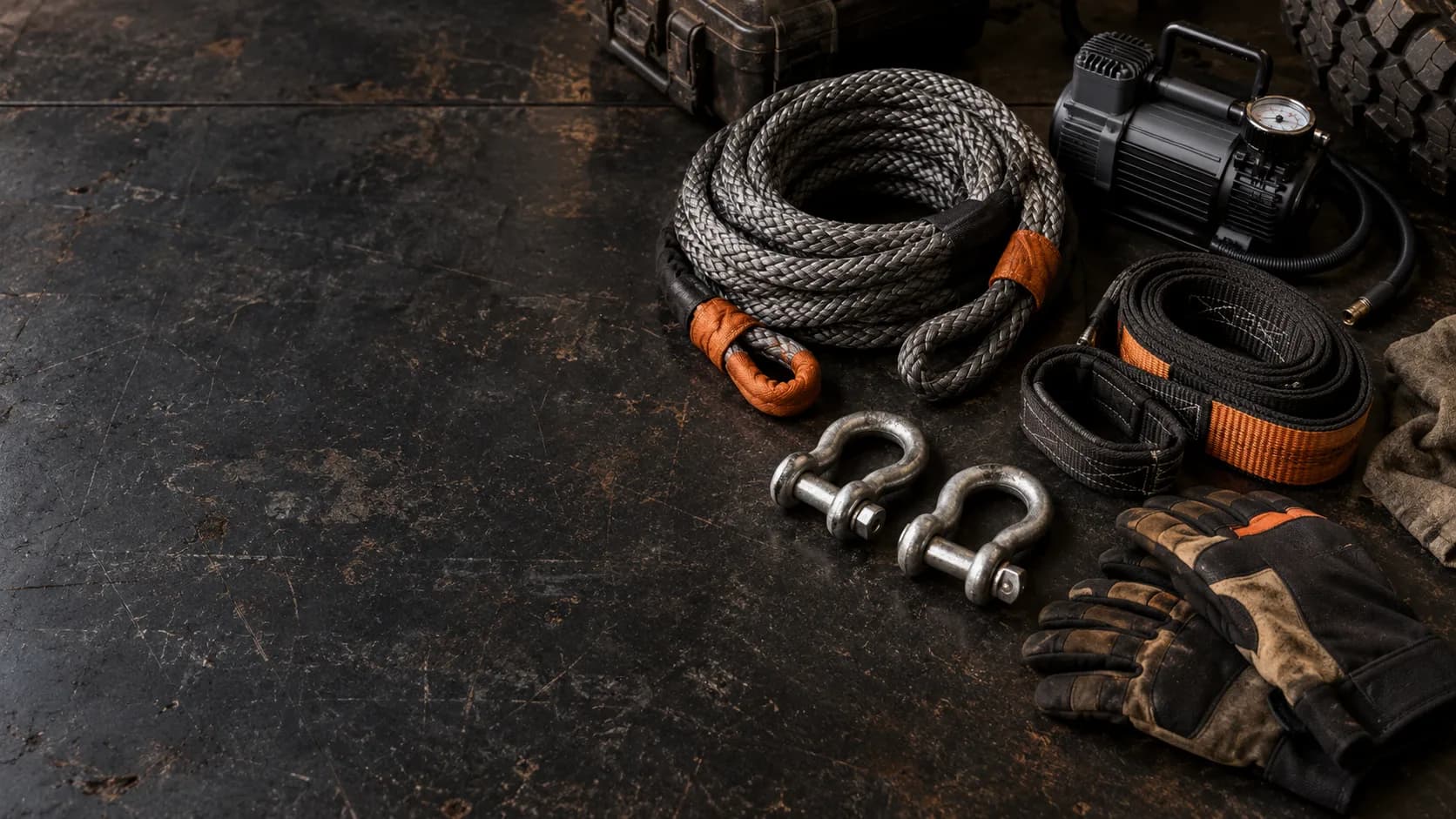
AI-generated representative scene
Quick answer
For most off-road use, a high-volume 12V portable compressor with a high duty cycle handles standard to moderately large tyres comfortably. Check CFM / L per minute (flow rate) and duty cycle (how long it can run before needing to cool down) — these matter more than peak PSI. If you run large tyres regularly or want to air tools, a permanent on-board compressor is worth the spend.
Why we recommend this
- Airing down for the trail is the single highest-impact free technique — it widens the contact patch, floats over sand, and cushions on rocks.
- Without a compressor you can't safely air back up for the road, which means you either skip the benefit or destroy your tyres and suspension on the highway.
- The right compressor for your tyre size means re-inflation in 3–5 minutes, not 20.
Things to consider
Cost
- Entry 12V portable compressors start from a few thousand rupees; high-volume units that handle larger tyres quickly are more.
- An on-board compressor (ARB, Viair, OBA kit) is a bigger spend but runs indefinitely and can also air tools.
Trade-offs
- Cheap small compressors overheat on large tyres — check the duty cycle (e.g. 33% = 10 min on, 20 min cooling before the next run).
- On-board compressors need mounting space and wiring, but outperform portables on speed and reliability.
Common beginner mistakes
- Buying on flow rate (L/min) alone — also check working pressure (min 130 PSI for LT tyres on-road) and duty cycle.
- Re-inflating to the same pressure for all surfaces — road, trail and load each need different pressures.
- Skipping the tyre deflator — manually removing valve cores is slow and imprecise; a quality deflator with a gauge is essential.
Choose your compressor type
High-volume portable (12V)
Best startBest balance of cost, portability and performance for most trail use.
Best for
- Most 4x4 owners who air down occasionally to regularly
- Tyres up to ~35 inches — fills in 5–8 min per tyre on a good unit
- Can be shared in a convoy
Avoid if
- Very large tyres (35+ inches) where duty cycle becomes a real constraint
- You want to run air tools off the same system
- Power
- 12V direct (battery clip or lighter socket)
- Duty cycle
- Check — good units: 50–100%
On-board compressor (OBA)
Permanent fit — runs indefinitely, fastest inflation, cleanest install.
Best for
- Expedition builds and frequent off-roaders
- Large tyres (35+ inches) where a portable struggles
- Running air tools (impact, bead seater) off the vehicle
Avoid if
- Weekend warriors where the cost and install effort outweigh the benefit
- Vehicles where there's no clean mounting space or wiring capacity
- Power
- Engine-driven or dedicated compressor
- Duty cycle
- Continuous — no cool-down needed
Compact entry-level (12V)
Light, cheap — for occasional use with standard SUV tyres.
Best for
- Occasional use with stock-size tyres on easy trails
- Emergency backup only
Avoid if
- Regular off-road airing down — the duty cycle is too short and the flow rate too low
- Large tyres — you'll overheat it before the tyre is up
- Flow rate
- Typically < 40 L/min — slow on big tyres
- Duty cycle
- Often 20–33% — needs long rests
Essential accessories
A compressor is only as useful as the tools around it.
Tyre deflator with gauge
Lets you air down quickly and accurately — no guesswork.
Best for
- Airing down to a precise target pressure before entering trail
- Faster than depressing the valve core manually
- Pair with
- Reliable pressure gauge
Long inflation hose
Reach all four corners without moving the compressor.
Best for
- Saves time on every inflation session
- Length
- Min. 6 m — 9 m is comfortable for most rigs
Spare valve cores + tool
A leaking core loses everything you just inflated.
Best for
- Emergency repair of leaking valve cores in the field
- Cost
- Negligible — always carry them
Use, maintenance & safety(duty cycle, over-heating, wiring and storage)
Operating safely
- Never exceed the manufacturer's rated working pressure; check tyre placards and the vehicle owner's manual for maximum tyre inflation pressure.
- Duty cycle means the proportion of time the compressor can run without overheating — a 33% duty cycle means 10 minutes on, then at least 20 minutes cooling. Ignoring this can burn out the motor or cause a fire.
- Keep the compressor clear of flammable material during use — the motor and head get hot, and fuel or dry grass near the unit is a fire risk.
- Use quality fittings that seal properly — a leaking chuck wastes time and can let a fitting blow off under pressure.
Tyre inflation on the trail
- Inflate in stages for large tyres: run the compressor for its duty cycle, let it cool, then continue — rushing causes overheating.
- Use a calibrated pressure gauge separate from the compressor's built-in gauge — cheap built-in gauges can be inaccurate at low pressures.
- After inflation, re-check pressure when the tyre is cold (or at the tyre's cold-set pressure, corrected for temperature), not immediately after driving.
- Carry a spare valve core and a valve core tool — a leaking or cross-threaded core loses all your recovery time work in seconds.
Maintenance
- Keep the air filter clean — a clogged filter restricts flow, causes overheating and shortens compressor life.
- Drain moisture from the air tank after each extended use (on units with a tank) to prevent internal corrosion.
- Inspect wiring, fuse rating and connections; a compressor drawing high current on a marginal cable or fuse is a vehicle fire risk.
- Store the unit clean and dry; coil the hose without kinking to prevent cracking in the inner liner.
Informational guidance only — not professional advice or a safety guarantee. Follow your vehicle and component manufacturers' instructions, verify against current local regulations, and consult a qualified specialist for safety-critical work.
Where to next
Buy it · get it installed
Technical notes — sizing by tyre volume, airing-down process & road pressures(deep dive)
Sizing by tyre volume
Larger tyres hold more air, so filling them back up takes longer. A 265/70R17 tyre holds roughly 35–40 litres of air volume; a 285/75R16 holds around 45–50 litres. At 12 PSI trail pressure you're likely filling 20–30 PSI worth of air per tyre. A 60 L/min compressor with good efficiency will typically fill a mid-size off-road tyre from 18 PSI to 35 PSI in 3–5 minutes. Below 40 L/min, budget 8–12 minutes or more per tyre on larger sizes.
The air-down process
- Stop before the trail start; check the terrain and decide your target pressure.
- Use a deflator with gauge: remove valve cap, attach, and bleed to target (e.g. 18–22 PSI for sand, 15–20 PSI for rocks with beadlock, or 20–25 PSI for general mixed terrain).
- Bounce the vehicle lightly to seat the tyre, then re-check pressure — it may drop slightly after driving off.
Re-inflating for the road
- Inflate ALL tyres before joining a sealed road — not just the punctured one.
- Target the road pressure from your door placard or manual (commonly 30–36 PSI for most off-road SUVs, higher for heavier loads).
- Measure when cold — tyre pressure rises 2–4 PSI after driving; adjust for this when using a hot tyre reading.
General guidance for India conditions. Confirm your vehicle's specified tyre pressures from the door placard or owner's manual. Tyre pressure targets vary by vehicle, tyre size, load and terrain.